

Flip 7 takes the premise of Blackjack and extends it to party game proportions. Flip over cards one by one without flipping the same number twice. While the game choices are simple (hit or stay), the ramifications of your actions aren’t. Are you the type of player to play it safe and bank points before you bust, or will you risk it all for the bonus by flipping over seven unique cards in a row? Hey, hey! Kyra Kyle here. We’ll review Flip 7 in a moment, but before we draw our first card, let’s discuss Flip 7’s fine print.

The Fiddly Bits
Designer: Eric Olsen
Publisher: The Op Games; KOSMOS
Date Released: 2024
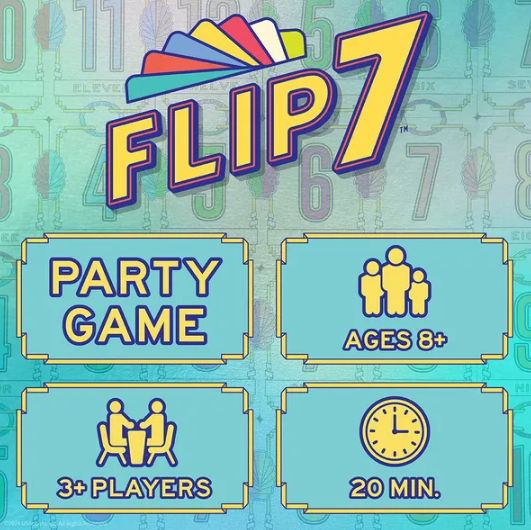
Number of Players: 3-18
Age Range: 6 and up
Setup Time: Nominal
Play Time: 10-20 minutes
Game Mechanisms
Card Game
Party Game
Push Your Luck
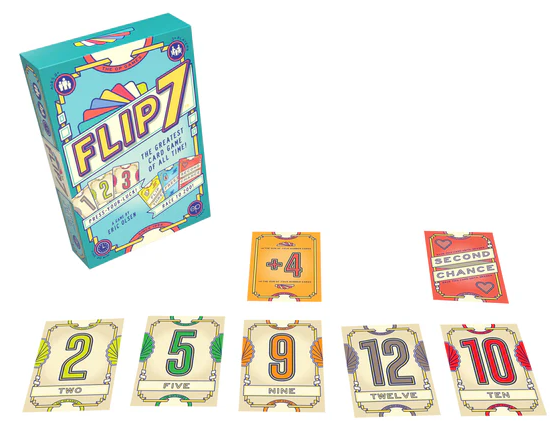
Game Setup
Shuffle the deck and choose a player to be the Dealer for the round.
In turn order, the Dealer deals one card face up to each player, including themselves. If an Action card is drawn, resolve it immediately (more on Action cards in the Game Flow section). Once any Action cards are resolved, continue dealing until everyone has been dealt a card. Not everyone will have a Number card (a card with a number). Some players may have multiple cards because of other Action cards.

Game Flow
The Dealer now offers each player in turn the option to “Hit” (deal them another card) or “Stay” (exit the round and bank their points). If you Hit, put the Number cards in a single row with Score Modifier cards.
Flip 7 features a special deck of cards. It’s Number cards range from 0 to 12. There are copies of each card equal to the card’s value. For example, there are 12 copies of the 12 Number card and 5 copies of the 5 Number card. Zero is the only exception; there’s only one copy of the 0 Number card. Flip 7’s deck also contains Score Modifier cards (Times 2 which doubles your point value and the rest adding a flat number to your score). Flip 7 also has three Action cards: Freeze, Flip Three, and Second Chance. Second Chance allows you to ignore one bust (drawing the same Number card). Flip Three allows the player to choose a player (even themselves) to draw three cards in a row. Freeze cards are given to a player to force them to stay for the round (they will not be able to draw more cards).

Remember: Players bust (don’t receive points and are eliminated from the round) if they draw two of the same Number card.
The round continues until one of two criteria are met. 1) There are no active players because all players have busted or chosen to stay. 2) One player can Flip 7 number cards, ending the round immediately.
At the end of each round, players score points. Add the value of all your Number cards. Adjust your score with any Score Modifier cards. If you Flip 7 Number cards during the round, score an additional 15 points.
When starting the next round, set all cards from the previous round aside. Do not shuffle them back into the deck. Pass the remaining cards in the deck to the left, that player becomes the new Dealer. When the deck runs out, shuffle all discards to form a new deck. If you need to reshuffle mid-round, leave all cards in front of the players where they are.
At the end of the round when at least one player reaches 200 points, the player with the most points wins.
Review
Flip 7 has taken the tabletop gaming community by storm. I can see why. It has a simple premise (party game Blackjack) and easy-to-understand choices each turn and round. Flip 7 is necessary for the tabletop community. In practice, Flip 7 is the game I can play with my grandma and my four-year-old niece. It’s the most gateway of gateway games.
Since this is the case, I’ve played Flip 7 a ton over the past several months. Seriously, Flip 7 was released during the holiday season (December 2024), I’m writing this in early May (we write many of our reviews weeks, if not months, in advance), and I’ve played this game with 10 different game groups and over 150 times. That’s about 30 times every month. I’ve almost played Flip 7 once every day. One of those months was February, so I’ve definitely played Flip 7 once every day. Frankly, I’m sick of playing Flip 7. It’s a good filler game, but I haven’t seen a game with this much crossover appeal.
And that’s a strength for Flip 7. It’s one of the few games I can get everyone on board playing. That’s why it’s necessary for the tabletop community and for tabletop gaming. But does it convince non-gamers to try other games that aren’t Flip 7? I’m unsure.
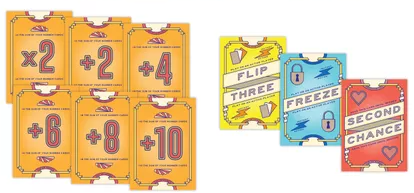
But I do like the inclusion of Action cards. There are three copies of each Action card. Freeze seems mean, but it could be pivotal in stopping someone who had an easy rise to the top of the scoring track; it’s a decent catch-up game mechanism of sorts but this can devolve into targeting the leader (like Munchkin). Players can only hold onto one Second Chance. I don’t know how many times I’ve seen a player forced to give a second copy of Second Chance to an opponent. Those cards have a way of finding the same player. But Flip Three has the most strategic value. During the early game, you may want to target yourself. Later in the game, you’ll want to choose someone else and force them to bust. Is this enough strategy? Probably not for many tabletop gamers.
I can see that people who can count cards have an advantage in Flip 7, but that takes the fun out of the game. While the rules don’t forbid someone from looking at the discard, it goes against the soul of Flip 7. The Number cards value equaling the number of copies in the deck is clever, and the game doesn’t overstay its welcome—unless you’ve played it over 150 times in a handful of months.
Flip 7’s box says 3+ players. Its entry on BoardGameGeek lists it as 3-99 players. The rulebook suggests that if you have more than a dozen players, use a second copy of Flip 7. While this may be technically true, the game plays best at 5-6 players. Flip 7 would overstay its welcome if you included over a dozen players. It would take forever for twelve people to determine whether they should hit or stay. There isn’t much else to Flip 7, but I’d be bored if I had to wait for eleven other people to make that simple choice. And forget 98 other people. I’d walk away from the table.

Too Long; Didn’t Read
While not my first or second choice of filler game, Flip 7 has enough crossover appeal to appease the masses. It doesn’t have enough strategy for hardcore tabletop gamers, but Flip 7 is the kind of game I can get my grandma or four-year-old niece to play. Therefore, Flip 7 is a good game to keep on hand for non-gamers.
 jkgeekly.com