

Kitaria Fables by Indonesian indie game studio Twin Hearts combines a farming sim like Stardew Valley with a mild adventure game. Players assume the role of a cat hero Nyanza (or Nyan for short), hence the name Kitaria, as Nyan upgrades his weapons and armor and learns new abilities to save the Empire.
Hey, hey! Kyra Kyle here. We’re covering a video game today that’s unlike most we’ve covered in the past. Kitaria Fables is a cozy game. Full disclosure: I’ve picked up this game on sale for multiple systems (Steam, Switch, and PlayStation 4), but I’ve played the most on PS4. Cozy games have taken off in the past few years, and I’m here for it. I love a good cozy game. But how does Kitaria Fables stack up against our review criteria?

Mechanisms: 7/10
Kitaria Fables has solid game mechanisms, but there’s a reason it’s often compared to Stardew Valley—I compared Kitaria Fables to Stardew Valley in the opening paragraph of this review. Kitaria Fables borrows many mechanisms, its graphic design, and some of its perspective from Stardew Valley. All of the mechanisms Kitaria Fables borrows are well done. But I can’t give it top marks.
Still, Kitaria Fables adds a few things to the Stardew Valley formula to make it stand out. Not the least of which is the adventure aspects. Gone are the procedurally generated mines. In their place are regions to explore and enemies to vanquish. Enemies will drop items to use for upgrade materials. So far, this sounds like a typical adventure game, but Kitaria Fables opts to go with ability upgrades instead of leveling.
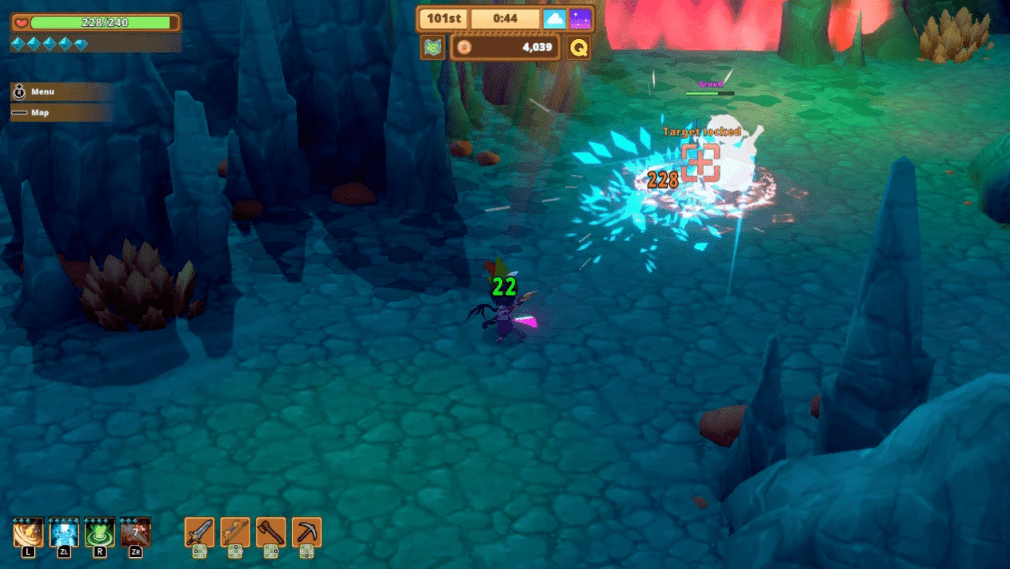
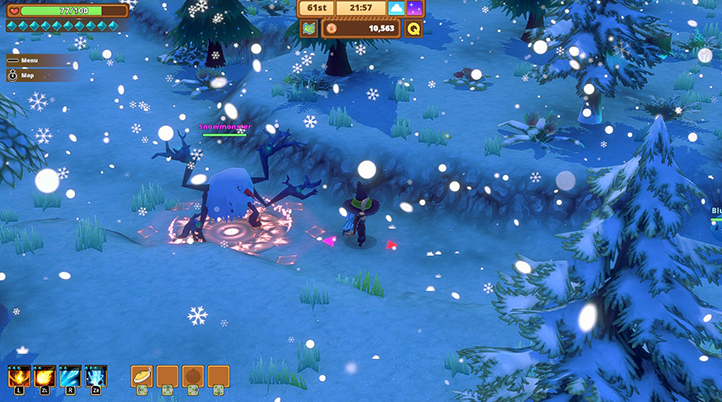
Players can trade out Nyan’s magic abilities at any time. The only downside is that more powerful spells usually cost more magic gems. In the top left-hand corner, you’ll see Nyan’s health. Magic gems are displayed below Nyan’s health bar. Nyan can gain more magic gems by physically attacking enemies, so there’s a push-pull with varying Nyan’s combat style.
I’ve seen other games use custom move-sets similar to Kitaria Fables’ setup (like the Cat Quest series), but Kitaria Fables does just enough to separate itself from its competition. But not enough to escape a slightly above average score.
Gameplay Loop: 8/10
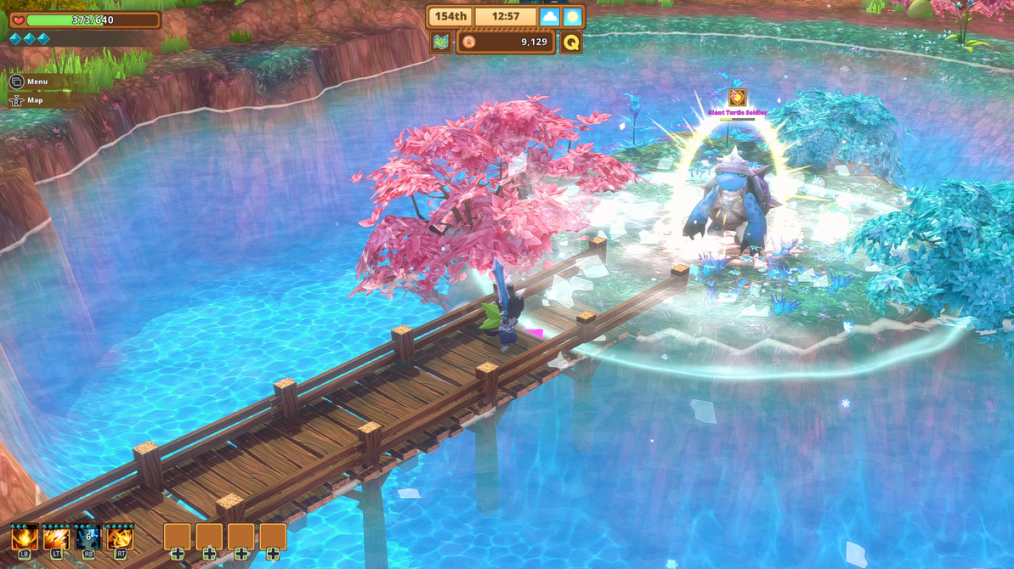
This score should come as no surprise. Kitaria Fables combines Stardew Valley and Cat Quest. I didn’t think of Cat Quest before writing this review (funny how both games have cat protagonists). With Stardew Valley and Cat Quest as inspiration, Kitaria Fables has a high gameplay loop score. All enemies (including bosses like the one pictured above) respawn at the beginning of each day, so it’s easy to grind Nyan to god-like powers.
Kitaria Fables has a couple of obtuse missions. I was stuck a handful of times and used trial and error to figure out what the game meant for me to do. But those moments were few and didn’t detract from the overall experience. And the NPCs rebooted their routine every in-game day in addition to the enemies respawning. If I couldn’t figure out something one day, I could try again the next. This is one of the reasons why Kitaria Fables is a cozy game. It induces little to no stress.

Narrative: 3/10
The Empire, the Calamity, Capital City, and other generic terms left me wanting. Kitaria Fables doesn’t have much of a story, and the story it has can get grown-inducing. I’m unsure if this lack of story comes from poor localization or if Kitaria Fables wanted generic names and storylines to make it easy for people from different backgrounds to follow. Either way, I’m unimpressed. Kitaria Fables has one big twist. I won’t spoil it here, even though that’s unnecessary. The big reveal is obvious.
Storytelling: 5/10
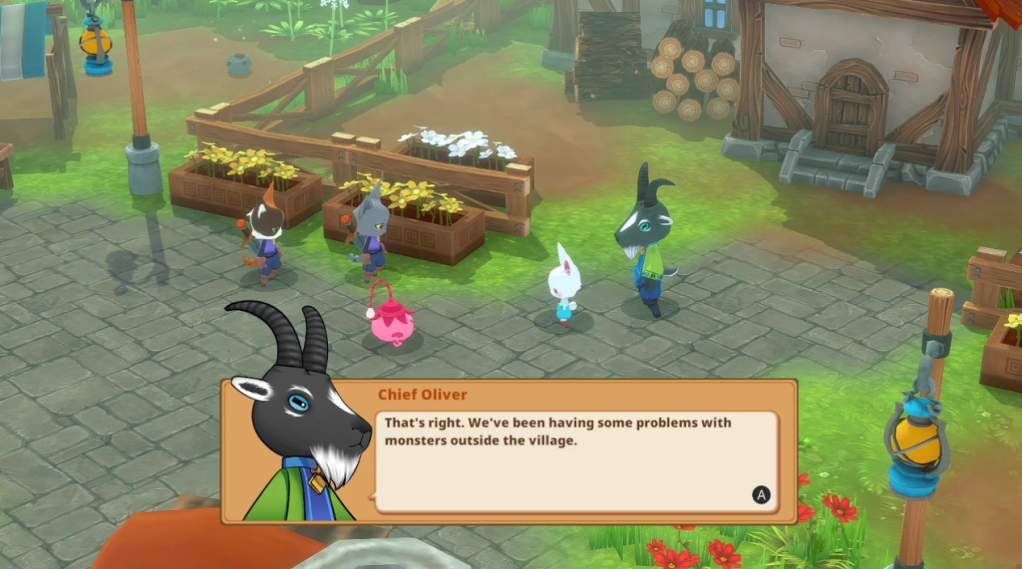
I can’t tell which score should be higher, narrative or storytelling. I’m giving storytelling an average score. That seems right. Kitaria Fables does a good job of executing its story, but it just has a forgettable story. Still, look at the adorable animal people. I love characters like Caramel, a brown furred mouse child who lives in Paw Village. Caramel will ask Nyan for a piece of candy. If you give him candy, you’ll unlock a mission. If you refuse to give him candy, you’ll unlock a different mission. This happens to be one of the obtuse story branches I mentioned in the gameplay loop section. You can unlock both missions. All you must do is interact with Caramel on two different occasions.
User Interface: 8/10
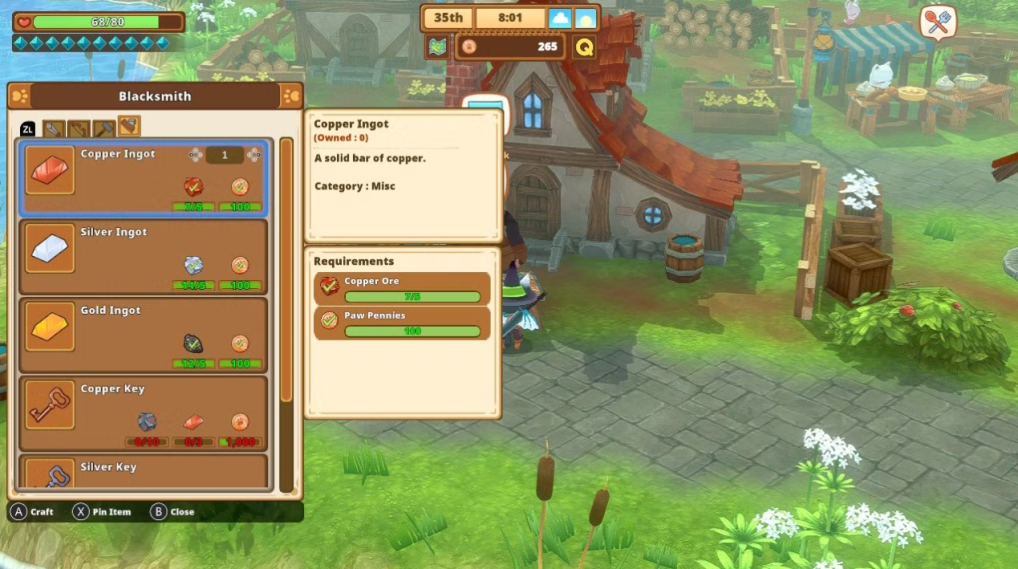
Kitaria Fables has an easy-to-use interface. During combat, Nyan will have items (to include healing items) and spells/moves assigned to hot keys. While not in combat, Nyan can pull up a menu (on the left-hand side of the screen) that will have clearly marked tabs. Players will receive different options depending on whether Nyan interacts with an NPC or an object (like a mirror to change Nyan’s appearance) or doesn’t interact with anything.
Players can pin items (if they find them in a store) to know how much of an item they need for an upgrade. This is standard stuff, but you’d be surprised how many games forget to include a pin object option. Kitaria Fables does a great job of incorporating good practices from other games with its user interface. The only reason I knock the game down a point is the Switch version. If you pick up Kitaria Fables on PlayStation 4 or Steam, go ahead and raise this score. The Switch version isn’t too difficult to navigate, but it’s lacking.

Graphics: 8/10
Kitaria Fables features charming graphics, but it doesn’t take top marks because Twin Hearts may have lowered the graphic quality to fit on the Switch. Honestly, if Kitaria Fables exclusively came out for the Switch 2 and PlayStation 5 (three or four years later), the graphics score could be even higher. Older systems may have held back the graphics, but that doesn’t mean that Kitaria Fables’ look is anything but enchanting.
I also love Kitaria Fables’ colorful world. Each zone feels unique: lush forests, dank swamps, and barren deserts. Kitaria Fables mixes up its enemies in quirky ways to match the various biomes. Despite some technical limitations, Kitaria Fables has gorgeous graphics.
Audio: 8/10
When I first booted Kitaria Fables, the music didn’t grab me. It was there and pleasant. But the more I played, the more Kitaria Fables’ soundtrack grew on me. Kitaria Fables’ soundtrack isn’t one of those wow you when you first hear it soundtracks. It’s one of those slow-burning soundtracks. I wasn’t surprised to see the Kitaria Fables’ soundtrack available on vinyl. It can be infectious.

Replay Factor: 6/10
I enjoyed my time with Kitaria Fables. Heck, I blew through the game in a few days and picked it up on multiple platforms. But I wouldn’t call Kitaria Fables a game with high replay value. I can hope that I’ll forget specifics about Kitaria Fables and return to the game in several years. While a solid game, Kitaria Fables’ linear story (with no alternative storylines) makes it a one-time play game. And that’s okay.

Aggregated Score: 6.6
Kitaria Fables delivers a well-constructed video game that combines elements of Stardew Valley and Cat Quest. I enjoyed a lot of the colorful characters and the gorgeous set pieces. And cats, who doesn’t love cat people? While I wouldn’t expect a game with a ton of replay value, Kitaria Fables is a great one-time play game, especially if it’s on sale.
 jkgeekly.com
Thanks for sharing your thoughts. Very insightful and thought-provoking.
LikeLike