
Stacklands merges a survival/civilization game with the skeleton of a collectible card game, and the results are interesting. Developed by indie designer Sokpop Collective, Stacklands takes these disparate themes and mechanisms and makes sense of them. Prepare to drag cards on a board and stack them on top of each other for numerous interactions.
Hey, hey! Kyra Kyle here. Today, I’m reviewing a quirky video game I’ve meant to cover for a while. Full disclosure: I’ve played a heap of Stacklands on Steam. I purchased all the DLC–we’ll only touch on some of the bonus content–and spent countless hours watching my card-sharped citizens build an empire. But how does Stacklands stack up against our review criteria? Let’s find out.

Game Mechanisms: 10/10
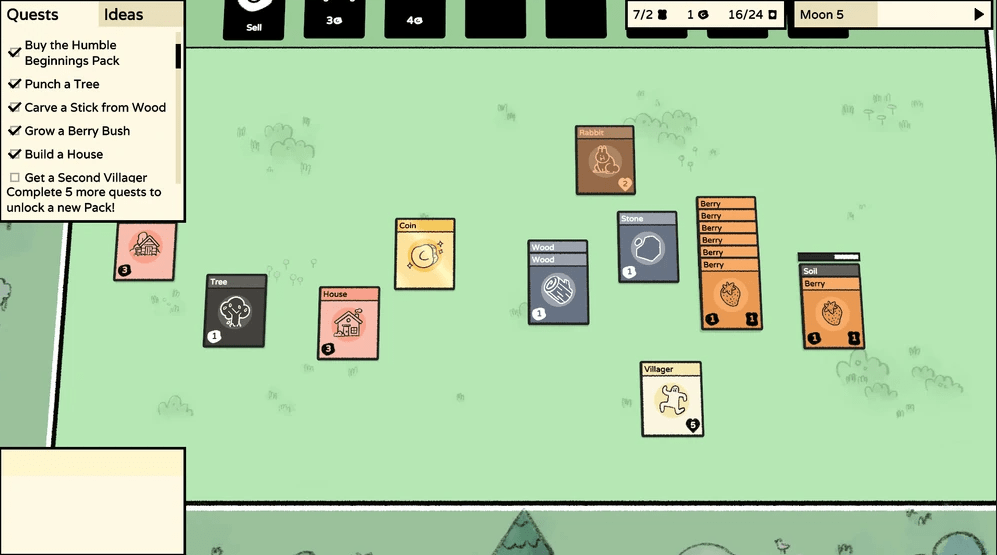
Quirky indie video games tend to sport fresh game mechanisms, and Stacklands is no different. Stacklands combines a collectible card game and a civ builder into a cohesive whole. The experience is a great loop of exploration and optimization for your villagers. I’ve never had this much fun stacking one card on top of another card and getting something in return. One chicken on top of another chicken yields an egg. Place that egg card on a campfire and produce a cooked egg. Sounds simple, but a multitude of these actions may occur at once. Players must manage the timers for each interaction and generate enough food at the end of the day to feed their civilians. Any items you don’t use or can’t use may be sold for coins that are used to purchase new card packs. Card packs contain new items and ideas.
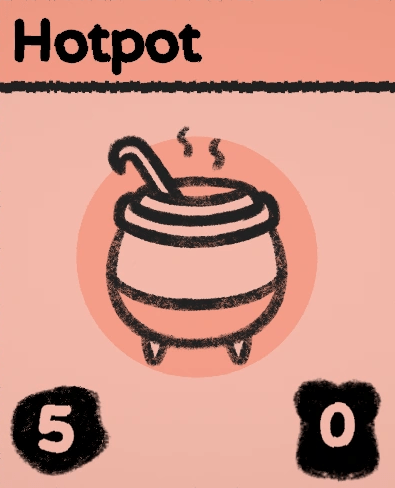
The gameplay loop and exploration (of what I can put together to make something exciting and new) are addictive. Earlier versions of Stacklands proved difficult to manage some of these elements, but later patches fixed many of these issues. I have as much fun optimizing my little village as I do discovering new ideas. If you were to construct a hotpot, you could place food into the pot that you wish for your villagers to eat first. This way, you can keep more valuable food items. Small upgrades like this add strategy.
And Stacklands is full of small and large upgrades ready to make your village strong enough to fight off invaders. Yes. There will be invaders who will randomly attack your village, but usually after the first five or six moons (or days). Enemy cards are indicated by red backgrounds. You may choose to fight these enemies unarmed (like the picture below) or upgrade your Villagers with weapons that will change their job title from Villager to something fancier, like Warrior or Swordsman.

Stacklands also has a knack for ramping up the difficulty. Most difficulty spikes happen organically; you won’t face a stronger creature unless you spend money to buy a more expensive pack that may contain the stronger creature. The largest of these difficulty spikes is at the player’s discretion. I don’t know how many times. I’ve accidentally summoned a demon and watched in horror as the demon decimated my villagers.
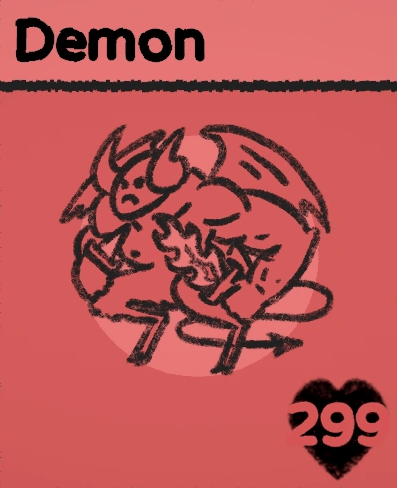
But I was the one who summoned the Demon. I’ll know for next time not to do the thing that summoned the Demon until after I’m prepared to defeat an enemy with 300 health. Like many survival games, you’ll need to restart your Stacklands village when you have no more living Villagers, but when you do restart your village, you don’t need to relearn skills and ideas. I don’t mind this. It lessens the danger, and often, I’ll have a better item I’ve unlocked and can outfit my villagers with better gear or a more optimized village. Heck. I’ve let a larger enemy torpedo my village, so I could start over.

Above Image from GameDesigning.Org
Gameplay Loop: 10/10
I’ve already mentioned Stacklands’ gameplay loop. Combining collectible card packets with building a civilization of card villagers is fantastic. Stacklands also manages its difficulty spikes well. Players have more control over what they’ll face. Buying more expensive packs could mean stronger enemies appear, but you’ll want to unlock every card in each packet type and as quickly as possible.

Collecting cards like Pokémon mixed with exploration is a potent combination. And since Stacklands has so many hidden tech trees (the game doesn’t spell out its tech trees in a diagram), you’ll find hours of enjoyment reverse engineering a recipe. How do I get a gold bar? I need a smelter and gold ore. How do I make a smelter, and which booster pack contains gold ore? Stacklands has so many rabbit holes to explore.

Narrative: 6/10
Stacklands has a few side stories that make up a somewhat larger narrative, but it doesn’t have a traditional storyline. There’s the demon I mentioned earlier. The demon isn’t too difficult to defeat if you have the proper equipment and a large enough army. You’ll also have to challenge a witch who summons monsters from a strange portal. Defeating the witch is the closest thing the base Stacklands game has to a larger story.

Players must construct a stable portal so they can enter the witch’s realm and fight her seemingly endless army of baddies. The army the player sends may choose to return home after each level of witch minions. Defeat the final level and then the witch. Players will receive a “you completed the game” notification, but that’s not the end. You may continue playing Stacklands and its DLC. The only location you can access without buying DLC is the island. This has a “story” similar to the witch on the mainland, but it’s the paid DLC that has fleshed out stories. I’m not including the DLC in this review, but if I did, this score would rise a point or two.

Storytelling: 5/10
Stacklands‘ storytelling is no better than average. I promised I wouldn’t include the paid DLC (which only costs a few dollars) in this score. The base game’s story is okay. The DLC ventures into some interesting territory. I talk briefly about them. One alternate plane deals with waste; you’ll need to optimize your village so you won’t produce too much pollution. Another plane centers around death. A third pivots hard into combat and rage. Stacklands‘ DLC is well worth the price (if you like the base game), but it’s the base game’s storytelling we’re grading here, so it’s average.
User Interface: 9/10
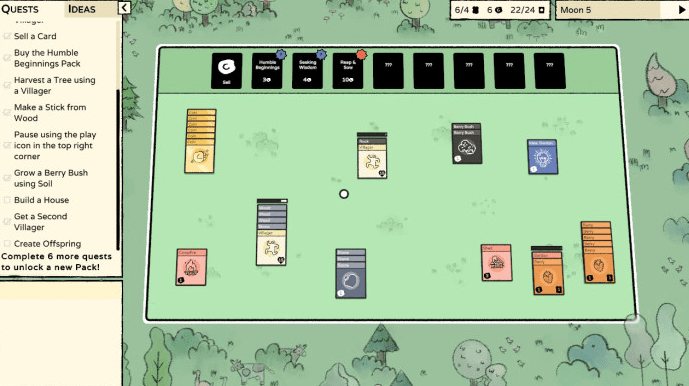
While Stacklands has a lot going on at once, it does a good job of presenting these options to the player. In the top left, you’ll find tabs for Quests and Ideas. The quests are self-explanatory. If you don’t know what to do next, check out your active quests.

Ideas are the recipes you know. Stacklands does a great job of grouping similar recipes into tabs. You may expand these tabs to see individual recipes or collapse them if you’re not looking for that recipe type.

In the far right corner, you’ll find out which day (moon) you’re on, and the symbol on the right of this box lets you dictate how fast time moves. To the left of the moon, you’ll find your village’s vitals (food, coin, and how many cards you may have in your village–booster packs don’t count toward this total). The image above may be from Moon 5, so there aren’t as many cards in play, but Stacklands has so many ways to optimize your village that you can build one that minimizes your number of cards and is almost automatic.
Once you find a consistent source of food, you’ll be able to focus on other things Stacklands offers, and there are plenty of choices. Stacklands rewards trial and error. Don’t be afraid to make mistakes.

Graphics: 6/10
While I enjoy Stacklands‘ graphics, they are minimal. Stacklands chooses legibility over style. Even though that’s the right choice for a game like this, I can’t tell you that Stacklands has amazing graphics. The game’s graphics are crisp, at times adorable, and most importantly, functional.

Audio: 7/10
You like lo-fi chill jams, don’t you? Who am I kidding? Of course you do. Stacklands’ soundtrack makes great background music. To be honest, I hardly notice it while I’m playing. Where this score gets a bump is when considering Stacklands’ sound effects: card shuffling, ripping open a booster pack, the little bloopy combat noises, and adorable animal calls. Sokpop Collective took time and care with Stacklands’ sound effects, and it shows.
Replay Factor: 9/10
Stacklands has plenty of DLC, and that DLC has its own puzzles for you to solve. The DLC adds a good ten to twenty gameplay hours. But the base game has tons of replay value in its own right. Even if you defeat the witch and the demon, you may want to beat the time it took you to defeat the witch and the demon. I’ve also discovered numerous recipes after beating these two, which then prompted another playthrough. Sure, I beat the game, but I figured out how to make a resource magnet. That would optimize my village to the fullest.
Again, I may be biased. I put a heap of time into Stacklands, but it has a fair amount of replay value. Each new play can lead to a different path to success.
 jkgeekly.com