

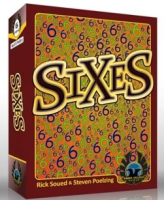
Hey, hey! Kyra Kyle here. We haven’t done too many tabletop game reviews over the past several years—before our Marvel United review last month (here’s the link for that review if you missed it). Today’s review is a much shorter game, but one that packs a punch: SiXeS.
Played over six rounds, SiXeS is a party game where players predict what their opponents will write that will match—or not match—depending on whether you’re in a “match” round or a “unique” round. The player with the most points after six rounds, wins.
Before we proceed, we’ll prep the party and discuss SiXeS’s details.
The Fiddly Bits
Designer: Steven Poelzing and Rick Soued
Publisher: Eagle-Gryphon Games and Hobby World
Date Released: 2016
Number of Players: 3-8
Age Range: 12 and up
Setup Time: Less than a minute
Play Time: 15-20 minutes
Game Mechanisms
Party Game
Card Game
Word Game
Game Setup
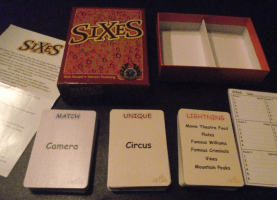
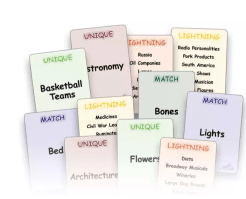
SiXeS consists of three decks of cards: “Match,” “Unique,” and “Lightning” decks and a scoring pad. Each player gets a sheet from the scoring pad and a writing utensil. Shuffle all three decks. Each card is double-sided with one side easier than the other. SiXeS’s rulebook shows which side to use for each round.
You’ll also need a means to keep time; you can use a minute-long sand timer (SiXeS doesn’t include one) or set your phone’s timer for a minute. Some of the rest of “Game Setup” can fall under “Game Flow,” so let’s continue with the next section.
Game Flow
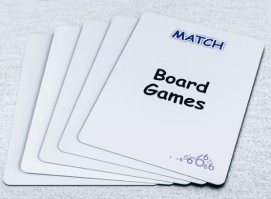
On the scorecard, you’ll find rounds 1-6 marked. Each round has spaces for six answers. Play begins with a “Match” card. After the timer starts, players will think of things that fit the category’s criteria (this will be the word or words printed on the card). For instance, a category like “Sandwiches” can yield answers like “Peanut Butter and Jelly,” “Hero,” or even “Knuckle.” You’re going to have to match at least one other person’s answer at the table, so you may not want to get fancy with which words you use during a “Match” round.
Players find out if they matched anyone else at the table by sharing their answers. You receive a point for each answer that matches another player. If all six of your answers have at least one match, you receive a “Crooked Six.” That’s a seven. You get seven points if you match all six answers. I guess the designers wanted to maintain SiXeS’s theme by calling a seven a “Crooked Six.”
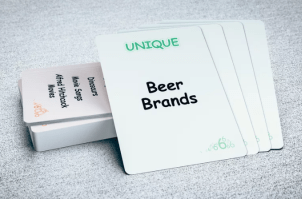
The objective changes with “Unique” rounds. “Unique” rounds play a lot like Scattergories, but you aren’t forced to begin each of your answers with the same letter. In “Unique” rounds, you receive points for each answer that matches no one at the table. You can also earn a “Crooked Six” if no one else puts down your valid answer.
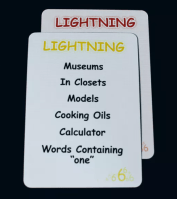
The final card type, “Lightning” has six different categories. You will answer each category in the order in which they appear on the card, and players will try to match answers with at least one other player at the table.
The player with the most points at the end of six rounds wins.
Review
SiXeS resembles Scattegories but with a twist. I like how the rounds vary. As a result, I find it easier to continue playing multiple rounds of SiXeS over Scattegories.
I have yet to play a game of SiXeS that doesn’t include someone getting miffed that no one else chose their cromulent answer or at least one round ending with multiple people unable to fill in all six spots on their scorecard. SiXeS can be frustrating at times but also engages a group of gamers. It’s a great ice-breaker game. It fits into the party game category and a “getting-to-know-you” game. I can see companies using SiXeS as a morale-building tool.

SiXeS’s box says you can play 3-8 players. I wouldn’t recommend three players. Four and five players can be a lot of fun, but SiXeS’s works the best at higher player counts. There’s nothing preventing someone from playing SiXeS with more than eight players. No one’s stopping you from handing out extra scorecards and writing utensils.
That said, beyond the eight-player mark is where SiXeS either becomes super easy and super hard, depending on the round. Matching one out of ten or eleven players would be easy—too easy—but coming up with a unique answer among ten or eleven players can be nearly impossible. I’d stick to as close to eight players as I can. You could convince me into a nine or ten-player game of SiXeS, but the game begins to crumble under the weight of eleven or more players.
Verdict
Easy to learn and fast to play with great replayability, SiXeS gives Scattegories a much-needed twist. It’s also highly portable. I won’t mind taking SiXeS with me on future trips.
 jkgeekly.com
2 thoughts on “Tabletop Game Review: SiXeS”