

Hey, hey! Kyra Kyle here. Back with another Top 5 Tabletop Games. 1982 and 1983 may not have the same heavy hitters as the previous two years, but there are still has some gems. You know the drill by now, let’s talk about some games.
But first, in case you’ve forgotten our criteria for the Top 5 Tabletop Games, let’s reiterate the ground rules again before we get started.
1: Cultural relevance plays as much of a factor as overall quality. A game might make a list that doesn’t hold up to others of its type, but you must admit the game is everywhere.
2: Only one game from a franchise makes the list. This will become more of an issue the closer we get to games with expansions.
3: Longevity plays a role, too. A game doesn’t have to fly off the shelves today, but it had to have some widespread appeal for a decent time.

5: Take It Easy (1983)
You could describe Take It Easy (designed by Peter Burley) as a strategic Bingo. Each player gets a board with 19 hexagonal cells and a set of 27 tiles which have different combinations of colored/numbered paths. The paths cross each other, and players try to continue the colored paths from one end of their boards to the next. The longer the paths go without being interrupted, the more points the player scores at the end of the game.

What makes Take It Easy a strategic Bingo, is that one player is the caller. They draw a tile randomly from a bag. Players will place the same tile simultaneously on their boards. Once a tile is placed, it can’t be moved. Take It Easy has a simple concept but challenges each player to place their tiles in the most optimal configuration. There’s even a Take It Easy app you can download.

4: Scotland Yard (1983)
Like Ogre a few lists ago, Scotland Yard uses asymmetric play. One player is Mr. X, who tries to escape London without being caught, while the rest of the players play as the police who try to capture Mr. X. So many games use this setup. 2006’s Mr. Jack casts one player as Jack the Ripper and the other player as the detective trying to deduce his identity. I haven’t yet made the 1987 list, but there’s a good chance The Fury of Dracula will make that list.
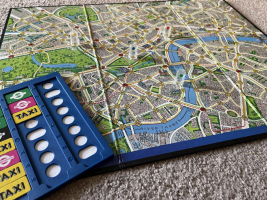
In short, Scotland Yard has influenced several board games. It may be an older game, but Scotland Yard does a great job of simplifying secret movement. And I like games that use secret movement. We may be seeing a lot more games of this type in the future.
3: Empire Builder (1982)
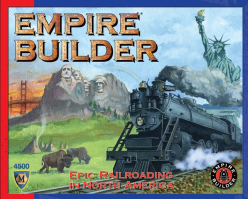
I wanted to put Empire Builder much higher on this list, but two other games edge it out because of their cultural impact. Empire Builder (designed by Darwin Bromley and Bill Fawcett) is THE crayon rails game. A crayon rails game is a board game that has players draw train tracks on a map with erasable markers. Empire Builder features a map of the 48 contiguous United States drawn to scale. There is a lot of strategic depth to Empire Builder. Players gain benefits by connecting their lines to specific locations. Do you want to dominate the trade of oranges? Canvas Florida with your train tracks. Do you want access to oil? You may want to build a route to Texas.

Gary Gygax (co-creator of Dungeons & Dragons) may have said it best in his review from Dragon Issue 65 (September 1982): “In my opinion (Empire Builder) is the best (board game) available, being more complex and challenging than the simpler sort and not as tedious and complicated as those at the other end of the spectrum.”
Empire Builder may be simpler than a lot of other heavy strategy games at the time, but it takes a while to play. You will dedicate hours to finish a game. But it’s worth it.

2: Talisman (1983)
If you ever wondered what game the cast of The Big Bang Theory had on their coffee table with the miniatures running around a track, chances are it was Talisman. Designer Robert Harris made Talisman to amuse himself and his friends. The game originally had a boys’ school theme, and the players wanted to become the school’s prefect.

Thankfully, the game was recast as fantasy and renamed Talisman. Players move about the board, trying to be the last hero standing. The spaces a player lands on dictate what action they can take for their turn. Like Empire Builder, Talisman is another longer game. And like Monopoly and Clue, Talisman has a lot of intellectual properties that have their version of Talisman. I may have to try the Kingdom Hearts variant.

1: Warhammer (1983)
Warhammer started a miniatures revolution. Before Warhammer’s release, most games used cardboard chits to indicate their combat units. I have fond memories of my family playing some World War II or American Civil War games; its map would stretch across a large dinner table. Anyway, there were a handful of miniature games that were released before Warhammer, but Warhammer began a craze.
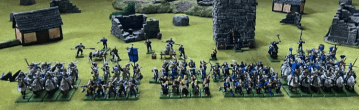
Let’s be honest. Of all the names of games on this list, Warhammer must be the most well-known. Plenty of video games and novels have set their stories in Warhammer’s dark and gritty world. I never got into miniature games because they can get costly. Someone can easily drop hundreds of dollars on a set of minis and then spend another mint getting those minis painted. I marvel at some of the artwork.
Even though I’ve never paid for a miniatures army, I have played my fair share of miniature games. Most people in the hobby are happy to share their minis with people interested in the hobby. You can search for a game shop or café near you and see if they have a miniatures game night. They can be a lot of fun. You can’t beat chucking a heap of dice. I love dice.
Did we get the list right, for the most part? Let us know in the comments. And wherever you are, I hope you’re having a great day.
Check out the other lists in this series:
Top 5 Tabletop Games Prior to the 1930s
Top 5 Tabletop Games of the 1930s
Top 5 Tabletop Games of the 1940s-50s
Top 5 Tabletop Games from the Early 1960s
Top 5 Tabletop Games from the Late 1960s
Top 5 Tabletop Games from the Early 1970s
Top 5 Tabletop Games from 1980-1981
Top 5 Tabletop Games from 1984-1985
Top 5 Tabletop Games from 1986-1987
Top 5 Tabletop Games from 1988-1989
Top 5 Tabletop Games from 1990-1991
 jkgeekly.com
15 thoughts on “Top 5 Tabletop Games from 1982-1983”