

Hey, hey! Kyra Kyle here. Back with another Top 5 Tabletop Games. As you can see from this post’s title, we’re doing things a little differently with this list. These upcoming lists will lump two years today, rather than splitting the decade in half. The 1980s saw an increase in board game production. A lot of new games hit shelves in this decade, and with the introduction of the Spiel des Jahres (Germany’s game of the year) award, the quality of board games also increased.
In case you’ve forgotten our criteria for the Top 5 Tabletop Games, let’s reiterate the ground rules again before we get started.
1: Cultural relevance plays as much of a factor as overall quality. A game might make a list that doesn’t hold up to others of its type, but you must admit the game is everywhere.
2: Only one game from a franchise makes the list. This will become more of an issue the closer we get to games with expansions.
3: Longevity plays a role, too. A game doesn’t have to fly off the shelves today, but it had to have some widespread appeal for a decent time.
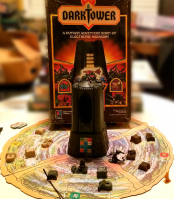
We have an honorable mention for this list: Dark Tower (1981) by Roger Burten, Alan Coleman, and Vincent Erato. Dark Tower deserves a mention because it uses an amazing tower as its centerpiece and incorporates a lot of innovative electronic elements. A sequel released in 2022, Return to Dark Tower, brought the original back to prominence.
I almost split 1980 and 1981 into two different lists; if I did, Dark Tower would’ve made a 1981-only list. There’s even a television commercial featuring Orson Welles for the board game. Yikes!
Here’s a link to that Orson Welles Dark Tower commercial.
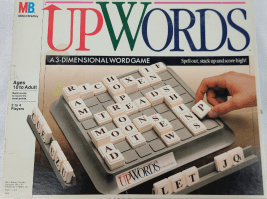
5: Upwords (1981)
Upwords originally played on an 8×8 square board with 64 letter tiles. The board expanded to a 10×10 board to accommodate languages with longer words like German and Dutch. Eventually, the game shifted exclusively to the 10×10 board. Upwords plays similar to Scrabble. The big difference is that the letter tiles can stack on top of the ones previously used. All words must read horizontally from left to right, or vertically from top to bottom.

I like the twist Upwords made to Scrabble. It doesn’t change the core rules too much, but the inclusion of elevation leads to interesting plays.
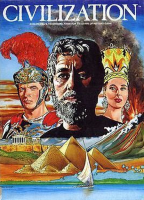
4: Civilization (1980)
Not to be confused with the Sid Meier video game of the same name, the original 1980 Civilization board game (designed by Hartland Trefoil) introduces the concept of a technology tree (or tech tree). This tech tree is the centerpiece of the video game Civilization that released over a decade later. Sid Meier’s Civilization isn’t the only board game or video game to use a tech tree. Any game that uses that concept owes a debt to Trefoil’s Civilization. And there are a lot of games that use tech trees.

I find it interesting that a game designed in 1980 has a streamlined yet strategically satisfying tech tree. Is it any wonder that Civilization was chosen for inclusion in the 2007 book Hobby Games: The 100 Best? There is little luck involved in Civilization. This is one of the first crunchy—and lengthy—strategy games. And it won’t be the last.

3: Axis & Allies (1981)
We didn’t have to wait long for another lengthy strategy game on this list. Axis & Allies (designed by Larry Harris) casts players as the major belligerents of World War II: Germany, Japan, the Soviet Union, the United Kingdom, and the United States. The Axis & Allies Anniversary Edition (released in 2008) included Italy as the third Axis power and China as the fourth Allied power.
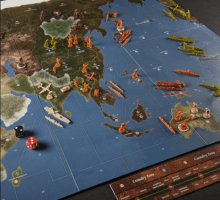
The combat could get convoluted and intense. Players would roll dice to hit and if a unit scores a hit, the opponent chooses which unit gets destroyed. I like the idea of a unit performing a retaliation before death. It took the sting out of losing a piece. Combat resolves when either side loses all their units or the attacker retreats. I enjoyed this one growing up, but my family never finished a game. Axis & Allies was one of those games where you needed a table just for the game, so you could keep it set up for future plays.
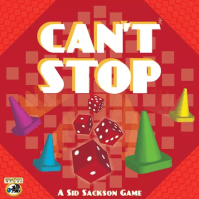
2: Can’t Stop (1980)
Can’t Stop is yet another Sid Sackson design. What can I say, the man deserves to be in the Academy of Adventure Gaming Arts & Design’s Hall of Fame. Can’t Stop has a wonderful press-your-luck mechanism. Players roll four dice on their turn and then group the dice however they see fit. If you were to roll a 1, 2, 3, and 6, you could group them as 5 and 7, 4 and 8, or 3 and 9. Once the player makes their decision of which pairs they want, they move their marker up columns on the board for those numbers. The press-your-luck comes into play with a potential second roll. If at any time you can’t move your markers any higher on a column, you bust and lose all your progress that round.
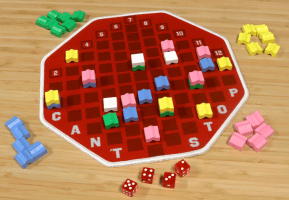
As soon as a player claims the top space in a column, no one can claim that number again. The game ends when one player has claimed the top spot for three numbers. Can’t Stop is such a great game. And Sid Sackson is a board game legend.

1: Trivial Pursuit (1981)
I struggled with which game should claim the top spot, but ultimately, Trivial Pursuit was the biggest cultural phenomenon from 1980 and 1981. Trivial Pursuit is the grandfather of all trivia-style board games. Heck, it’s the grandfather of all trivia games.
Each of the Trivial Pursuit playing pieces has spaces for six wedges. Players compete by answering trivia questions from six different categories, matched with a different color. In the classic version, Blue is Geography, Pink is Entertainment, Yellow is History, Brown is Arts & Literature, Green is Science & Nature, and Orange is Sports.
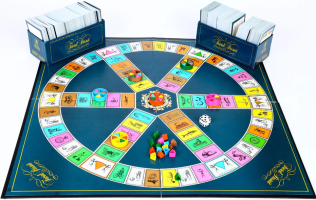
To this day, trivia games—even trivia video games—will assign similar colors to the same categories. I’m looking at you, Trivia Crack. Trivial Pursuit has spawned numerous copycats and more than one game show. It’s the one game on this list that most people will know. I had to make it number one. My hands were tied.
Did we get the list right, for the most part? Let us know in the comments. And wherever you are, I hope you’re having a great day.
Check out the other lists in this series:
Top 5 Tabletop Games Prior to the 1930s
Top 5 Tabletop Games of the 1930s
Top 5 Tabletop Games of the 1940s-50s
Top 5 Tabletop Games from the Early 1960s
Top 5 Tabletop Games from the Late 1960s
Top 5 Tabletop Games from the Early 1970s
Top 5 Tabletop Games from 1982-1983
Top 5 Tabletop Games from 1984-1985
Top 5 Tabletop Games from 1986-1987
Top 5 Tabletop Games from 1988-1989
Top 5 Tabletop Games from 1990-1991
 jkgeekly.com
15 thoughts on “Top 5 Tabletop Games from 1980-1981”