

Papers, Please by indie game developer Lucas Pope has received widespread acclaim. Who knew that working as an immigration officer in a fictional Eastern Bloc country named Arstotzka would strike a chord with so many people? I’m not sure if any empathy game (a type of role-playing game that asks players to inhabit someone else’s emotional world) has ever received this much attention.
Hey, hey! Kyra Kyle here. Today’s post returns to a much older review I did for a now-defunct website. Unlike most of the video games I cover on Geekly, Papers, Please is a paid game. You can get a good deal on the game through sites like Steam or GOG (Good Old Games). Usually, Papers, Please sells for around $10, even without a sale. I’m reuploading my almost six-year-old review of Papers, Please to Geekly with a few tweaks to tighten the review and match our criteria. Six years is a long time. Let’s see how well Papers, Please stands the test of time.

Mechanisms: 10/10
I have never seen a game as immersive and nerve-racking than Papers, Please. It wasn’t just Papers, Please’s ethical choices. There were plenty of those that made me nervous. The frenetic pace of checking people and their documentation as they crossed Arstotzka’s border took a lot out of a person.
If one divorces its setting (good luck with that), players gain an appreciation for the long lines one may encounter at an airport or the DMV. Papers, Please functions as an “empathy game,” or as Papers, Please’s designer Lucas Pope would say, an “other people simulator.” There aren’t too many games that ask players to inhabit another person’s life.
Papers, Please is one of those games. There’s a reason why Papers, Please is cited as a video game that suggests that the medium be treated as an art form.
(Note: Geekly posted a “3 Lists of 3” for Video Games as Art, check out that post with this link.)
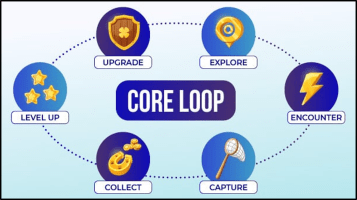
Above Image from GameDesigning.Org
Gameplay Loop: 8/10
It doesn’t matter how well Papers, Please embodies government paperwork, it’s gameplay centers around government paperwork. “I wish someone would make DMV: The Video Game,” said no one ever. You know, I might just play DMV: The Video Game. Don’t @ me. The tedium of checking passports and other supporting documents is mind-numbing at times. Fortunately, there’s the threat of death and supporting one’s family to spice up the act of checking IDs.
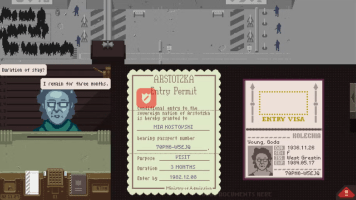
The choices the player makes between each day are a large part (if not the largest part) of Papers, Please’s narrative, and by extension its gameplay. The inspector may be given choices like adopting his niece, but his family goes without food or heat for one day. Do you help EZIC and risk being found out by the government? Do you do what you’re told and uphold Arstotzkian law? Glory to Arstotzka! But these are overarching choices, Papers, Please also gives the player plenty of choices and moral dilemmas within their job and daily routine.
An immigrant could ask to be let into the country so they can reunite with their children, but any violation of protocol results in a citation. Too many citations and the player character could be charged fines and possibly thrown in jail—or even executed. The choice to grant leniency to someone could negatively impact the player or the player’s family and that creates plenty of tension with which choices the player makes.

Narrative: 8/10
Whew. There’s a lot going on with Papers, Please’s gameplay and I may have covered some narrative structure in the previous section because gameplay and narrative are so intrinsically linked in Papers, Please. But narrative is where this game shines like an eagle, or some other mixed, cliched metaphor.
Papers, Please paints its narrative in the game’s blank space. Sure, there’s the tedium of checking government documents (and much of the game is centered around that), but the story of the inspector and his family comes in between the inspector’s daily chores. Do you uncheck the expenses for “food” or “heat” to purchase something else, knowing that your family will suffer? Do you confiscate passports, accruing warnings, or even financial penalties, so that you can doctor those passports for your family and escape? Do you keep your head down out of fear of being caught? All of these are valid choices. All these choices, or illusion of choices, puts the player in the role of the inspector.

Much like the gameplay, I can’t tell where the “story” for Papers, Please ends and the storytelling begins. It’s difficult to separate the two and that’s a wonderful thing. So many games we cover on Geekly are easy enough to separately grade a game’s narrative and storytelling. I’m still going to try to separate the two.
Papers, Please has a compelling story because its premise is compelling. But the game’s storytelling is where it truly shines.

Storytelling: 10/10
I mentioned earlier about Papers, Please telling its story in the game’s blank space. I’ve never seen a video game do this is such dramatic fashion. Papers, Please doesn’t just go for large moments and big decisions. It sprinkles in some nice character moments like after the first time the inspector tranquilizes a terrorist and his son hands him a drawing with the text “Arstotzka’s Hero.” Papers, Please’s character building and story come out in ways that only a video game could tell a story or build characters and that’s why it’s received several awards.
I don’t want to get too far into Papers, Please’s storylines, wading deep in spoiler waters, I may have said too much already, but Papers, Please not only challenges preconceived notions of right and wrong and what someone may or may not do if put in an untenable situation, but it also challenges video games to branch out with new forms of storytelling.

Sure, there are some moments where characters feed the player exposition and some of the world-building comes from newspaper headlines or clippings, but they aren’t used in excess. Papers, Please does a good job of showing instead of telling. It does an even better job of immersing players in its world, so much so that an indie film based on the game exists.
It’s difficult to separate Papers, Please’s narrative form from how it builds its characters, world, and story, but that may be the point. It receives high storytelling marks if only with innovation.
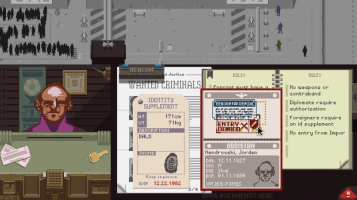
User Interface: 5/10
While Papers, Please takes things slowly and raises the temperature of its difficulty a little over time, it doesn’t hand-feed players. The inspection booth can be difficult to navigate at times and chat rooms and question-and-answer sites are littered with places where gamers get stuck. Papers, Please could use more of a tutorial, especially in later rounds of the game. The rulebook does point out changes to the ruleset, but it’s too easy to mess up and restart over a day or two or thirty.
Graphics: 8/10
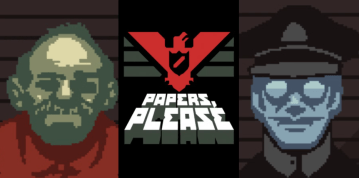
Papers, Please mirrors the era in which its narrative is set: the early 1980s. Its 8-bit sprites add to the overall vibe of the game, but the gameplay suffers at times as a result.
Pixelated portraits can make cross-referencing passport photos, and other supporting documents, to a person a chore. On the other hand, the graphics amplify the game’s difficulty and provide a double dose of meta-gaming. Government documents often get damaged and become illegible, even for people whose job it is to deal with them, so the graphics are in keeping with the era and the simulation it’s trying to achieve.
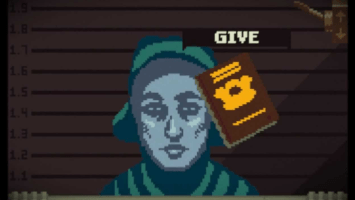
The cruder graphics also grant Papers, Please a touch of abstraction. Sometimes players must fill in the gaps when something awful befalls a would-be immigrant. Other times the player is spared a gruesome scene. Either way, the player is actively engaged in this world and anything one creates in their imagination is worse than what a visual medium can show. Horror films have known this for decades.
Still, I must dock Papers, Please a couple of points for its graphics. That’s her face? She looks nothing like that, and I just wasted a few seconds clicking buttons and waiting for results. There are limits to the copious number of times I erroneously scanned people’s faces.
Audio: 7/10
Papers, Please doesn’t use that much music, but the music it employs drives home the point that Arstotzka is an Eastern Bloc country. The main theme, which plays at the beginning of each day, feels like the protagonist inspector is high stepping his way to work each morning.
That’s fantastic. I can, and have, listened to that song on a loop. That’s not a good sign, but at least I didn’t dance the Mamushka, “the dance of brotherly love.” Mamushka!
While the rest of the music is mostly forgettable, character voices and other sound effects come from public sources—one could download midis or wave files from sites like Soundcloud and create one’s own government document thriller—but Papers, Please’s usage of these sound clips is well done. Garbled voices conjure the idea that what immigrants or superiors or peers say to the protagonist doesn’t matter like much adult dialogue in a Peanuts television special. Heck, even what the protagonist says doesn’t matter to him. He’s going through the motions.
The main theme elevates the rest of the soundtrack, but I’m counting off a few points here. Papers, Please’s soundtrack is largely functional.

Replay Factor: 8/10
This is a difficult category to grade. On one hand, Papers, Please has plenty of replay value and even demands players to repay it at least a handful of times. But once one achieves a dozen or so of Papers, Please’s twenty possible endings, I’m not sure if there’s a lot of replay value after doing so. Lucas Pope included an endless mode once a player finished the game at least once, but the game loses something with that game mode.
With twenty endings there’s still plenty of replay value. One can finish Papers, Please in under an hour. Heck, one could deliberately fail as an inspector and end the game in less than five minutes. I put in over 20 hours for this review and still found avenues I could navigate the story.

Aggregated Score: 8
Even after reexamining Papers, Please, I ended up with the same score of eight. I wasn’t anticipating that. I said that I tweaked the scoring criteria to match our modern reviews, but I revisited the game, trying to see if I spotted anything different. Our new scoring criteria could’ve changed Papers, Please overall score, but it didn’t. Papers, Please is the best game (to date) of the ones we’ve covered on JK Geekly. Even after a decade past its original release, Papers, Please is worth your time.
 jkgeekly.com