




Hey, hey! Kyra Kyle here. I’m kicking off these gacha critiques with Genshin Impact. I have two logins (one for PC and the other Playstation), so I’ve spent plenty of time in Teyvat (the world Genshin is set in). But I’ve only recently revisited the game. The new continent Natlan brought me back. So, what does Genshin look like in over a year? The graphics are dated but not as bad as I would’ve thought. The oversaturated colors bugged me. They’re loud. So loud that I almost grabbed a pair of sunglasses to shield myself from the glare. The music was always great, almost iconic. But these are surface-level viewpoints. How does Genshin Impact hold up to some of these new or updated video game criteria that we talked about in yesterday’s post? As it turns out, not too well.
Genshin conducted a massive copy paste to Zelda: Breath of the Wild’s mechanisms, so you won’t find too many innovative game mechanisms. The mechanisms that are here work well, even if they are dated, but more on that in the following segment. Is there anything left to say than Genshin’s mechanisms whimper banal? 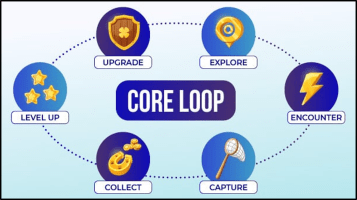
Above Image from GameDesigning.Org
It worked in Breath of the Wild, and it works here. The core gameplay loop can keep players engaged for countless hours. That can be a good and bad thing. Elemental reactions play a huge role in Genshin’s combat, so players will often switch characters. Breath of the Wild only has Link. The physical swapping of characters goes a long way to hold a player’s attention, and it doesn’t hurt that players need to build more than one character and that each of these characters have different interactions. 
Genshin does little to respect a player’s time. It’s an older game, four-years old at this point, and it shows its age. As I mentioned previously, Genshin borrows most if not all of its gameplay from Zelda: Breath of the Wild and that includes the glacially slow glider and snailing up mountain faces. And there are so many mountain faces. But it goes deeper than that. Repetitive storylines and dialogue with no way of skipping said dialogue can make me want to rage quit. The game time gates upgrade materials. One can only farm materials on certain days of the week. I forgot about this in my year off. Why can I only farm skill scrolls on specific days? It makes no sense.
And speaking of these upgrade materials and skill scrolls, one can’t skip the domains these items can be found. You must defeat the same bosses or mid-level bosses every day. Every. Day. I miss older gachas. They knew they were mobile/timewaster games and allowed players to skip. I’ve beaten this level with a five-star rating before, so I can spend my energy and auto-clear this domain. The trend of disabling auto-clear in gachas began with Genshin. Hoyoverse assumed the attitude of “I created a robust world with better graphics and demand you see this world as much as possible, even if it’s repetitive.” Ugh!
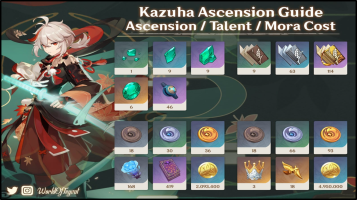
It takes one-two minutes to defeat these domains. That’s not that long but considering you could clear about eight to twelve a day, that’s a good ten-twenty minutes. It’s half that if you use condensed resin (which acts like finishing the domain twice in one go), but you also need to farm the items with which to make condensed resin, and we’re doing the time warp again. And not in the fun Rocky Horror way. These domains don’t sound like they take long, but time adds up fast. Genshin also offers daily tasks which don’t take that long, but they’re daily tasks and they can last up to five minutes. It’s a lot of busy work with not enough pay off.
And it goes even further with minor time wasting inconveniences. Items burst out of things. I don’t know how many times I’m on a mountain face, open a chest, and the treasure spills down the mountain. Really? Auto-collect the treasure. And I can’t interact with things like a waypoint for the first time if an enemy spots me. I don’t have to see the enemy. Half the time I’m scratching my head wondering where the enemy is. Genshin invents new ways to waste time. But it’s super easy to finish the battle pass. That’s a huge plus.
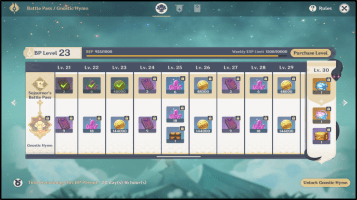
Genshin doesn’t really require a player to purchase its battle pass. I advise purchasing the battle pass once annually because some extra goodies can go a long way, but one can get by without it. And if that was all that mattered, I would’ve given Genshin top marks.

Unfortunately, Genshin has seen few upgrades to its battle pass in four years. There has been one major inclusion: artifact experience items. Genshin Impact is playing with a player’s ability to build their own artifacts with these experience items and that could ease the pain of farming artifacts. I didn’t mention this in the Respecting Time segment, but Genshin’s artifacts are the most time consuming of all items one must farm.
That said, I still can’t give Genshin high marks in Battle Pass because the BP weapons are okay at best, and the ability for players to build their own artifacts is getting tested in this patch. We don’t know if Genshin intends to keep this function, even though it’s been in Honkai: Star Rail from the beginning. Fingers crossed that it stays.

Genshin is below average in terms of True Cost, but I struggled with how far down it should fall. It originally received an average score years ago, but I have more context with which to stratify Genshin Impact. The release of Wuthering Waves (WuWa) and how much Kuro Games gifts their players with free five-stars and upgrades and convenes (those are WuWa’s version of a gacha turn) leaves Genshin in the dust.
Even so, I can’t crater this score. One doesn’t need that much in terms of primogems (the in-game currency players can buy with real-world money) and only a few characters are needed, specifically anyone who can facilitate hyper bloom. But it’s fun to get new characters and Hoyoverse’s other game Honkai: Star Rail (HSR) is far more generous. Both HSR and WuWa provide more in-game currency for exploration and completing events.
Sure, Genshin has given their playerbase more primogems and free gacha turns in this patch (5.0) than most other patches, but someone smarter (and more dedicated toward number crunching) than me kept track of how many gacha turns a person can make with freemogems and gifts in Genshin versus HSR. Over the years, Genshin has given players 80 turns per patch. To date, HSR gives players at least 100 turns per patch with just finishing in-game content. That means that HSR players are guaranteed a five-star character each patch, while Genshin players must pay for 20 turns of the gacha crank or not get a five-star. Or they need to get lucky. Just be lucky. Simple.
And it doesn’t stop there. Genshin Impact changes for the worse with its weapon banner. You must lose the 33% chance twice before getting a guaranteed weapon. If you miss both times and go to hard pity every time, you could spend hundreds of real-world dollars. Yikes! Genshin’s weapon banner is abysmal. What’s worse is that the current banner is an improvement. I saw a video years ago of someone spending thousands of dollars and never getting the banner weapon.

I gave Genshin an 8/10 for this category years ago. I would’ve given it 9/10 if I only gauged its story and not the storytelling. Genshin Impact has an engaging story; Hoyoverse stinks at telling stories.
This will be a problem with most gacha games. Gachas tend to dice up a story, toss the segments into the air, and let them fall wherever they will. As a result, I can seldom follow what’s going on in Genshin’s story. I need YouTube creators like Ashikai to compile Genshin’s story from various mediums, to include mangas, short animations, one shots, forums, and even some events that I may have missed because I was AFK. Quick plug, you should check out Ashikai’s YouTube channel; they do amazing work.
Once you know the plot points, Genshin Impact has a great story. The idea that this could be a post-apocalyptic world, and the sky is fake fascinates me. I won’t spoil the whole thing here. You should check out Ashikai’s playlist on World Structure Theory. Great stuff. The narrative itself rocks. I just wish Hoyoverse would elevate their storytelling.

Ugh! Genshin hardly makes sense half the time and the times when it does make sense, Paimon repeats what a character just said.
Random NPC: I think the wolf headed east.
Paimon: It sounds like (random NPC) thinks the wolf headed east.
Skip. Skip! Skip!!! I already know that. Why don’t you give me a skip function? Why does Paimon repeat everything? Why doesn’t Paimon recap the parts of the story that I could’ve missed in timed events or the manga or some other media I haven’t seen? Hoyoverse’s team must’ve heard that no one can follow their plot, but they didn’t get the memo that their tossed salad method of storytelling could be the issue. It must be that the player wasn’t paying attention. Let’s repeat the same dialogue five times because the following happens way too often:

Random NPC: That’s right, Paimon! I believe the wolf headed east.
Paimon: Oh! (Random NPC) believes the wolf headed east.
Random NPC: That’s right, Paimon. You should head east in order to find the wolf. Paimon: Paimon thinks that Paimon and the traveler should head east in order to… Stop! Skip! Why?
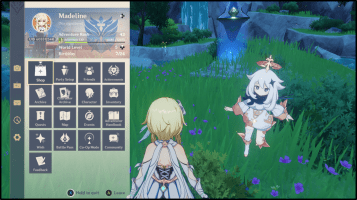
Genshin Impact streamlined a lot. So many gachas have cluttered interfaces. Tower of Fantasy (ToF), which was released after Genshin, is a good example of a cluttered interface. I can’t follow half of what ToF is trying to show me. It has too many sub-sub-sub-sub categories. Send a search party.
Genshin does a good job of showing the most pertinent information. But it can be better. I can do with even fewer sub, subcategories. Even so, Genshin has done such a good job at minimizing clutter that Wuthering Waves copied Genshin Impact’s interface as much as Genshin Impact copied Breath of the Wild. That tends to happen when a game does something right. If something works, copy the homework.
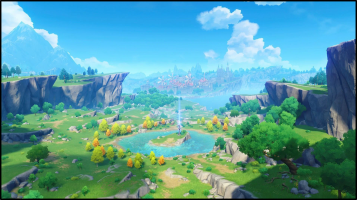
Like I said, the graphics look good but they’re dated, and I could do without Genshin’s oversaturated color palette. But the music catapults this score. Hoyoverse sunk a ton of money into making each region and even specific locations within a region unique. It says something when you can close your eyes, listen to a track, and know exactly where the piece plays.
A high music score will be a common trend for Hoyoverse games. Hoyoverse knows the value of good music. They honed their skills in Honkai Impact 3rd. “Nightglow,” anyone?

These new scoring metrics lowered Genshin Impact’s overall score. I still have a little hope that Hoyoverse will improve Genshin Impact, but several of the game’s improvements were first tested in Honkai: Star Rail, and it took over a year for those improvements to make their way from HSR to Genshin Impact. It’s the same company.

Hoyoverse has shifted assets and focus to HSR, Honkai Impact 3rd: Part 2, and Zenless Zone Zero. As I said in my review years ago, Hoyoverse may cut their losses and not give Genshin Impact the overhaul it needs. They don’t improve their profit margins if they upgrade the current Genshin Impact. It’s only a matter of time until Hoyoverse releases Genshin Impact 2nd: Give Us More Money. That’s all I have for now. Let me know your thoughts on Genshin Impact. And wherever you are, I hope you’re having a great day.

Hey, hey! Kyra Kyle here. I haven’t shared a video game review in quite a while. I started by covering a bunch of Gacha games and intended on including them all in this post, but I pared that down to one gacha Genshin Impact, which will post tomorrow. I found that most video game reviews aren’t effective when discussing free-to-play video games. So, let’s give video game reviews the enema it needs.
Video game reviews often cover things that are easy to spot. Visuals? You can see screenshots: unnecessary. Audio? I guess that’s helpful, but again there are video shorts, and one can get the feel of a game’s audio before purchasing. Gameplay might be the most useful and some sites will even include a video game’s replayability. But we’re living in a free-to-play video game world, and there are video game review categories that get overlooked.
Respecting a player’s time may be the biggest omission. Replayability is fine and all, but video gamers are getting older. So many of us are parents and grandparents and even the ones who don’t have kids have other real-world obligations.
Respecting a player’s time has become more important than replayability. I said it. Whenever I see a game boast that it has 100s of hours of replayability, I lose interest. I don’t need another part-time job playing a video game for certain unlockables or item upgrades. That’s good for someone whose job is video games or someone still in grade school. The rest of us have other things we could be doing or other things we need to do.
True cost. Free-to-play games need a true cost category. Can players effectively play a game without buying the battle pass every patch? Yes. Battle passes should also have their own category, because most free-to-play games include one. Heck! Several paid games include a battle pass in today’s climate.
But Gacha games, which have gained popularity in recent years because of their monetization system, find ways to price-gouge players with drop rates for characters and items. But Kyra, you could play 40 hours a week to—see respecting a player’s time. I guess this one could also be called respecting a player’s money.
I’d take it further with splitting gameplay into mechanisms and gameplay loop. Mechanisms are what you’re mechanically doing in a game, but what one does in a game only matters if the game mechanisms are unique. And gameplay loop is how satisfying and engaging the mechanisms work together as a whole.
Gameplay combines the two ideas. I guess the combo works, but separate categories may attract different gamers. Some like playing a unique game even if the combination of elements gets clunky. Other gamers look for a cohesive whole.
I’d do a similar thing with story or narrative. Storytelling and a story are not the same thing. John Updike’s A&P has a simple premise, but Updike’s storytelling elevates the story into a classic. On the flip side, Genshin Impact has a great story if you can follow it, but Hoyoverse has done a piss pour job at storytelling. Oops! That may have spoiled the Genshin Impact review.
With all of that said, let’s see if we can pin down a good set of video game review criteria before covering the first of a few larger gacha games. But before we do that, we’ll need to discuss what makes a gacha game for the folks who may not know. For those of you who know what a gacha game is, feel free to scroll past this next section. I’ll try and keep it short.

Gacha games have been around for decades. One of the first, MapleStory released in 2003. Yikes! It has been decades. But the polish and larger budget and success of 2020’s Genshin Impact launched gacha games into mainstream popularity.
Gachas have always been popular, especially in eastern Asia, but Genshin’s blend of Zelda: Breath of the Wild’s gameplay and the gacha monetization system brought in new fans. Let’s be real. Genshin is a Breath of the Wild clone. So, the only new thing Genshin really introduced to that formula was the gacha system. So, let’s discuss what makes a Gacha game.
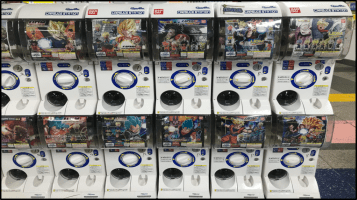
Gachas work like collectible card games or like the gacha machines the game type borrows the word. Gacha machines are the machines one can find at the front of a grocery store. Insert a coin (quarter) into the machine, turn the crank, and a plastic ball with a toy inside spits out from a spout. Gacha originates in Japan. The Japanese call it that because they believe that’s the sound a gacha machine makes as one turns the crank. Gacha. Gacha! Gacha!!!
In gacha games, players wish or warp or convene—each game has its own word for what you’re doing, so let’s come up with a universal term “turn”—or takes a turn on a banner. Each banner will feature a character.

Usually, but not always, players take a certain number of turns on the banner before they can receive the featured character (usually about 80-100 turns). I say “can receive” because gachas typically employ a percentage chance of gaining the featured character or item. Often, one needs to lose their percentage chance of gaining a featured item before receiving a guaranteed character/item.
As you can guess, this monetization system is how gacha games make most of their money. And they make a LOT of money. Despite most gacha games using a free-to-play model, one will often find gacha games at the top of the most money earned over any given month. This fact is also why gachas became popular. Video game companies like money.
With those new ways of earning—or syphoning—money from customers, we may need new video game review criteria. So, let’s pin down some free-to-play/gacha video game categories.
This will be a category for the folks who like interesting mechanisms in their game. Games that push what can be done with video games from a technical gameplay standpoint will earn good scores.
Above image from GameDesigning.org
This is how the mechanisms work together to make a cohesive product. A formulaic game can score a high Gameplay Loop score, but that doesn’t mean that it doesn’t anything unique.
This applies more to free-to-play games, but I’ve seen plenty of other games waste a players time. Games that don’t waste a player’s time with busy work will score high in this category.
If a game has a battle pass, it will receive a score in this category. Who are we kidding? Most, if not every, gacha game has a battle pass. Even some paid games boast battle passes. I’ll split this score between the necessity of buying the pass and what one gets for completing it, giving difference to the latter.
How much does the game actually cost? Again, this is more a question for free-to-play games, but players can be asked to purchase add-ons. How much does everything cost?
I mentioned this prior. This is the story, not the storytelling. Gachas have a nasty habit of chopping up their narratives and tossing them into the wind. I’ll be leaning on YouTubers and other people to help me piecemeal these stories together.
Again, this I mentioned this prior. How well does the game tell its story? These are two very different concepts, especially for gacha games.
Gachas are also notorious for having difficult to manage menus. This wouldn’t be that big of an issue for most video games, but free-to-play games have a knack for hiding things within sub-sub-sub-sub menus so gamers can’t find them.
Yes. It’s obvious but still a necessary category. I’ll use this as a catch all for graphics and audio, giving an internal score for both within the segment.
And with that, I think we have a good set of parameters. I’ll see you tomorrow. And wherever you are, I hope you’re having a nice day.
 jkgeekly.com