

Hey, hey! Kyra Kyle here. I didn’t realize that I hadn’t reviewed today’s game, so we’ll fix that. Today’s review is another party game: Don’t Mess with Cthulhu.
Don’t Mess with Cthulhu is a social deduction game with secret identities. Players assume the role of investigators or cultists. The investigators must uncover all the Elder Signs to win, while the Cultists win when Cthulhu is revealed or if the game ends before all the Elder Signs are discovered.
Before we venture further into madness, let’s discuss Don’t Mess with Cthulhu’s details.
The Fiddly Bits
Designer: Yusuke Sato
Publisher: Indie Boards & Cards
Date Released: 2014
Number of Players: 4-6
Age Range: 10 and up
Setup Time: Less than a minute
Play Time: 1-30 minutes
Game Mechanisms
Bluffing
Card Game
Deduction
Party Game
Negotiation
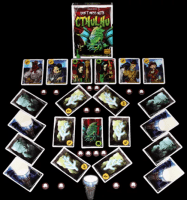
Game Setup
You’ll have a different number of investigators and cultists, and various numbers of futile investigation and Elder Sign cards based on the number of players. Consult the charts in the rulebook to determine how many of each needs to be in the game.

Shuffle the appropriate number of Character tokens, dealing one to each player face down. Each player secretly looks at the role assigned to them on the Character token. Place any unused tokens out of play without revealing them.

Then, shuffle the appropriate number of Investigation cards, dealing five to each player face down. Beginning with the starting player (who will have the starter player token, which is a flashlight), each player secretly looks at their Investigation cards and declares (truthfully or not) the number of Elder Sign and Cthulhu cards they were dealt. (Note: there’s only one Cthulhu card in the deck, but that doesn’t mean that more than one player can “claim” to have a Cthulhu card.)
Everyone shuffles their Investigation cards and places them in front of themselves, face down.

Game Flow
Each turn consists of the Active player selecting any Investigation card in front of any player other than themselves. They place the flashlight token on the card they wish to reveal. Other players should feed the player information, keeping in mind that players with the Investigator role want to find Elder Signs, while Cultists want to reveal Cthulhu.
The chosen card is revealed and placed in the center of the play area so everyone can see it. Check to see if the game ends (all the Elder Signs are revealed or if Cthulhu makes an appearance). Play continues with the player whose card was just revealed. They take their turn the same way and this continues until the round comes to an end.

The round ends after the number of actions taken in that round equals the number of players in the game. After the round ends, the remaining Investigation cards are shuffled together and dealt evenly between the players. Again, the players secretly look at their Investigation cards and place them in front of themselves face down.
The game ends immediately if the Cthulhu card is revealed or if all Elder Sign cards are revealed. If neither condition is met, the game ends after four rounds.
If all Elder Sign cards are revealed, the Investigators win. If Cthulhu is revealed or four rounds are played without all Elder Sign cards being revealed, the Cultists win.

Review
Like most party games, Don’t Mess with Cthulhu has a quick setup and playtime. I’ve played this game quite a bit over the years and found that you don’t always need to bluff when playing—but it helps. And it’s fun when more than one person claims that they have Cthulhu. I’ve played a round where three people at the table said they had Cthulhu and then the next round, everyone said they had Cthulhu. It’s a goofy game that doesn’t take long.
And the reason why I say that you don’t have to bluff if you don’t want to is that chance plays a huge role in Don’t Mess with Cthulhu. Even if everyone tells the truth, you still must select the right card, or the game ends and the game can end in the way you don’t want. My family struggles with bluffing in games. Don’t Mess with Cthulhu gives players an option to bluff or not bluff. This leads to some great metagaming. I’ve heard many players say, you never tend to bluff but you did this time and fooled everyone. I’ve also seen the opposite. Don’t Mess with Cthulhu may get better the more games you play with a group.

The stakes are low with Don’t Mess with Cthulhu. Most games last about fifteen minutes with some games going as short as less than one minute. I’ve seen plenty of games where the first or second card the active player chooses is the Cthulhu card. It doesn’t matter. Laugh it off, shuffle the cards, and play again.
Too Long; Didn’t Read
Don’t Mess with Cthulhu is a great change-of-pace game for most gaming groups. It won’t be a group’s main game, but I’ve seen many game nights where this game caps off the session. It’s endlessly replayable and has low stakes. Don’t Mess with Cthulhu’s goofy fun doesn’t force you to bluff—but bluffing doesn’t hurt.
 jkgeekly.com