The Flash Secrets: “Fast Lane”

Coast City Pizza The Flash

Coast City Pizza

The West family went to dinner at Coast City Pizza. We’ve seen this restaurant chain before, in “Who Is Harrison Wells?,” and it’s likely inspired by the real-life California Pizza Kitchen. Of course Coast City is where Hal Jordan, the Green Lantern, calls home in the comics. Arrow and The Flash have mentioned and spent time in Coast City.

Tarpit The Flash

Tar Pit

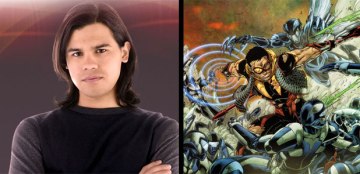
Tonight’s villain was Tar Pit, created by Geoff Johns and Scott Kolins and introduced in 2001. He was a small-time drug trafficker who learned he could astral project himself out into the world while still behind bars. At one point, his spirit became trapped in a vat of tar, leaving Tar Pit to walk the earth with a body made of molten asphalt. His physical form remained in a coma at Iron Heights Prison.

Oliver Queen for Mayor

If you listened closely to the newscast on TV, you could hear someone mention Oliver Queen’s mayoral campaign. Ollie’s campaign returned in this week’s Arrow.

Diamond Comics

Diamond Detailing

The Diamond Detailing sign has a logo that looks similar to Diamond Comics Distributors. It could be a coincidence but perhaps it’s not.

Did you miss our Flash “Fast Lane” review? Here’s a link. Thanks for reading.

iZombie Review: “Fifty Shades of Grey Matter”

iZombieSeason2Banner

Kyle’s Thoughts

Usually, iZombie places personal drama on the backburner in order to tackle the zombie criminal underworld and check the boxes for a police procedural, but with an episode title like “Fifty Shades of Grey Matter,” the episode lived up to the punny name by the way, the show had to focus on romantic relationships and that part of the show was okay, even though I didn’t buy into any of the relationships. I had forgotten about the bouncer zombie working for Blaine and his and Liv’s relationship won’t last. Peyton’s affair with Blaine is a plot device. Now she’s stuck with him as a star witness against a crime lord despite her knowledge of the murders Blaine committed. She may have to maintain the romance for a while, and that might get interesting, but the affair was always a plot device to insert Peyton in the middle of the zombie madness and further tie in the criminal element into the main arc.

Liv and company are back in action. She had been on the outs with Detective Babineaux before the mid-season break and they’ve recaptured their working relationship, so that’s good. From a police procedural aspect, “Fifty Shades of Grey Matter” was by the book. Seriously. The gang did a good job of detective work, but the weekly mystery’s solve was obvious, down to the red herrings that kept you guessing.

The zombie underworld got the shaft but not really. Blaine was physically in this episode but he wasn’t moving pieces behind the scene and still, he may have found the biggest pawn in his plan: the aforementioned assistant DA Peyton. Next week should see a lot more underworld action.

Major almost got caught as the zombie killer but he escaped just before Detective Babineaux discovered his identity. But Major left a clue and that’s a great thing. The pieces are in place for a dramatic build to a season finale.

“Fifty Shades of Grey Matter” also had Liv on sex-starved librarian brain and it was awkward and silly to see her lust after every man on the screen. The episode didn’t do everything well but it had enough bright spots and it earned its title. There were things introduced in this episode that should have lastly ramifications on Liv and the rest of the gang, and that holds my interest.

Agent Carter Review: “Smoke & Mirrors”

AgentCarterSeason2

Kyle’s Thoughts

I’m not sure if the Hedy Lamarr estate (check out last week’s Agent Carter review) likes how her namesake Whitney Frost has gone the way of a double agent, but “Smoke & Mirrors” did its best to fill viewers into Frost’s past and explain why she’d want to gain power. Agent Carter did a great job of using flashbacks. The pacing felt right as this week’s episode went back and forth from Peggy to Whitney and back again in order to form a shared history between these female characters, even though they just met. The woman in a man’s world theme continues to dominate the storyline but the moments where this is most evident in this episode are quieter moments that occurred in the past and that works. Instead of a public display, “Smoke & Mirrors” opted for parents scolding their children and that better illustrated the cause of such a world; this mindset and behavior is learned.

Unfortunately, the rest of the show delved into interpersonal relationships. Sure, there were plenty of laughs, I chuckled at Jarvis’s attempt to be an action hero, but Agent Carter pushed the would-be love triangle of Peggy, Sousa, and Dr. Wilkes. Sousa is engaged, and Peggy would never steal him away from his fiancée, but she has more chemistry with Sousa than she does Dr. Wilkes. Most of Peggy and Wilkes’s forced relationship comes from the fact that Wilkes has no physical presence. Literally. He’s fading from existence and this is another relationship that’s doomed to fail, and Peggy didn’t have enough time to develop a strong rapport before he turned ghost.

Agent Carter continues to hit more than miss. The backstories did a great job of setting up Frost and providing some background for Peggy. The show also takes advantage of the time in which it’s set. And the move from New York last season to Hollywood this season doesn’t hurt either.

Grimm Review “Eve of Destruction”

GrimmSeason5GeekSpeak

Kyle’s Thoughts

“Eve of Destruction” did a good job of bringing Grimm back from the mid-season break but it’s morphing into a political allegory and borrowing more from comic books at this point than fairy tales.

Comic books love secret organizations, and Grimm has at least three in play here: democratic revolutionaries (a new government spawned from a secret society), royals trying to hold onto power (we haven’t seen much of them), and a wesen fundamentalist group (Black Claws). Juliette has returned from the dead—another comic book trope—and she’s become the ultimate weapon—ditto. Trubel is Nick’s sidekick of sorts. She’s even been reprogrammed by one of the secret organizations and she shares more with Captain America’s Bucky than she does with a fairy tale counterpart. Some of these developments work, while others don’t, but I liked how Grimm had separated itself from the other comic book shows I’ve been watching, and time has eroded that distinction.

The political allegory generally works because Grimm tends to use a subtle hand. The fundamentalist group borrows from so many historical factions that you can’t pinpoint any one in particular, except for the few times they take on Nazi party characteristics. The royals have stepped into the shadows. Renard has to factor into this group somehow but Grimm won’t say, or show, us how, and as a result, they’re the most opaque. And the democratic revolutionaries acted as if they supported the council (a townhouse level governing body) but didn’t actively defend it. Honestly, I’m glad the fundamentalist group wiped out the wesen council. We needed fewer pieces in play, and I wasn’t a big fan of the council in the first place; I never knew exactly how it worked. Grimm didn’t tie down exact rules for the council, they changed many of them on a whim. Getting rid of the council focused Grimm’s conflict on the two main factions (the revolutionaries and the fundamentalists), while sowing the idea of suspicion throughout the wesen world. Now all Grimm has to do is wait for the dust to settle and focus the swirling tension.

I also like the awkward pairing of Adalind and Nick. They didn’t have a lot of screen time together but the ones they shared were tense, tender, and shined. We saw a lot more of Trubel and even though I didn’t care much for her at first, she’s grown on me, especially when I think of her as Bucky to Nick’s Cap. She’s also the only connective tissue viewers have between the world of Grimm’s secret organizations and Nick. Trubel actually works—for the most part—but I’d like something more than Juliette’s return as a tie-in.

I never believed Juliette was dead or that she’d stay dead, so I wasn’t surprised to see her again. (We did catch a glimpse of her before the break.) What does surprise me is that she’s subservient to the secret society and that doesn’t ring true. Juliette must have a reason for working with these people, otherwise she’s just like Genie from Aladdin: phenomenal cosmic powers, itty, bitty living space.

Ultimately, “Eve of Destruction” was a little plot-heavy for its own good. The episode did too much and since there were only six episodes that preceded it this season, there wasn’t enough to ground the characters once the show went down its many rabbit holes. Still, it held my interest, and I’ll stick with it.

DC Comics Legends of Tomorrow Review: “Pilot, Part 2”

DC Comics Legends of Tomorrow

Kyle’s Thoughts

Okay. Part of my delay with our weekly Legends of Tomorrow comes from the big snow storm knocking down my cable/internet for an extended time period. The other part for my delay is that I can’t find too many good things to say about the series besides they continue to push the special effects capabilities of a CW show as far as they will go. There were moments when I forgot this was a TV show instead of major motion picture. But there’s not much to like about the story. Since this is the second part of the pilot, I’ll cover some ground covered in the previous week’s review; both parts make up the full vision of the show’s inaugural episode.

Let’s start with characters. They didn’t have time to develop before the show or during the show, disappeared and then suddenly reappeared in contrived ways, or they grated on my nerves during the Arrow and/or Flash. The motivation for these individuals to make something of themselves rings hollow except for Dr. Stein and Ray Palmer. Everyone else on this roster either wouldn’t care (thieves want to die fat and happy, not leave their mark), shouldn’t want to be well-known (the best assassins are anonymous), or they’re Hawkpeople and they want revenge on Vandal Savage, and that’s another good—if not generic—motivator.

We’re supposed to believe that this incompetent group of heroes—I’m sorry, legends—will prevent the world from going to heck. They got manhandled by Chronos in the first episode. How are they supposed to be a threat to Savage if they can’t (as a combined team) deal with a random, solo bounty hunter? It’s one thing to lose. It’s another to lose by 30 points at home, when the visiting team is resting half their starters. Unfortunately, the legends didn’t pull their heads out of their hind quarters in the pilot’s second half.

Stein all but tells his younger self who he is and destroys his timeline in the process (only to have Rip Hunter restore it). The two thieves are sent out on a burglary mission, which makes senses, but Atom’s shocked when they grab more loot than the mission tells them to. Again, they’re thieves. Rip cites the Butterfly Effect (if you do so much as kill a butterfly in the past, you could change time irrevocably) and then the group turns Captain Caveman on the black arms market, complete with a nuclear explosion. That’s even before Atom leaves a parting gift, a piece of future tech fell off his super suit, for Savage and his vandals, which hastens mankind’s demise. They put out the fire Palmer started and go after Savage, and that’s where we get to Hawkman and Hawkgirl.

Hawkgirl is the key because she knows what the inscription on the dagger (that can kill Savage) says. The only problem with this logic is that when Hawkgirl accesses her memory of what the dagger says, she doesn’t read it to herself, she recites the poem on the dagger to Hawkman. Why doesn’t Hawkman have this memory? I thought two Hawks were one too many and (Spoiler) Legends agrees. Hawkman dies in the pilot’s second part, after he plunges Hawkgirl’s dagger into Savage’s chest and then Savage returns the favor. As he delivers the killing blow, Savage tells Hawkman that he should’ve know that he can’t use Hawkgirl’s dagger, and I agree with him. Hawkman should’ve known not to use Hawkgirl’s dagger. For being the one of the two Hawks who had the most clear recollection of their past, he knew shockingly few details. And that’s where Legends falls flat: the details.

I might be able to get over Hawkman’s death as a plot device to galvanize the team, even though the bulk of the team doesn’t know him from Atom. I may even be able to forget that Legends pulled the same plot device in the pilot’s first part with Hawkman and Hawkgirl’s son, but Legends of Tomorrow concerns itself too much with its beautiful CGI to bother with things like characters and story. I hope this was opening show jitters, and Legends rights the ship soon.

There were plenty of secrets in Legends of Tomorrow. Warp to our Legends of Tomorrow secrets page.

DC Comics Legends of Tomorrow Secrets: “Pilot, Part 2”

DamienDarhk

Damien Dahrk

Dahrk was a minor villain in the comics but he caught fire with Arrow fans this season. He’s the head of H.I.V.E. but he’s also behind plenty of mysteries in the show’s history.

BoosterGoldRealityLost

Egyptian Dagger

If that dagger looked familiar, it might be because an Egyptian ceremonial dagger makes for a good prop and you could’ve seen Rip Hunter chase down one in the comics. The trade paperback Booster Gold: Reality Lost by Rick Remender, Chuck Dixon, and Dan Jurgens has Booster Gold and his son Rip Hunter square off against Chronos (from the Legends pilot, part 1). The two heroes chase the dagger through time before Wiley Dalbert, a minor villain from Gotham City, gets his hands on it. Chronos was hired to prevent the father and son duo from succeeding.

LegendsOfTomorrowJonahHex

Jonah Hex

The internet was all aflutter when Legends announced that the legendary and cursed cowboy Jonah Hex would make an appearance. We’ll have to wait awhile before we meet Hex, but if you look behind Hawkman, you’ll see a wanted poster with a familiar face.

TheAtom

Dwarf Star

According to Legends, Alpha Particles were emitted from the Dwarf Star Alloy in the ATOM armor, and it was a fragment of a White Dwarf Star that allowed the Atom to grow and shrink.

IvyUniversity

Ivy University

The young Dr. Stein worked at Ivy University, and that’s where the gang meets him. Many other DC Comics characters have toiled hours as an Ivy employee. Ray Palmer even worked there.

The university has been name-dropped on Arrow and even Constantine; John said he knew someone who worked there. John could’ve meant Ray Palmer since both characters have made appearances in Arrow and exist in the world of Legends of Tomorrow.

SteinFlash

Elon Musk

Elon Musk is the multi-billionaire who owns PayPal, Tesla Motors, and SpaceX, one of the private companies bringing back the United States’ space program. The elder Dr. Stein namedropped him in this episode. It makes sense that elder Stein would look up to Musk, but it also makes sense that Marty has no idea who Elon Musk is. In 1975, Musk would’ve been four or five.

BackToTheFuture

Marty McStein

Stein isn’t the most famous time-traveling Marty. That honor goes to Marty McFly (of Back to the Future fame) and I wonder if the disappearing wedding ring was a tip of the hat to Marty disappearing during his famous scene on-stage.

MikeCarlin

The Carlin Award

Marty Stein sure is proud of the fact that he’s a five-time winner of the Carlin Award. And why wouldn’t he. The hardware was named after longtime DC Comics editor Mike Carlin, who governed titles like Superman, and the ones that featured Rip Hunter, the Linear Men, and Waverider.

Those are all the secrets we have for Legends of Tomorrow. If you missed our review of the pilot, part 2, here’s a link. Thanks for reading.

Arrow Secrets: “A.W.O.L.”

SuicideSquadArrowAmandaWaller

Amanda Waller

We saw Amanda Waller’s brief and triumphant return this week. Just as a refresher, she’s a government agent who works for various secret organizations, but mostly with A.R.G.U.S. and Checkmate.

Waller is also the woman behind the Suicide Squad and will make her next appearance in this summer’s Suicide Squad movie, directed by David Ayers, where she’ll be played by Viola Davis. But Arrow’s and Suicide Squad’s aren’t the only times Waller had graced the screen. Pamela Grier portrayed her in Smallville and Angela Bassett played her Green Lantern.

HotWheels

Hot Wheels

Felicity jokes that her codename should be “Hot Wheels.” That’s an obvious reference to the popular brand of toy car. I’ll admit it. I had plenty of them growing up.
Big_Belly_Burger

Big Belly Burger

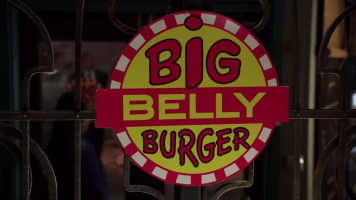
Here we go with another Big Belly Burger reference. This franchise is a take on Bob’s Big Boy and has become a staple on Arrow, The Flash, and the video game DC Universe Online. One of my virtual superheroes has eaten at Big Belly Burger once.

Even though Big Belly Burger has made plenty of appearances and boasts unique herbs and spices, I don’t know if I agree with Diggle that it has restorative properties.

Arrow -- "The Secret Origin of Felicity Smoak" -- Image AR305a_0359b -- Pictured: Emily Bett Rickards as Felicity Smoak -- Photo: Cate Cameron/The CW -- © 2014 The CW Network, LLC. All Rights Reserved.

Goth Felicity

We first saw Goth Felicity in “The Secret Origin of Felicity Smoak,” which was originally titled “Oracle” before it went into production. If you look hard enough, you’ll find the raven haired, nihilistic Felicity on Tumblr. She has quite the following.

ShadowCabinet0

Shadowspire

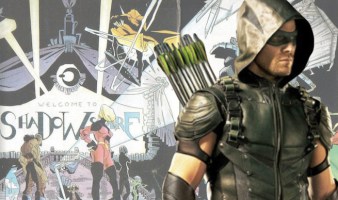
This criminal organization first appeared in a Deathstroke comic, even though the name was first uttered in Shadow Cabinet a year prior. The organization is headed by The Baron (Arrow uses Baron Reiter) and went toe to toe with Deathstroke and Damage.
ArrowShadowspire

LT Joyner

Lieutenant Joyner was named for the writer who created Shadowspire, Dr. Tom Joyner. Joyner used the concept in Deathstroke and Damage.

KordIndustriesTrucks

Kord Industries

We’ve seen it before and here it is again: Kord Industries.

Ted Kord, the second Blue Beetle and longtime member of the Justice League, owns the company that shares his name. At one point Ted, not Ray Palmer/The Atom, was supposed to appear on Arrow’s third season. I wouldn’t mind seeing Ted even if he doesn’t don his costume.

Overwatch

She’s not Oracle. Felicity Smoak’s codename is Overwatch. I don’t know if Smoak is going to use this codename that often but this isn’t a subtle video game reference (there’s a video game called Overwatch on the market); it’s a reference to a novel producer Marc Guggenheim wrote titled Overwatch.

And Overwatch is a U.S. military doctrine where you send one unit or small military vehicle to watch over and observe the battlefield before your troops enter the fray. That’s pretty much what Felicity does for Team Arrow.

Oracle

Oracle

Does this mean that Oracle—and the rest of the Batman mythology—exists in the world of Flash and Arrow? Perhaps not. There is a computer software company with the name, and the Golden State Warriors play in their arena. But with all the references to Bludhaven (Dick Grayson’s new home town since he left Batman to become Nightwing) and the name Oracle already taken, how could their not be a Batman Universe somewhere in the dark recesses of the Arrowverse.

ForeverEvilArgus

Other Justice League References

Okay. There have been plenty of Justice League references in the past, so let’s recap a few from previous seasons of Arrow and Flash.

Superman: When The Flash faced his grade-school bully, Girder who was made of metal, a newspaper headline read “The Streak versus a Man of Steel.” Harrison Wells also quipped that Girder was a “Man of Steel” in the same episode.

Batman: In a future headline in Flash we see that Wayne Enterprises merges with Queen Industries. Someone mentions to Flash that he should shine his symbol in the sky (Batsymbol). Harley Quinn cameo (she was in silhouette the first time we met the Suicide Squad). Blackgate prison has made multiple appearances; no one stays locked up there.

Aquaman: Jay Garrick (Earth-2’s Flash) mentions that he’s been to Atlantis. The Flash had a cut scene where Barry said one of his best friends lives under the sea.

Green Lantern: Mulitple Ferris Air reference. Both Barry and Ollie have been to Coast City (Hal Jordan’s home city). Coast City mentioned a missing test pilot (Hal Jordan). Someone wearing a Jordan name tag on a flight jacket flashed in front of the screen for a moment.

Wonder Woman: No direct references, but Felicity mentioned Amazons no an episode.

A Toast for Waller
During the memorial toast to Amanda Waller, Felicity had to put the kibosh on the good mood by reminding everyone that Waller tried to take down the city with a drone strike.

Smoak’s line is a reference to Season Two’s finale, when A.R.G.U.S. thought it was better to level Starling City than allow Deathstroke’s Mirakuru soldiers to run loose. She’s all heart.

If you missed our review of Arrow “A.W.O.L.,” here’s a link. Thanks for reading.

Arrow Review: “A.W.O.L.”

ArrowSeason4

Kyle’s Take

We’ve entered the dog days of Arrow, the time of year when Arrow marches in place after the mid-season break. The episodes get mired by flashbacks trying to stay relevant in the current storyline but often get the story stuck in the mud until someone gets out and pushes the show from its rut by episode 16 or 17, which is in time for a crescendo before the season finale. “A.W.O.L.” was better than some episodes of this ilk, but it wasn’t as good as it could’ve been.

We got some Diggle family drama, and that’s usually a breath of fresh air, but the Diggle brothers’ arc was marred by the aforementioned flashbacks. I’m not sure I buy the militant Reiter searching for mystic power, paralleling the militant Darhk who searches for mystic power. And where was Darhk? Oh, right. Arrow had to add Shadowspire, another secret organization, to the growing hoard of secret organizations. Besides Shadowspire, the flashbacks show us the Diggle brothers’ history. This would be a great thing if we didn’t hear the two brothers bicker, telling us their history before showing us the same history. At least we should see fewer forced interactions between John and Andy after this week, and I move we make Andy’s codename “Little Diggle.”

Even though the flashbacks didn’t work, the present Diggles did work. Andy was more than the one note character he’s been up to this point, and that was refreshing. John was forced into a situation where he had to trust his brother, and his faith was restored. I don’t know if Diggle would’ve ever given his brother the chance if he wasn’t placed in a no-win scenario. It was a plot device, but it was effective in moving that conflict forward. I don’t think we’ve seen the last of Andy backstabbing his kin.

It also looks like Lyla, Diggle’s wife, will take over A.R.G.U.S. because Team Arrow will need the intel A.R.G.U.S. has on Darhk and H.I.V.E. so they can take them down. This was another obvious plot device, but we’ll have to wait for Arrow to pull the trigger before we see exactly how A.R.G.U.S. helps the Green Arrow. The Rubicon might play a role in combating Shadowspire, should Shadowspire have a part to play, but they may be season 5’s big bad.

Okay, I’ve put off talking about Felicity for as long as I could. It’s official; she’s paralyzed. In a turn akin to Barbara Gordon she’s Team Arrow’s Oracle, only her codename is the cumbersome Overwatch. While I like the name change, Arrow can’t borrow everything from Batman, I don’t care for Ollie’s explanation of the name change: Oracle was already taken. Does Batman exist in the CW universe? Barbara Gordon was Batgirl before she became Oracle. Now I hear Supergirl admits that there’s a Superman because you can’t have Supergirl without Superman. But Batman still doesn’t exist in the CW shows. How is the codename Oracle already taken? Can you have a Batgirl without Batman? Getting back to Felicity’s story arc, she faced her teenage goth self in “A.W.O.L..”

I liked the idea of Felicity tripping on her insecurities, fears, and good pain meds, but I don’t know what Goth Felicity was trying to accomplish. Was she trying to use reverse-psychology to get Felicity back in action, or drive her away from her current life and back to her previous one, or send her packing to a third undisclosed life? At times Goth Felicity wanted all of these things at once and at others just one or maybe two. I get that she’s not in her right mind but something tells me Arrow didn’t give her arc that much thought. Regardless, it didn’t take long to resolve this and for that I’m grateful. I don’t know if I could’ve handled five to six episodes of GothyContin Felicity.

Do you want more Arrow? Check out our Arrow secrets page. Thanks for reading.

The Flash Secrets: “The Reverse-Flash Returns”

Zero-Hour

Timeline Remnant

Okay, timeline remnants do exist in the DC Comics universe. It’s as convoluted as Flash made Eobard Thawne’s return sound, but they do exist. I’ll try to give a short-short break down of how they worked in the DCU.

During Zero Hour: A Crisis in Time, Jay Garrick aged rapidly by a chronal energy attack. He and the rest of the Justice Society of America aged to or near death. When the DCU was wiped out during Zero Hour, the heroes found a means to turn back the clock, recreate the Big Bang, and fix most of what happened. Lives and timelines were repaired. The only people who stayed dead were those who died outside of the flow of the time stream.

DC didn’t call these individuals timeline remnants, but the concept was the same. These folks were displaced from time’s flow and not subject to the self-correcting forces that occurred after Zero Hour. This also explains how Rip Hunter and Booster Gold can operate from Vanishing Point, a place outside time and space.

CiscoAndVibe

Vibe’s Sunglasses

Wells modified Cisco’s shades in this week’s episode and that affords him the ability to use his vibe powers at will. We knew this was coming but it was nice to see.

9:52 PM

The time Team Flash needed to beat in order to save Tina McGee was another 52. The CW shows can’t help but make as many references to 52.

Vibrating through walls

Barry used this power for the second time this week. The first time Barry vibrated through a wall was when he vibrated through a truck to rid himself of a wristwatch bomb.

Big_Belly_Burger

Big Belly Burger

Here we go with another reference to Big Belly Burger. Apparently, they exist on every Earth. Me thinks we’ll see another Big Belly Burger.

TheFlashOnATreadmill

Cosmic Treadmill

Cisco caught a glimpse at a treadmill while vibing this week. That could be the Cosmic Treadmill.

No one of consequence

Leave to Cisco to give us a pop-culture reference. Here he quotes The Princess Bride. The Reverse-Flash asks Cisco, “Who are you?” To which Cisco responds, “No one of consequence.”

HunterZolomon

Hunter Zolomon

Earth-1’s Jay Garrick calls himself Hunter Zolomon. This was a huge revelation.

There’s more than one character who called himself Reverse-Flash or Professor Zoom. The first, Eobard Thawne, is a time-traveling supervillain who drew his powers from the speed force. He had comparable speed and powers to Barry Allen but used his abilities for evil. He sounds familiar doesn’t he?

The second Reverse-Flash/Zoom was named Hunter Zolomon. He’s the Reverse-Flash who worked as an aide and friend of The Flash. He didn’t have super speed. He manipulated the pockets of time around him—sounds like The Turtle but in reverse—and it looked like he moved at super speed.

Zolomon gained his powers after Gorilla Grodd injured him, leaving the future-speedster paralyzed. Zolomon wanted the then-Flash Wally West to travel back in time (by using the Cosmic Treadmill) to prevent the injury from happening, but Wally turned down Zolomon. When Zolomon tried the treadmill himself, the resulting explosion granted him his powers. He wanted to make Wally a better hero by teaching him personal loss and so Zolomon targeted Barry’s loved ones.

I wonder why Zolomon was introduced on an episode entitled “The Reverse-Flash Returns.”

Did you miss our Flash “The Reverse-Flash Returns” review? Here’s a link. Thanks for reading.

The Flash review: “The Reverse-Flash Returns”

FlashSeason2Banner

Kyle’s Thoughts

Flash has always been flexible with its dealings with time travel and its consequences—didn’t someone say something about time travel being another Lazarus Pit last week?—so it should come as no surprise that the Reverse-Flash, whose ancestor Eddie Thawne killed himself so there would be no more future Thawne’s, would make his triumphant return. Okay, Flash gave us a reason. Eobard was stuck inside the Speed Force (the extra-dimensional source of super-speed that exists on a plane of existence, which Geoff Johns the series producer thinks is silly) when Eddie killed himself.

I think many fans shrugged off this explanation and liked seeing Reverse-Flash’s return. Others snickered at how goofy Flash handled its plot holes and Reverse-Flash’s origin story. Still more viewers would moan that the show pulled a fast one and betrayed its audience with a flimsy, pseudo-science reason for Eobard to exist. For the most part I laughed at the absurdity. I don’t know where Jim falls on this sliding scale of reactions. Regardless, this was a source of irritation, and yet there was one good development.

Barry’s culpability in his mother’s death (by returning Thawne to his timeline and fixing a time paradox) and putting the rest of Season 1’s events in motion added some weight to the message Eobard/Harrison left Barry: you’ll never be happy. The video’s contrived and didn’t work for me at the time but the events of “The Reverse-Flash Returns” sold the tape a little more than Season 2’s premiere and better yet, Flash didn’t beat us over the head with “Barry can never be happy.” Well, sort of.

I’m glad the Barry/Patty relationship has flown to Midway. Barry was stupid for not telling Patty he was the Flash last week (when I thought he would) and Patty was dumb for insisting the two of them talk after she invoked the silent treatment just a few days ago because he wouldn’t talk to her. After that Barry goes full on martyr and cries, “Everybody I love always leaves me, so I’m used to this sort of thing.” If you listened real close, you could hear a violin play until the moment Detective West slaps Barry upside his head reminding him that not everyone he loves leaves him. Then we had to suffer through Patty giving Barry plenty of last chances, even though she packed her desk last week. People can change their minds and they can fight for a relationship they think can work but this back-and-forth-and-back-again was torture.

Applying the salve was Cisco and his going full on Vibe. I also liked the bickering between Cisco and Harry as they work together. What we found in “The Reverse-Flash Returns” is that Harrison Wells, from any Earth, can serve as Cisco’s mentor. The fact that Cisco doesn’t trust Harry adds an extra layer. We also saw Barry choose to save or help others even if it costs him personal happiness. Understandably, Barry wanted Eobard to rot in his cell but he freed his nemesis to save his friend, and I liked that Barry, who wallowed in his own self-pity for the majority of the episode, could look beyond himself and be a hero.

Jim’s Take

I’ll start by answering Kyle’s question right off the bat; my reaction to the sleight-of-hand that brought Thawne back into the fold was a negative one. Because Wells/Thawne made mention of the Speed Force last season, when he was talking Barry through the process of phasing through solid objects, I can’t say it’s exactly a cheat. They’ve established that the Speed Force is a thing, but it’s something shown to be drawn from, not trapped inside of. You might say that’s a nitpick, and you might be right, but the explanation for Thawne’s survival is unsatisfying to me. It’s the thematic equivalent of having the bad guy survive the destruction of his secret lair because he was in the crapper down the hall.

This show has gone the direction of a young Barry Allen. I was skeptical at first, but Grant Gustin has done a marvelous job, so it’s worked. When they have him whine, though, when they have him feeling sorry for himself and moping they run a very high risk of giving us an emo Flash. I don’t think we quite hit those lows with this episode, but it’s something they need to keep in mind. The audience needs to always be able to cheer for Barry, but if he starts wearing guy-liner and quoting Holden Caulfield, I’m switching my allegiance to Zoom.

I’ve said in a number of reviews now that I think the time came, sat down, had coffee, chatted about the weather, fell asleep on the couch, and drove away in the morning for Barry to tell Patty about his identity. It went from the right thing to do, to the only thing to do, and somehow he still hasn’t done it. For me, that makes their relationship officially uninteresting. I can’t root for Barry to get the girl here, or for the girl to get the Barry because he doesn’t deserve her, and she deserves better. I’m glad we got her saying his name aloud, clearly demonstrating that yes, she does know his big secret anyway. I can go back to taking her seriously as a detective, but at this point, I want them to drop the relationship from the story, and I know they won’t.

I’m not sure I understood or bought Cisco’s condition this week. By that, I mean how he fell into seizures because of the temporal changes. This isn’t even the third time that’s happened, and as for Thawne not “belonging” there, neither do Jay or Diet Dr. Wells. I don’t doubt this was explained and I missed it, but I still felt like another cheat to force Reverse-Flash back into play.

I think the strength of this show continues to be its characters. The story is tripping on its own lose ends and falling into its own gaping plot holes, but the fact remains that I like these people. If they can keep the emo off of them, I think I can hang with it.

Want more Flash? Zoom to our Flash secrets page. Thanks for reading.