Geekly Comics for the week of 7/26/2016

SteveRogersCaptainAmerica

I’ve been worrying a lot lately in these posts about being imbalanced between Marvel and DC. The truth is I see the two as being mirror images of one another at this point. DC’s comics are showing strong in Rebirth, and their movies are failing miserably. Marvel is the reverse of that. Their movies are unquestionably solid, and their comics are floundering. There was only one Marvel book in my pull list this week. It was Steve Rogers: Captain America #3, and I’ve made my feelings on this arc pretty well known. So, rather than bash the book again, I’ll just say this book continues to stick me some place between rage and boredom. There wasn’t much happening in this issue. We got a Vader/Palpatine-like holographic dialogue, and the threat of Jack recovering from the fall and exposing Steve. It’s a little bit of plot progress, but given the fact that I detest the plot, there’s little comfort in that. Let’s move on now.

Nightwing

Nightwing came back to the fold this week with Nightwing #1. It was a little slow getting into it, but I think a lot of that is tied to an expectation of readers to have followed the Grayson series, which I didn’t. There are some okay moments with Barbara and Bruce where Dick says his goodbyes and prepares to leave for his overseas adventure. Those do a little something for fan-service, but they can’t quite carry the issue. When Dick meets with the “Parliament,” we’re spoon-fed a lot of the exposition, and it isn’t great stuff, but it gets us pointed in a direction. It wasn’t a strong debut for the title, but the ending promised enough to make me interested in the next issue.

Superman-Rebirth

Action Comics # 960 kept things going with the Doomsday brawl. The pace slows a little to give us some character moments as Wonder Woman shows up to help, and there was some good banter in that. At one point, we’re shown how Superman is counting the blows he’s dealt Doomsday (he’s up to 4-thousand-and-something), so I can’t help but wonder if even Jurgens suspects what he’s writing is more than a little bit tired. There’s still no development on the mysterious, non-Superman version of Clark Kent, and that’s beginning to annoy me. In the end, this issue served to move the threat from Metropolis to Superman’s family, and you could call that a raising of the stakes, but it took a little long to get there. This wasn’t a bad issue, but it is the weakest in this arc.

BatmanRebirth

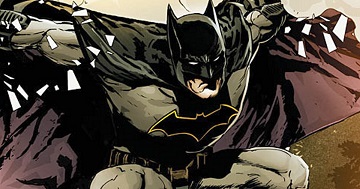
Detective Comics #937 didn’t tell us much more than we already knew. In this issue, we pretty much see Batman learn everything Batwoman did in the last issue, but we did get to see him fight back a little. I enjoyed that because while it’s clear this title is going back to highlighting the Bat Family, I hate seeing Bruce ride too much of the bench. This issue really just served to put the pieces in place and set up a dramatic confrontation between the Bat Family and the Colony, but the League of Shadows/League of Assassins bit is a pretty exciting hint at what may be around the corner. Tynion is pacing this arc fairly well, and Martinez and Fernandez (pencils/inks) are keeping it looking nice.

WonderWomanRebirth

Wonder Woman #3 was the highlight of the batch for me, and the book officially made my pull list this week, where I had just been picking it off the shelf since Rebirth. We had a nice character moment with Cheetah and Diana in this issue, and while Trevor and his team’s story didn’t move much, it also didn’t slow down the rest of the issue. Sharp’s work on this book is gorgeous, and I have to say, while the writing has been solid, the art is making Wonder Woman one of, if not the single best looking comic in DC’s lineup right now.

Star Trek: Beyond

StarTrekBeyond

Jim’s Thoughts

I’ll start off with a minor point about this movie. A lot has been made of the film’s decision to make Sulu gay. For what it’s worth, it’s a very minor point in the story. It’s a glancing reference, really, and it’s pretty clearly designed to be a nod to George Takei, who played the character originally. When you consider what Gene Roddenberry was up against when he started Star Trek; the world divided by cold war tensions, the fact that he was kicked off the air in the south for having Kirk kiss Uhura, it seems like an attempt to one-up the man by making one of his original characters gay. George Takei has stated Gene Roddenberry would have liked to do a gay character, but didn’t want to take on too many barriers at once. For the movie to come along now, not facing anything close to the level of institutionalized bigotry that he did, it feels like an insult to all the messages the show did take risks to put out there. As Takei put it, I would have liked to see a gay character, but an original one that didn’t feel like taking a red pen to Roddenberry’s work.

The reason I bring all that up is because Star Trek: Beyond does so much to reference its source material. There’s so much fan service that it makes its failures all the more surprising. Star Trek, as a series, is what’s known as “Hard Sci-Fi.” That means it’s Science Fiction, but it has a stronger emphasis on science than franchises like Star Wars, which fall more under Science Fantasy. Its technology is fake, yes, but it’s meant to have enough of a basis in scientific theory that it’s easy to imagine there being a time when it could be real. Star Trek: Beyond gets lazy in that, settles for throwing a bunch of scientific-sounding word-salad at us, and that’s a thing that’s destined to drive its core audience absolutely insane. Star Trek is a franchise that inspired the generation of engineers and physicists who are currently steering vehicles on Mars and taking photos of Jupiter. For them, it isn’t enough to see and hear things that look and sound cool.

The movie spends a lot of time aiming for gravitas. In the opening, it’s a lot of monologues and heart-to-heart conversations that are meant to spoon-feed us the philosophy of the film, and not only is it awkward, it’s wasted time that should have been spent developing its villain. For what it’s worth, I’m still not entirely sure what the villain’s motive was. I’ve settled on “crazy dude went crazy.” It’s not necessarily unbelievable, but it’s a backstory we’re tossed in the movie’s final act, and just expected to swallow.

There’s plenty to criticize about Star Trek: Beyond. It’s easily the weakest of the new films, but for all its flaws, it didn’t bore me. Even when it was preposterous, it threw in an occasional (intentional) laugh, and tried not to take itself too seriously the whole way through. Whenever the next installment rolls out, I’ll still see it. This movie wasn’t nearly bad enough to make me quit on this generation of films, but I question how essential this one will have been to my understanding of the larger story.

Kyle’s Take

Jim avoided spoilers in his thoughts, but I won’t, so consider yourself warned: spoiler alert.

In many respects I’m still the small, mixed kid who grew up in the Deep South, so I can’t help watching films through that lens. I also can’t tell you how much I wanted Idris Elba to be an alien instead of a human. I was actually chanting under my breath, please let him be an alien, while watching the movie. Star Trek: Beyond preaches “unity” throughout, it shoves the message down our throats, and anyone who has experienced racial discrimination in the United States can’t help but draw a line from this message of “unity” to the Black Lives Matter movement and the controversy associated with it—specifically, but by no means limited to, the Deep South.

Star Trek: Beyond moves our human race into the future. It shows humans of all shapes, sizes, creeds, color of skin, gender identity, and sexual orientation living together in harmony. These same humans even build friendships and more with alien lifeforms. Star Trek: Beyond’s reality is Martin Luther King Jr’s dream. The one being in the universe opposed to this “unity” is the token black man from a Federation starship. What the actual hell?

I love Idris Elba as an actor. I think he deserved an Academy Award nomination for his work on Beasts of No Nation—you should watch it on Netflix if you haven’t seen it yet. But I can’t tell you how disappointed I was when I found out Elba’s character went crazy because of how his nation (or Federation) treated him, and how he lashed out violently, prepared to kill all life in the universe, peace be damned. That is the antithesis of Black Lives Matter. Sure, you could write it off and say “crazy dude went crazy”—and I think that’s what the writers want us to do—but you can’t preach “unity” all movie long and have this be your plot device, Star Trek: Beyond. It’s tone deaf.

I can let the Sulu thing slide. Were Gene Roddenberry alive today, I believe he’d be fine with that minor story line (this is an alternate timeline Sulu, the climate of the United States toward homosexuals has changed since the 60s, and Roddenberry loved and accepted George Takei), but Roddenberry and Leonard Nimoy, another activist, would roll over in their graves from the main plot device of a black man’s plan to destroy a utopian future.

See. That’s what can happen when you don’t develop your villains, Star Trek: Beyond. I’m sure this wasn’t the movie’s intent, but they cheated by presenting Elba’s character as an alien, switching him to a human at the tail end, and not giving us a plausible reason for why he’s doing what he’s doing. For being a 50th anniversary celebration, Star Trek: Beyond betrayed its fan-base in a similar fashion as George Lucas did with his Star Wars prequels. And the main villain cheat isn’t the only transgression.

I assume director Justin Lin added a Kirk on a motorcycle scene as a nod to his tenure on the Fast and the Furious franchise. It looked cool, but in a Venn diagram of Star Trek and Fast and the Furious fans, you’ll see little to no overlap.

The Beastie Boys “Sabotage” as a secret weapon against the baddies was pilfered from Mars Attacks, but Mars Attacks was supposed to be a comedy and it made more sense. Sound doesn’t travel in the vacuum of space. You could say that Spock hotwired into the alien’s sound system. But how does he do that in 30 seconds and no prior knowledge of this technology? How are these aliens (or humans turned aliens) exploding when Jaylah cranks up the volume to her interstellar iPod?

Speaking of Jaylah, the actress who portrays her (Sofia Boutella) was fun and gave a great performance, but she’s Algerian and she’s in whiteface the entire movie. I’m not sure what kind of message that’s supposed to make—most likely no message at all—but it’s a bad look when you pair it with the angry black man plot.

Then you have the actors forgetting how to lean, jerk their bodies, or fall down to portray the ship getting pelted by missiles and lasers. Instead, Director Lin had the actors grimace and the camera man shake his camera to produce a vomit-inducing effect. I couldn’t follow the action and reached for my popcorn bag for something to puke into during half the movie. If I wanted a shaky camera, I’d watch home videos.

After all this, I’m still a fan of the Star Trek franchise. Star Trek: Beyond may be forgettable, but there were some good one-liners—these one-liners were marred by the writers elbowing us in the ribs and saying, “See what I did there,” but they were good one-liners. I’m still going to watch the next film in the series, but they have a lot of issues to address.

Geekly Games: July 25, 2016

The holiday earlier this month threw me off schedule, and I’m not sure which day of the week I should post Geekly Games. We could be looking at a semi-weekly post until we balance video games, tabletop games, and comics posts. Don’t worry. I didn’t forget about you guys. So, here we go with another Geekly Games.

Memoir44

Memoir ‘44

I finally played one of the games on my bucket list: Memoir ’44. I stopped by Omaha’s Game Shoppe and played the introductory scenario, Pegasus Bridge, with my brother-in-law Tim. It wasn’t an auspicious start. My biggest problem was reading the rules aloud verbatim—something I hate doing—and the more I read the rules, the more I wondered what I had gotten myself into. The rules aren’t that involved, nor were they long. It’s been some time since I’ve had to read rules on the fly and relay them to others. I was out of practice. Don’t ever read rules aloud verbatim; you can see the life drain from the eyes of those who are listening. If you must, read the rules to yourself and paraphrase them. As soon as I switched to paraphrasing, the rules reading went smoothly.

Memoir ’44 was everything I wanted it to be. It’s earned its place as an accessible war simulation game. Memoir ’44 was released on the 60th anniversary of the Allies’ invasion of Normandy during World War II. Players command Allied or Axis forces and take turns reenacting key skirmishes of famous battles.

I could talk at length about how Memoir ’44 differs from the war games my father and cousin Wally coaxed me into playing when I was young—okay, I didn’t have to be coaxed. I won’t get into too many details on how Memoir differs from these war games. Let’s just say that Memoir ’44 has lightning fast turns.

For the most part, each scenario remains faithful to the moments they recreate. German forces may have advantageous positioning but the Allies are the historical winners, have numbers, and initiative (usually), since they’re the aggressors. As a result, most of the scenarios are slanted toward the Allies, but the inclusion of cards and dice in combat and maneuvering gives both players a chance.

MemoirCardsCloseup

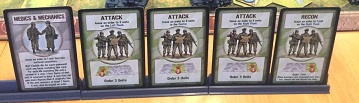
During a turn players choose a card to play from their hand, and the card they choose dictates which units they can activate. This mimics what happens on the battlefield. You plan as best you can but elements outside your control can prevent you from doing something. For instance, you mobilize your troops on your right flank, getting them in position for an attack, but you don’t draw into any more right flank cards to execute the attack. This can be frustrating. Thankfully, you don’t have to wait long for the right cards, secondary options allow for creativity and they aren’t that bad of an option, and games are quick. We’re talking 30-45 minutes.

After your card resolves (you complete the action printed on the card), you draw a new card and pass the turn to your opponent. Play continues like this until someone accrues enough victory points for the scenario. You gain victory points for collecting a victory token (not every scenario has these tokens but when tokens are used, they represent strategic locations on the battlefield) or when you kill an enemy unit. And that leads us to Memoir ‘44’s combat.

Memoir uses specialty six-sided dice. I won’t get into “line of sight” and the variable number of dice you roll when attacking. These two concepts are the most dense, confusing, and easy to misinterpret. That said, they still aren’t that complicated. I’d just rather not discuss them here. Let’s get back to the dice.

Memoir44DiceCloseUp

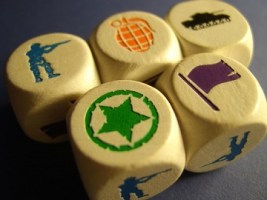
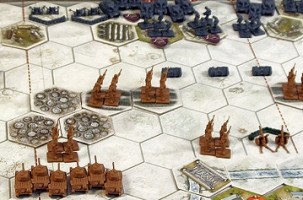
Yeah. Those are the ones. I love Memoir ‘44’s dice. You want to roll the unit you’re targeting. If you’re attacking infantry, you want to roll infantry. Are you targeting a tank unit? You’ll want tanks. Grenades hit everything. Stars miss everything. Flags miss and you’re forced to retreat. Each unit has a number of plastic figurines to represent the unit’s health (4 for infantry, 3 for tanks, and 2 for artillery). Once all the figurines are gone, the unit’s removed from play and one of its pieces is placed on the victory point track. Someone wins when they have enough victory points for the scenario. It’s a simple concept but Memoir ‘44’s surprising deep.

Memoir44EasternFrontFigures

Those older war games could be fun but they took forever to play (turns could last thirty minutes—the entire time it takes to play a full game of Memoir) and you had rules the size of a phone book (reference page 539, paragraph 21, sentence 5 for the effects wind has on mortar shots on the bottom right 1/3 quadrant of the Normandy map). I know I’ll get flak from “real war gamers”—there is a sizeable group of them who don’t consider Memoir ’44 a war game because it isn’t complicated enough—but Memoir boils down everything that makes those war games fun and presents it in a manner that’s digestible for a larger audience. There are other war games out there and many of them are great, but Memoir’s an excellent place to start.

It’s a lot fun. If you have any interest in a World War II game, I highly recommend it. I’ve already bought a couple of expansions—don’t tell Jen.

BehindTheGame

Behind the Game

Tabletop games—and American made tabletop games in particular—have received a bad reputation for taking hours to play, but that isn’t the case for most modern tabletop games. True. You can still find modern board games that take hours to complete—Twilight Imperium, and Descent come to mind—but most games speed up gameplay so you can play multiple, unique games or several rounds of a game you like in a single night. Many gamers who enjoy some of these longer games, like the old school war gamers who would claim that Memoir ’44 isn’t a real war game, might claim that the game’s length adds to the game’s depth. While no one would question the depth or immersion of longer games like Twilight Imperium and Descent, a shorter game like Memoir can provide an immersive experience.

Historical reference helps Memoir, but games like Arcadia Quest—I still need to write a review on Arcadia Quest—do a great job of building a background story and dividing missions into easily digestible, hour-long or less sessions. Story helps…a lot. Having a character or two who you can root for helps too, but tabletop games are a balancing act between story or theme and game mechanisms. Game mechanisms that fit with what you’re doing in the game not only help to make learning the rules easier, they make for better player engagement.

The right combination of story/theme and game mechanisms can also lead to greater depth of play. Even simple concept party games like Codenames (2016’s winner of the Spiel des Jahres and first party game to ever win the coveted German game of the year) provide wrinkles to their game play that players can exploit—or fail to do exploit in epic fashion.

So do you lose game immersion or play depth with a shorter tabletop game? As with most things, the answer’s complicated. Some games demand to be long. I couldn’t see Twilight Imperium taking 45 minutes to play, the game would lose a lot of what makes it work, but board games are getting shorter play times in order to compete with other mediums. That presents a challenge to designers to keep game play to a speedy 30-45 minutes, while maintaining the game’s depth and player’s investment. We’re in the middle of a board game renaissance of sorts and these shorter play times could be part of the reason why.

Well, I’m off to the game table. I’ll fit as many games as I can in a couple of hours each night, so until we meet again, thanks for reading.

Geekly Comics Update for Week of July 23, 2016

It’s obviously a busy time in the world of comics with San Diego Comic Con in full swing. I’ve fallen a bit behind in reading my books, and I’d love to blame it on that, but I’m not lucky enough to be there this weekend, and it’s really just been life getting in my way. With that said, I have worked my way through most of my pull file over the last two weeks, and I thought I’d share some thoughts on what I’ve found.

Superman-Rebirth

For the first time in years, I can say DC’s trinity (Superman, Batman, and Wonder Woman) are being well-represented in at least one title. It’s too early following Rebirth to crown any one book yet, but Wonder Woman under the new creative team has been excellent. I may go as far as to say it’s my top book at the moment. With each member of the trinity showing strongly, I had high hopes for Justice League #1, but they didn’t exactly pan out. It’s not a bad book in any one sense. It’s just a bland one. On individual stages, the big three are doing much better. Action Comics #959 gave us an action-heavy chapter for Superman. Though there may have been a nostalgia appeal for people who are thrilled to have the pre-New 52 Superman back, this is still a massive fight with Doomsday, and that’s a pretty tired area to explore. The art is solid here, and Lex’s involvement does add a fresh element to things, so it isn’t a total rehash, but people like me, who may be a little tired of Doomsday, may have had a little trouble getting past the fatigue. Superman #3 did a little better job of catching my interest. Eradicator isn’t nearly as played out, especially lately, as far as enemies go, and while it was much lighter on the action, it did well to make me interested in Clark’s family.

BatmanRebirth

On the Batman end of things, Detective Comics #936 continues to be more focused on the Bat-family. Specifically, I think they’re trying to catch up to and fill the void left by Batwoman. She’s the focus here, and while it’s reasonably well done, I can’t help but feel her father’s involvement is shoe-horned in to keep her as the focal point. Again, she’s interesting enough, and it works, but I see where the plot is being bent around her, and the writing is showing some rough spots because of it. Batman #3 gave us a little context for Gotham and Gotham Girl as characters. Having them be people Bruce saved some time ago makes their story feel too familiar, especially as Duke comes into the picture, but I’m excited to see what will be done with Hugo Strange. Finch’s artwork is really solid on this title, and while it’s very different from Greg Capullo’s, it works as one of DC’s better-looking titles.

Daredevil9

For Marvel, Amazing Spider-man and Daredevil are pretty much the only two titles that aren’t consistently letting me down. It should help then that Daredevil #9 features Spidey riding shotgun alongside Matt. The result wasn’t as good as I hoped for, as I think some of Spidey’s banter with Daredevil got far too campy. It’s a well-drawn book, and it kept my interest, but it had the feel of a one-off, where some larger plot progression would have been nicer. There’s some pretty heavy suggestion of a change of heart coming for Matt, as he comes (mostly) clean with Spidey about how he altered people’s memories to restore is secret identity, but it was a long way to go to make that point.

Velvet

On the side of things that’s neither DC nor Marvel, Velvet #15 wrapped up a pretty big bit of story. This book hit a massive pothole in the road with its foray into Watergate, and its portrayal of historical people, and I wish it came back from that stronger than it did, but I’m afraid it only managed an “okay” bit of closure to the arc. Velvet faking her death and taking revenge dipped pretty deep into espionage cliche, and I can’t help but feel it was too convoluted a story to end so simply. Epting’s art continues to be a massive strength for this book, and while I’ve always loved Brubaker, he’s missing the mark here, at least a little.

O Comic Con 2016

O Comic Con

O Comic Con 2016 is in the books. For those of you who don’t know/aren’t in the Omaha metro area, this is only the second year for the event. It started strong last year, and it came back bigger and better this year. As before, I went all three days, and I found plenty there to warrant the trip each time.

For those unfamiliar with the area, O Comic Con isn’t actually in Omaha. It’s actually not even in Nebraska. The convention has been held both years just across the river from Omaha at The Mid America Center in Council Bluffs, Iowa, and I absolutely love that venue for the event. There’s free parking, the building is a great fit, and the staff members are friendly.

The guest list was exciting, and pretty impressive for such a young convention. Wrestling fans who may have been excited to meet Mick Foley last year had a chance to meet Jack “The Snake” Roberts this year. Futurama fans who geeked out over meeting Billy West and Maurice LaMarche last year, had Lauren Tom to look forward to this time out. Also, TV stars like J. August Richards, Michael Coleman, Veronica Taylor, Trace Beaulieu, and Frank Conniff were there for photo ops, autograph signings, and some Q&A panels. In the future, I’d love to see more guests specifically from the world of comics, though that’s not to say we were without them. Phil Hester was a great guest, and those familiar with Sun Bros. Studios of the Kickstarter comics fame (Chinatown, Monkey Fist, Apocalypse Man) will be happy to hear the Sun brothers themselves came out. They had some great informative panel discussions, and were altogether friendly guys.

I was happy to see quite a bit of a growth on the expo floor this year. Not only were there a lot of great local (and not so local) artists whose work was well worth checking out, but there were a lot more comics for sale this year. I think specifically Legend Comics & Coffee (my favorite place in Omaha) and Krypton Comics brought a wider array of merchandise, and I was happy to see that. Between collectibles, vintage books, and trades, I’m a little surprised I got out of there with any money left.

When it comes to events like comics conventions, the crowd always has an impact on the feel of the event, and the fans who came out to share their various corners of geekdom were great. The people were friendly and enthusiastic, their costumes were creative and impressive in ways that made simply going to people-watch worth the price of admission. I already can’t wait until next year.

Geekly Comics for the Week of 7/6/201

Amazing_Spider-Man

I hope nobody thinks I forgot about them last week. I didn’t have a lot of books in my pull list last week, so I decided to wait and cover two weeks with one update. Brace yourselves, because things get a little rocky.

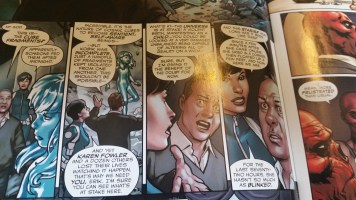
There are two Captain America books to talk about this week, but I’d gladly settle for just one decent one. Nick Spencer is writing both, and I’m sorry to say he’s doing an exceptionally poor job of it. Steve Rogers: Captain America #2 came out last week, so I’ll start there. We get a bit of an explanation behind Hydra-Cap AKA the revelation that Steve Rogers has been a Hydra agent all along. I blasted Spencer and Marvel for this when it dropped, and I take absolutely none of it back. Issue #2 is devoted to explaining away the twist, and its exactly what you’d expect, some Cosmic Cube nonsense, but even its execution, this is an objectively bad book. Spencer buries the issue in speech bubble after speech bubble dripping with exposition and clunky dialogue. In fact, let me illustrate my point by sharing a couple panels with you.

Here is Dr. Selvig explaining every single thing about every single thing.

20160707_122105

And on the next page we have Red Skull

20160707_122002

It’s fitting these panels appear as they do in the book, but Skull’s proclamation of boredom is completely separate, I assure you. It’s not some breaking of the fourth-wall, but he’s complaining about the meal his kitchen staff made. The arm in the panel belongs to a chef whom he murdered because he made a soup with a celery base. That’s not a joke. That’s actually what happened. Therein lies the other problem with Spencer’s writing. It lacks any nuance whatsoever.

Sam Wilson: Captain America #11 suffers from the same lack of approach. It’s another Civil War II tie-in, which I detest, but unlike last issue it doesn’t grind Sam’s story to as much of a halt. We do get some relation to the conflict with Americops, but it’s more of the same from Spencer. He’s overreaching for relevance, and it’s beginning to read like some angst-laden teenager’s anti-government blog. It’s not even that he’s wrong about any particular thing, it’s just that he’s not saying anything new, or in any interesting fashion. Nothing about this book says “Marvel Comics” to me. It’s more like a rejected Buzzfeed article.

Amazing Spider-man #15 was the lone exception for Marvel in my eyes. This has been a consistently solid title, and though I never invested all that much in Regent as a character, it managed to keep my attention. As long as it took this arc to build, Mary Jane coming to save the day in a handful of panels makes the story feel a little rushed. If there’s one thing I can really gig this arc on, it’s the pacing, but I think I value titles like ASM and Daredevil so much because they’re some of the only Marvel books I still recognize these days. The ending to this arc may have come a bit too easily, but I look forward to the next one, and that’s all any of us can expect when we follow a series.

On the DC side of things, it wasn’t all roses, just in case I’m sounding more and more biased. Justice League Rebirth #1 probably fell flattest for me on that side of the big two. It wasn’t a bad book, but it didn’t really offer much. We got a look at Clark and his family, which we’ve gotten from other books, a parallel story about the JL going on without a Superman, and a decision for the new (old?) Superman to throw in with them. Again, nothing wrong with any of that necessarily, but it’s just sort of a long-winded introduction. Aside from the writing, Henriques’ art was a bit inconsistent. I’ll go so far as to say some of his panels with the league fighting to save the infected were downright ugly. I’m not put off from picking up the series, but I’m not pumped for it, either.

Speaking of wonky art, that was my big gripe with Superman #2. Gleason’s art is never ugly, but it’s sometimes uneven. I was particularly thrown by some of his work with faces. In a couple panels, he gives Clark an almost Joker-like smile, and the characters lose their facial features more than once, even in what are meant to be static panels. The story itself was a little more of the same. We get a little character development, particularly with young Jonathan, and while it isn’t bad, I’m not that invested in the “Smith” family (Kent family in hiding). What saves the book is the ending. Here is where the Fortress of Solitude is broken into, and we get our first look at what the big threat is in this book. It sounds interesting enough, and I’m hopeful it will bring Superman back to being the focus of his own book. If nothing else, there was a definite sense of momentum building with this issue.

Lastly, Batman #2 delivered a solid issue. We got a little team-up with Gotham and Gotham Girl working alongside Bruce. The creative team still isn’t tipping their hand with the new heroes yet, but they’ve given us enough to keep the interest up. King’s writing here shows some of the subtlety that Nick Spencer’s (on the Marvel side of things) hopelessly lacks. We know Batman doesn’t trust the newcomers, but he doesn’t need to go on for page after page about it. He lets Alfred tell an anecdote about Bruce that highlights his suspicious nature, and he trusts us to know the character ourselves. That way, he can state the issue, move on, and let the story build instead of bogging us down with trying to sell us on something we already know, like that Red Skull is not a nice guy.

I’ll be at O Comic Con this weekend. If you’re in the area, come on out and support a growing young con. If you see me, say hello and we talk about comics, TV shows, movies, or why Yogi Bear wears a hat and tie, but no pants.

Geekly Games: June 26, 2016

SuburbiaBoardGameAndCastlesOfMadKingLudwig

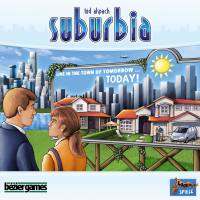
I wanted to do something a little different with this week’s Geekly Games. There are two games, by the same designer, that I’ve played in the past year that play similarly. In fact, they’re sibling games where the second of the two games took the measured play of the first game and made it more unsystematic. I’m taking a look at Suburbia and The Castles of Mad King Ludwig with this week’s side by side tabletop games.

SuburbiaBoardGame

Suburbia

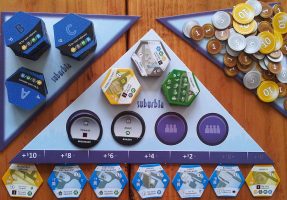
Let’s start with the elder sibling game Suburbia. As the name suggests players compete with each other to build the most prosperous suburb of the same larger city. You earn victory points for tile placement (this game uses hexagonal tiles of the same size, and it’ll make more sense why I mentioned the same shape and size tile when I talk about Mad King Ludwig), and you can earn bonuses for putting similar city blocks close to each other, score negative points for placing factories next to residential areas or similar unharmonious pairings, and some tiles even give you a multiplier for the total number of a certain city block type you have in your suburb. Whoever has the most point at the end of the game wins.

Scoring is further complicated in Suburbia with the addition of end-game bonuses that are selected at the beginning of the game—so each player can work toward trying to get these bonuses throughout the game—and individual, hidden player bonuses, like you get a ten point bonus for having the most commercial blocks. Each player keeps tabs of their suburb’s progress on a point track, and the way the point track is designed makes it close to impossible for a run-away winner.

I really like the point track in Suburbia. There are thresholds (depicted by lines) on the point track where if you pass them, you have to pay a fine from your income that turn and if you can’t pay the fine, you travel backward on the point track. Throw in some money bonuses for people in last and you get a system that makes it difficult for someone to win the game wire-to-wire, though I have seen a game of Suburbia go that route. I enjoy playing Suburbia and will gladly play it if it hits the table, but I’ve been on the wrong end of a run-away loser game on more than one occasion, and most of that comes from a different game mechanism: turning any city block tile into water.

SuburbiaBoardGameCloseUp

Each tile is double sided with the common side being a block of water (like a lake, pond, or river). There’s a cost track for the tiles you can purchase. Newer tiles get placed at the end of the track and that’s where tiles cost more, and players can purchase one tile a turn. I like this system. You could wait and see if a tile you want gets cheaper in a future turn or pay the large price tag for a tile you really want. What I don’t care for is that a player can purchase any tile on the track as water by grabbing it for free. I don’t know how many times I’ve had the funds to purchase an awesome tile, only to have the player in front of my scrap it for water. This plays too much like a “screw you” move.

There are bonuses that reward you for the most water tiles, and other tiles that feed off of water, and I don’t like playing with either of these tiles, especially if we have new players. I see how converting a tile to water could be tactically sound—it’s an easy way to separate industrial and residential blocks—but there has to be a way to limit which tiles you can turn into water. I’ve seen one player corner the market in a particular tile type, and the player with the water bonus took a tile he needed on the first turn the tile was on the board by scrapping it for free. That’s shameful.

Still, with some rule modifications, Suburbia is a great game, and one of the best city-building games on the market.

CastlesOfMadKingLudwig

The Castles of Mad King Ludwig

The younger sibling game, The Castles of Mad King Ludwig, tasks players with building the best castle instead of suburb. The Castles of Mad King Ludwig works similarly to Suburbia, except that it changes a few things that make it a wildly different gaming experience.

The scoring track is still there, but gone are the thresholds—you won’t need them. The player with the most points at the end of the game wins, so that hasn’t change, and you gain bonuses or penalties for tile placement—another similarity—but these tiles come in different shapes and sizes. Instead of putting a hex next to another hex, The Castles of Mad King Ludwig has you connecting one room with another with doorways. It doesn’t matter how you connect the rooms, so long as you have space for a new room and it connects with another one of your rooms with a doorway—which can be tougher than it sounds. You end up with some very interesting castles.

CastleOfMadKingLudwigCloseUp

The tile cost track is still used in The Castles of Mad King Ludwig, but instead of each new tile heading to the end of the track, there’s a player each turn (the master builder, which changes after each turn) who determines how expensive each tile should be, and this is an elegant addition to the game play. Half of The Castles of Mad King Ludwig’s strategy rests with where the master builder places each tile on the cost track. Players’ main source of income is getting paid as the master builder—players who aren’t the master builder have to pay the master builder for their tiles—and if a tile doesn’t get sold, a coin gets added on top of it, so it’s offered at a discount the next turn. There’s an art to placing a room tile with coins on it at the right spot to maximize the money you’ll earn, and getting a mountain of coins in one turn is satisfying.

As you can probably tell I like The Castles of Mad King Ludwig more than Suburbia—although I still like Suburbia a lot, despite losing most of the time. Being able to affect the tile cost track gives players a sense of control. Anyone can scrap a tile for water for free in Suburbia at any time, but if someone purchases a room you wanted as the master builder in The Castles of Mad King Ludwig, you’re the one who placed the room on the tile cost track. I like that addition to The Castle of Mad King Ludwig’s rules, and the game’s theme. But you can’t go wrong with either game.

I’m off to the game table, so until next we meet, thanks for reading.

Geekly Comics for the Week of 6/22/2016

SamWilsonCaptainAmerica

This was a pretty light week for me, and I’m sorry to say it’s another one that’s not very balanced. I just had one Marvel book this week, Sam Wilson: Captain America #10, and the results for it aren’t great. I’m a fan of Sam Wilson as a character, as Falcon, but his run as Captain America has fallen flat. That’s been my general feeling for the series, but the problem with this issue is two-fold. First, it’s a Civil War II tie-in issue. If you’re anything like me, you hit a serious case of “event” fatigue way back when DC was doing Forever Evil, and it’s only gotten worse on both sides, DC & Marvel. Because of that, I have paid next to no attention to this iteration of Civil War, and having my solo books derailed to tie into that plot frustrates me as a reader. This issue didn’t offer anything new. Actually, the bulk of it just depicted a eulogy for Rhodie/War Machine given by Sam. There’s not a lot of opportunity in that, but Nick Spencer’s writing didn’t help. Issue #10 used the beginning and end to reinforce (yet again) that Sam Wilson is Marvel’s version of Green Arrow. That’s to say his character is being used to champion social issues (though Green Arrow has moved away from that to some extent). It’s here, maybe more than anywhere else that Spencer’s complete lack of subtlety comes through. He’s heavy handed in plot as well as dialogue, and while he’s not saying anything a sensible person would object to, he’s saying it in such an overt, clumsy, cliched manner that it’s becoming increasingly cringeworthy.

I’m sure it’s begun to sound like I’m playing favorites, but DC gave me two solid reads this week (maybe three, haven’t had a chance to read Justice League yet). Detective Comics #935 brought us back to the bat-family’s new HQ, and delved a little bit into Red Robin’s relationship with Batman. Batwoman had a fairly nice character moment with her father in this issue, and while I wish there had been a little more motion in the plot, there was some decent value here. It’s still too early to say for sure, but it seems DC is planning to use Detective Comics as a more bat-family-centric title, and while I’m hit-and-miss on how much I care about each individual member, I think there’s a lot of appeal in going back to some of what The New 52 gave up. Tynion IV’s dialogue is a bit stilted in parts, and that continues to be a weak-spot in his work, but I really enjoyed Eddy Barrows’ artwork.

Wonder Woman #1 gave me some hope for the character getting back to the sort of solid storytelling we saw back on Brian Azzarello’s run. Greg Rucka’s writing is pretty solid in general, and he does well to not waste any ink in getting this arc going. The focus is split between Diana’s personal quest, and Steve Trevor’s mission, and that slows things down a little, but it never quite drags. We get a nice moment with Trevor in the jungle and Diana’s picture here, but it’s a little on-the-nose, and it highlights a fear that there will be too much focus on love-interests, but it’s only the first issue of the arc, and we’re not there yet. I particularly enjoyed Liam Sharp’s art in this book, and Laura Martin’s colors. There’s a distinctive aesthetic here, and I think it’s working. I’m not sure how Trevor’s fight against the warlord and Diana’s pursuit will intersect, but until they do, each is at least interesting enough to keep me turning pages.

Geekly Games: June 18, 2016

I didn’t play too many new tabletop games this past week because my daughter Season left for Mexico to assist with sea turtle conservation. She’s settled and made new friends. Here’s a picture of one of her new friends.

GeckoInMexico

Okay, that’s a gecko that sneaked into her room. Anyway, we broke out a lot of older, classic games before we said farewell. We played more than one session of Liverpool Rummy and Wa-Hoo. Season likes Boss Monster and we played that a few times too. I’ve reviewed a lot of these games already so I won’t do that here, but I’ll dig deeper into why I don’t mind playing Wa-Hoo, while I can’t stand Sorry! in the “Behind the Game” segment; the two games are almost the same, except for one important game mechanism.

Instead, let’s tackle a large game I’ve been meaning to discuss for a while. The game has so much going on that I was too intimidated to cover it in a full review.

MageKnight

Mage Knight

I’m not going to go into too much detail with specific gameplay with Mage Knight—there’s too much to cover—but I’ll list the various game mechanisms with hyperlinks to definitions of those mechanisms.

Card Drafting
Cooperative Play
Deck/Pool Building
Dice Rolling
Grid Movement
Hand Management
Modular Board
Role Playing
Tile Placement
Variable Player Powers

Yep. That’s a lot going on for one game, and the above list only scratches the surface. If you’re new to tabletop gaming, don’t start with Mage Knight. Begin with other games that use the various game mechanisms listed above as sort of a scaffold learning approach before tackling this beast.

MageKnightCloseUp

Mage Knight, the board game, delves deeper into the world Mage Knight, the collectible miniatures game, created. Players can team up together to bring peace to the land or they can battle each other for dominance. I prefer competitive play, but the cooperative modes are great and that’s how my gaming group likes to play—that is if I can get Mage Knight to the table. Most of the time, I play Mage Knight by myself, and fortunately, solo play is solid.

The game’s complexity and length keep Mage Knight from hitting the table as much as I would like. It takes two to four hours to play a game. Now I know I may receive some backlash from saying this, but the game isn’t as much complex (the individual parts merging to form something new, intricate, and exciting) as there are a lot of things going on and rules to keep straight. The reason why I played Mage Knight a couple of weeks ago was that I found my memory of the game’s rules had turned fuzzy.

MageKnightOverview

I still like Mage Knight a lot. It deserves the praise and high marks it gets on sites like boardgamegeek (8.1 and rated in the top ten games overall as of this write-up), but I don’t see people playing this game. I’m sure folks will correct me and say that they play Mage Knight all the time, but I’ve been to numerous local gaming conventions—Omaha and its greater surrounding area has a wealth of game cons—and I never see this game on a table. There are other games of similar length and complexity at these events, but I’ve never seen Mage Knight on a schedule or playing surface. Does everyone who likes this game play the solo version like me? I’m not sure. If you’re ever in the Omaha area, I’d be happy to bring my copy of Mage Knight to one of the many game shops in the area and play a game.

I will add that I’m a Vlaada Chvatil fanboy, so I may be biased, but Mage Knight has enough going on that you’ll find some aspect or aspects that you’ll love. My favorites are choosing which cards you’ll discard to gain movement or combat bonuses and which ones you’ll use for their effect, and how you share the dice pool with the other players. But you’re also likely to find an aspect or two that you aren’t too crazy about. My main sticky point is the game’s combat system: too clunky and mathematical at times. There’s a reason Mage Knight gets a lot of praise, it’s earned it. If you’re interested in an epic fantasy board game, you should check it out.

BehindTheGame

Behind the Game

The tabletop game for this week uses a mountain of mechanisms. A gaming experience can be affected if even one mechanism is out of whack and that may be what happened when Sorry! traded dice rolling for a deck of cards.

I’m not alone in the tabletop gaming community for my disdain of Sorry!. I’ve already went on a tirade about Sorry! in the past and cited that it lost the tactile goodness of dice rolling, but it goes deeper than that. By trading dice for a deck of cards, Sorry! shifted game play from deploying the competence of dice rolling to the deterministic approach of cards. Most people prefer competence.

Let’s play a game. Well, let’s play two games. In both games, you pick even or odd numbers and win $5 if a traditional die shows the number type you chose and win nothing if the die doesn’t show the number type you picked. The difference between these two games comes with who gets to roll the die.

In the first game you get to roll the die. In the second game I rolled a die in a cup before you showed up and reveal the die’s result after you make your choice. Now, there’s no way for me to cheat you in the second game, even if I doctored the roll, because I don’t know if you’ll pick even or odd, but most people would prefer the first game. In fact, during a questionnaire given out by University of Alabama sociologist students, folks were given this choice and two thirds of them picked the first game. Mathematically there’s no difference between the two games because players named their number type. Your expectation of winning is the same, but this comes back to the concept of competence.

In 1991, Tversky and Heath proposed the framework of competence. The short of it, as it pertains to gaming, is that people prefer games where they have a higher level of competence. Now, this type of competence doesn’t use the standard definition. Competence in this sense means what you can know about a situation versus what can ever be known about a situation. And this is where we get back to Sorry! versus Parcheesi, Ludo, and Wa-Hoo.

SorryBoardGame

#SorryNotSorry

Someone could know which order Sorry’s cards are in. I’m not saying someone’s cheating and they know the order, but the potential is there for someone to know the order of the cards. No one can ever know which number will be rolled on a die until after the die rests, which yields a higher level of competence.

The deck of cards in the game of Sorry! functions like a die that has already been rolled and the result is hidden from the player, while Parcheesi, Ludo, and Wa-Hoo empower players with rolling their own dice. If you aren’t getting the roll you want, give the die some backspin or different English. Will it work? Probably not, but gamers like to have their fate in their own hands—or they like to think that their fate is in their own hands.

I’ll have to get to the game table more often this next week, but until next we meet, thanks for reading.

Geekly Comics for the Week of 6/15/2016

BatmanRebirth

DC’s launched its first issues of Batman and Superman under the Rebirth heading this week, and the results were mixed. Batman #1 has some considerable shoes to fill. Regardless of how you feel about how Scott Snyder’s run on the book ended, he was on it for five years. King does well to not make his introduction to the title too jarring, and Finch gives us an aesthetic that’s not trying to ape Greg Capullo’s work, and stands well enough on its own merit. Where #1 disappoints is in the writing. This story basically shows us Batman doing a lot of pseudo math in order to divert a plane which is about to crash land. Again, the tension builds into an attempt to get us to believe Bruce’s life is in danger, and you all know how I feel about that. Watching DC threaten to kill off its cash cows is starting to feel like seeing that one person who keeps pushing the elevator button harder and harder because they assume that makes it work faster. Bruce’s conversation with Alfred, asking “Is this a good death?” feels hollow, and too sentimental for the character. In the end, it’s all a device to bring in the characters who save the day, Gotham and Gotham Girl, the city’s new saviors. It’s an underwhelming finale that left me feeling like it was all just a long-winded introduction to what was advertised on the cover art. Still, a little awkward dialogue aside, I’m hopeful that the new creative team can deliver a good run. I just look for much better pacing in the future.

Superman #1 spent a little more time grieving for The New 52’s Superman, and celebrating the return of the original version of the character. Brevity helped a bit, as the script gave us a nice monologue in the first few pages, an inspiring image, and kindly moved on with the story. My big problem with the story itself is how very light it was on Superman. This issue focused on little Johnathan, Clark and Lois’ son, and the family’s life in hiding as Clark goes back to filling the role of our world’s Superman. We see Superman Jr. wrestling with his powers, resenting the need to hide, and generally being obnoxious and emo. That’s not why I read Superman comics, and I got enough of that nonsense in Man of Steel. Maybe I’m being too hard on the book, but I’m absolutely fed up with DC trying to shoe-horn a “dark and gritty” take on the character, and using his family to do it doesn’t make it any less tired. I’m hoping the next chapter puts Clark into action, and loses the family docu-drama element.

Star Wars #20 brought us back to the journal of Obi Wan. It picked up where our last visit to Kenobi’s adventures left off, and it gave us the confrontation we were promised. We talk a lot about suspension of disbelief when we talk comics and comics-related-shows/movies, and it’s an essential part of being an audience for those things. The Star Wars books haven’t asked all that much from us, comparatively speaking, but I think they need to tread carefully when involving adolescent Luke, Uncle Owen, and Aunt Beru in the early adventures. Owen and Beru weren’t particularly developed characters in the films, but it was established that Luke led a pretty boring life on a moisture farm. He can only save the day from so many Wookie mercenary attacks before there’s another Star Wars franchise continuity discrepancy. With that gripe aside, it was a satisfying entry for the title, and one that leaves plenty of possibilities for the next leg of the story.

Amazing Spider-man #14 kept things going with Regent. If anything, the problem here was that the story moved too far, or maybe it’s better to say it tried to do too much. Regent took down Miss Marvel in a couple panels, Falcon-Cap with a single panel and not but an “ughf” from Sam Wilson, and reminded me Thor is a woman now by taking her out with a flick of the wrist. There were others mentioned, Hyperion, comes to mind, but that was off screen completely. There’s building up a villain, and there’s gutting a bunch of heroes, and this issue slipped all the way to the latter. With that said, I’m glad to see the story moved along. Stark and Parker/Spidey continued their bickering, and while I can’t say it did anything for me, it didn’t grind the issue to halt. This wasn’t a standout issue, but I wouldn’t call it much of a stumble. Regent is still a reasonably compelling antagonist, and there’s good reason to look forward to where the arc goes with him.