

Happy Friday, Geekly Gang! I haven’t shared a Writing Brain Dump in a month. Today looks like a good day for a Writing Brain Dump. I’m about halfway through my most recent edit for Rustbucket Riots (working title). And the biggest step I made was reformating the story’s arc.

The Three-Act Structure May Need Tweaking for a Novel
I found Julian Maylett’s YouTube channel a short while ago. Maylett has a great AuthorTube channel, and I like his six-pillar structure. But I adapted this structure so it works better for me. I’ll paraphrase something I said in the previous Writing Brain Dump. What works for someone else’s writing practice may not work for yours. Everyone is unique. So, it made sense that I adapt Julian Maylett’s method to better suit mine. Feel free to do the same.
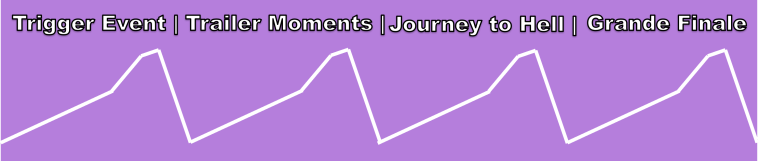
I boiled down Maylett’s method to a novel’s storyline resembling a heartbeat. The Three-Act Structure (pictured above) begins with an inciting incident, followed by rising action (complications), a crisis, a climax, and falling action (or denouement if you want to be fancy). Maylett claims that (except for a novel’s prelude, which is different from a prologue) each segment within a novel includes its own version of a Three-Act Structure. After mapping out the four segments following the prelude (Trigger Event, Trailer Moments, Journey to Hell, and the Grand Finale), the novel’s shape resembled a heartbeat.
We’re looking at four Three-Act Structures occurring consecutively.

See what I mean. Each segment contains an inciting incident, rising action, a climax, and falling action. But, paraphrasing Maylett, segments will morph what constitutes an inciting incident, rising action, etc., each time, depending on when in the story the segment occurs. One of the examples Maylett gave (for the Trigger Event) was The Hunger Games. We’re talking the first novel (or movie) here. And viewing this novel through Maylett’s lens can be eye-opening. If we view The Hunger Games in the classic three-act structure, one would most likely cite Katniss offering herself as tribute as the story’s inciting incident, but that isn’t the inciting incident when using what I’m going to call the heartbeat method.
The Reaping itself is the inciting incident for The Hunger Games’ Trigger Event (the first full segment). Prim being old enough to participate in the Reaping is a complication (rising action), as is Katniss placing her name into the Reaping multiple times to feed her family. Katniss has a brief moment of doubt when Prim’s name is drawn (the crisis), and she must choose to save her sister by offering herself as tribute or let Prim participate and most likely die. Katniss choosing to offer herself as tribute is the Trigger Event’s climax.
Then, we see the fallout of Katniss’s decision (the resolution or falling action), before the next segment (Trailer Moments) begins with another inciting incident and the process starts anew. I love Maylett’s approach. I took the bones of this approach and applied it to my manuscript.
I’ll press pause on the rest of the segments, so I can edit those and share my thoughts after editing each segment, but there is an odd segment before these four: The Prelude.

The Prelude is Not a Prologue
A prologue’s events occur separately from the rest of the novel, while the prelude sets the novel’s tone. If you’re talking about speculative fiction, the prelude introduces the reader to your novel’s world, while hopefully not inundating them in exposition. Unlike the other segments, the prelude has only three parts: an opening image, a flawed action, and the theme whispered.
Let’s go back to The Hunger Games as an example for the prelude. The novel (and movie) opens with Katniss illegally hunting game. We’re introduced to Katniss’s world through the simple act of survival. Katniss bags a kill. Her family can eat. This hunt is The Hunger Games’ opening image. It’s a concrete image. Then, The Hunger Games progresses to the Flawed Action. In the novel, Katniss shares that she spoke out against injustice, and it got her in trouble, so now, she protects herself and her family by keeping her opinions to herself. All this does is close off Katniss. It’s a flawed action Katniss needs to unlearn, but she isn’t yet ready to learn.
Finally, The Hunger Games reaches its Theme Whispered. Katniss’s friend (and love interest) Gale suggests the two of them should head to the forest, live off the grid, and effectively leave the country. Gale implies Katniss’s crime of hunting isn’t wrong. The government is wrong. By the end of three books, Katniss takes on the government head-on, but she isn’t ready to hear this yet. According to Maylett, the Theme Whispered should be spoken aloud by a character who doesn’t have too much relevance to the story (at least not yet), and the whispered theme should be memorable enough to stick in the back of the reader’s head.
The Hunger Games does this well. If you’ve read (or watched) The Hunger Games, you may not have noticed the Theme Whispered in the first chapter (or opening sequence), but now that I’ve mentioned it, you can’t help but see it. Lovely foreshadowing.
Echoing Heartbeats
And that’s why I like the heartbeat system. Since readers get repeating beats, they can’t help but notice patterns. Maylett’s system includes some specifics, the deeper into the story we journey, but I’ll save those for later.
I hope you’re having a wonderful Novel in November (formerly NaNoWriMo). Where are you with your progress this month? Are you editing or writing something new? Let me know in the comments. Thank you for reading, and wherever you are, I hope you’re having a great day.
 jkgeekly.com
One thought on “Writing Brain Dump: November 14, 2025”