
Geekly discussed commonly used board game mechanisms last month (here’s a link to that post if you missed it), so let’s switch things up and talk about some interesting, underused game mechanisms. We turned to Board Game Geek again to find some good board game mechanisms that don’t appear in enough board games. Thank you again, Board Game Geek.
Hey, hey! Kyra Kyle here. I scoured the hundreds—and I mean hundreds—of game mechanisms listed on Board Game Geek and ran searches to see how many games are listed on the site with each mechanism. Several game mechanisms have thousands of games that use them. That’s a lot. We aren’t looking at those today. We’re giving some love to those game mechanisms that are used in less than 300 games. I baseline like most of these mechanisms. It helps a game mechanism to make this list if I like it, but I included some mechanisms that I thought were in a lot more games. Which board game mechanisms made this list? Let’s find out.
Crayon Rail System
Number of games
171
Description
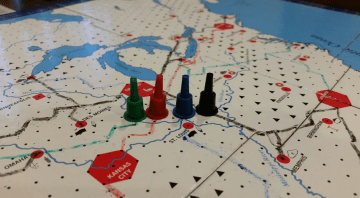
The Crayon Rail System is a subcategory of Route/Network Building. This game mechanism uses crayons or another non-permanent method of drawing lines on a board. Typically, the route/network constructed in games that use this mechanism are railroad tracks. Empire Builder is the most popular Crayon Rail game.
Thoughts
We begin this list with a game mechanism that’s a subcategory or variant of a more prominent game mechanism. The Crayon Rail System deviates from Route/Network Building just enough. I like Route/Network Building, and by extension, the Crayon Rail System. Real talk. The mechanism has one major issue: most games that use the Crayon Rail System are almost always train games. I like train games. I have over a dozen train games and have played dozens more. However, a game mechanism needs more than one theme to be used by more games. The Crayon Rail System is too niche.
I’ve played a handful of games that use the Crayon Rail System mechanism. The ones I’ve played were a joy. There must be themes other than trains that can use this mechanism. Free the Crayon Rail System.
Games that use this mechanism
Empire Builder, Iron Dragon, Nippon Rails, Eurorails, and Empire Express

I Cut, You Choose
Number of Games
175
Description
I Cut, You Choose is a game mechanism where one player divides a set of resources into different groups, and then, the other players choose which group they want first. Typically, drafting continues with the player who divides the resources into the groups receiving the final group. A group could include abstract resources, like turn order. Stamp Swap includes a first-player token. Many other games that use the I Cut, You Choose mechanism will include a “swap rule” to minimize a first-player advantage. In Hex, after the first player moves, the second player can choose to switch sides (taking over the first player’s color as well as their first move).
Thoughts
Less than 200 games use the I Cut, You Choose game mechanism. That’s shocking. Okay. Technically, the I Cut, You Choose mechanism is a drafting variant (like the Crayon Rail System is a variant of Route Building), but I Cut, You Choose adds so much to the drafting game mechanism that it feels unique. I love playing head games with my opponents. I Cut, You Choose is almost like playing Chicken with your opponents. Can I nudge you to pick one group over another? Can I psyche you out over picking a group because you’re worried about why I split the groups the way I did? Games that use the I Cut, You Choose game mechanism often have a lot of table talk. Table talk gives board games a spark.
Before my research, I didn’t know of Hex. I may have to try that one or a game that allows for the second player to swap moves with the first player. That sounds like another layer of messing with one’s opponent. Why did they pick that move? Should I swap with them? I love that kind of tension.
Games that use this mechanism
New York Slice, Dice Hospital, Castles of Mad King Ludwig, Tussie Mussie, and Stamp Swap
Mancala
Number of Games
208
Description
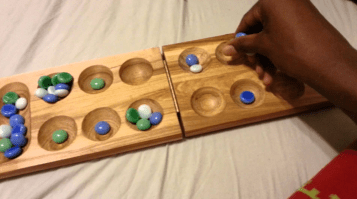
Typically, a game featuring the Mancala mechanism will have players picking up tokens in one space and then place them one-by-one in spaces in a specific direction around a circle with the space that receives the last token having special significance. The Mancala mechanism gets its name from the original game Kalah which dates back to Ancient Egypt.
Thoughts
Several games using the Mancala mechanism have been released recently. I was shocked the Mancala game mechanism made this list. Is it a favorite of mine? Not exactly. The Mancala game mechanism is elegant. I respect the heck out of it. But something with this game mechanism and my brain doesn’t click. Lol, I stink at games that use the Mancala game mechanism. Picking a game that uses the Mancala game mechanism when you play against me is the easiest way to secure a victory.
My inability to play games with this mechanism well aside, more games should include the Mancala mechanism. I like the tactile feel of dropping tokens one-by-one in consecutive spaces. Games that use the Mancala mechanism also include playing head games with your opponent. Spatial awareness is key. Because you move tokens into spaces one-by-one on your turn, making a move could empower your opponent to make an even better move on their turn. I love it when a game gives me feedback on how I lost. You can lose some board games and tally it up to luck. In games that feature a Mancala mechanism, you give your opponent the ability to defeat you.
Games that use this mechanism
Five Tribes: The Djinns of Naqala, Trajan, A Fistful of Meeples, Gold West, and Finca

Programmed Movement
Number of Games
267
Description
Typically, board games that feature programmed movement have players simultaneously program movement, reveal, and then execute their movement. Chaos can ensue, and players who have good spatial relations tend to benefit from programmed movement. Robo Rally uses this game mechanism to good effect.
Thoughts
The description of programmed movement took me by surprise. I gathered these definitions from various sources, including Board Game Geek, so I can’t take sole credit. The simultaneous nature of programmed movement is what got me. This eliminates games like Space Alert (I checked BGG and as of the time of this post; it doesn’t qualify as having the programmed movement). Space Alert has players select actions for their characters in real-time (there’s an actual countdown that occurs) and after the timer sounds, they execute their actions. Except for “revealing and then executing movement,” the mechanism works the same. It’s a head-scratcher.
Space Alert isn’t alone with its programmed movement adjacent mechanism. This could be why there are fewer games with programmed movement as a mechanism, but even if one made the description broader, games with programmed movement would still have fewer than 400 games. Getting back to the mechanism as defined, I like programmed movement a lot. The chaotic nature of programming something and then watching your plans crumble can cause frustration, but it can be a joy.
Games that use this mechanism
Robo Rally, Mechs vs. Minions, Flamme Rouge, Colt Express, and Space Cadets
Rondel
Number of Games
268
Description
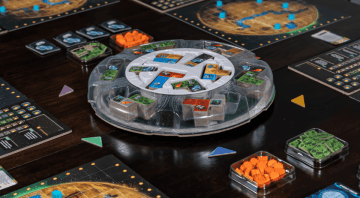
Rondels are wheel-shaped game mechanisms that contain multiple actions players can take. Player choice is limited to their ability to move around the rondel and select the action depicted on the rondel’s wedge. Typically, the rondel mechanism prevents players from taking the same action in consecutive turns. Board games that feature rondels tend to allow players to move further around the rondel by paying a cost.
Thoughts
While many games include a “don’t take the same action in consecutive turns,” rondel games are subtle. They don’t tell you, “Don’t take the same action.” Rondels nudge players not to play the same action and to try more of the actions the game has to offer.
Many rondel games do allow players to pay for additional movement around the rondel, but making a complete trip around the rondel (to claim the same action) is usually cost-prohibitive. I hope you really want that action because it’ll cost you half your victory points or in-game currency to claim it again. I always thought of the rondel mechanism as one of those game designer’s game mechanisms. I enjoy rondels. I also thought they showed up in thousands of games because the circles I play games with love talking about the latest game that uses a rondel. I agree with them. Game designers need to increase the number of games that use rondels. Double the number of games. Triple them!
Games that use this mechanism
Planet Unknown, Wonderland’s War, Unconscious Mind, Merchants of the Dark Road, and New York Zoo

Closing Thoughts
We shortened this list from the 10 Common Board Game Mechanisms list a month ago. Ten may have been too many mechanisms. While some of these mechanisms make sense that they wouldn’t show up in too many games, I’m looking at you, Crayon Rail System, others like the Mancala game mechanism should be in a lot more games. I’m shocked that with the tabletop game industry’s current climate that the Mancala mechanism doesn’t have at least 500 games to its name.
Like the game mechanisms that made the most popular list, we’ll be handing out board game designers a questionnaire to get their thoughts on each game mechanism. This may still be a month or two away from happening, but we’ll let you know when this series is ready. Until then, let us know of any board game mechanisms you think should be in more games. I hope you found something useful in the post. And wherever you are, I hope you’re having a great day.
 jkgeekly.com