

Comic Hunters casts players as comic book collectors trying to collect the most impressive comic book collection over a single weekend. Comic Hunters also marks the first of several games I picked up over Christmas. I’ve had enough time to play these games for a review so be on the lookout for more games I picked up over the holidays.
Hey, hey! Kyra Kyle here. We’re taking a break from playing as superheroes to collecting the works in which they appear. Comic Hunters has an intriguing premise. It also features a heap of iconic Marvel comic book covers. I can’t want to get into the review, but before we get any further, let’s look at Comic Hunters’ fine print.
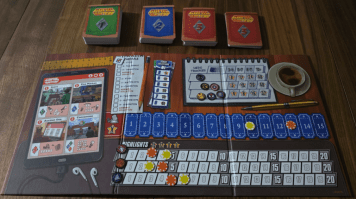
The Fiddly Bits
Designer: Robert Coelho
Publisher: Arcane Wonders and Spin Master Ltd.
Date Released: 2020
Number of Players: 1-4
Age Range: 10 and up
Setup Time: 5-10 minutes
Play Time: 45 minutes
Game Mechanisms
Auction: Turn Order Until Pass
Closed Drafting
Hand Management
Open Drafting
Set Collection
Game Setup
Comic Hunters has special setup rules for games with fewer than four players. It even has a solo game variant. These rules aren’t too difficult (mostly removing cards and other bits from play that relate to the removed cards). We won’t include those special rules here. We’ll continue the game setup section as if you’re playing with four players.

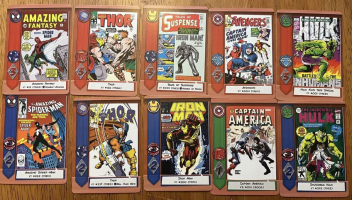
Comic Hunters has three card types that represent different comic book eras: level 1 (2000-present), level 2 (1980s and 1990s), and level 3 (1960s and 1970s). Each of these card types (with unique card backings) also represents locations: level 1 (comic book stores), level 2 (flea markets), and level 3 (auction websites). Shuffle each one of these three decks separately. Without looking at the cards, take ten cards from each of these decks to make a fourth deck. Shuffle this fourth deck. This will be the convention deck.

Place the checkmark token in the first Schedule box of the first round. You will play rounds according to the Schedule.
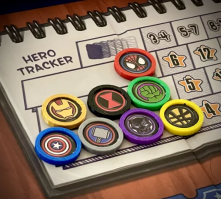
Assemble and organize the 8 Hero Tokens on the Hero Tracker Table. In a 4-player game, draw and place 1 Hero token for the first row, 3 Hero Tokens for the second row, and 4 Hero Tokens for the third row. The value of these heroes’ comic books will vary with the top row being the most valuable and the bottom the least valuable.
Each player takes their Player Token of their chosen color and places it on the “15” space of the Secret Stash track. This will be your money with which to buy lots during auctions. Any of your remaining stash becomes victory points at the end of the game.
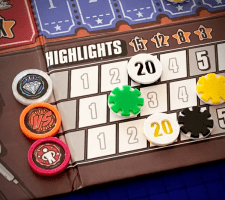
Next, setup the Highlights section. Draw one of the Highlight Tokens and place it on the leftmost space of the top row. Do the same for the next two rows. Each of these Highlight Tokens denotes something special about a comic book. They can be a character’s first appearance, the first issue of a series, an epic battle, a new look (for a character), or a special edition. Players will score points depending on who has the most comic books that match the in-play highlights. Since there are five tokens and you’ll only play with three Highlight tokens, scoring changes from game to game.
Finally, hand one player the First-Player Token. The rules suggest that the player who’s last seen a Marvel Movie or read a Marvel Comic should go first, but you can choose the first player randomly.

Game Flow
Comic Hunters is divided into 3 rounds. Each round has 2 stages: Treasure Hunting and Assemble Your Collections. During the Treasure Hunting stage, players will visit 3 of the 4 possible locations to acquire comic book cards. All you must do is follow the rules of the location indicated by the schedule. Once the first location is played move the schedule to the next location. Each location plays differently from the next.
Treasure Hunting
Comic Book Store
The comic book store plays with classic closed drafting rules (like Sushi Go). Players get dealt four cards from the level 1 deck. They select one card and pass the cards they didn’t choose to the player to their left. This continues until there are no more cards left to pass.
Flea Market
In this location, players take turns, clockwise, starting with the player holding the “First-Player” token. To set up the Flea Market, make a column from the level 2 deck equal to the number of players. Reveal a card from the level 2 deck to place in the first position of each Row. When it’s your turn, you must perform one of two possible actions: reveal a card from the deck and place it to the right of the rightmost, available space in one of the rows, or pick up all the cards from one Row of your choice. Rows can have up to four cards.

Auction Website
To set up the auction website, lay out four rows of the level 3 cards. The first row must contain 5 cards. The last row must contain 3 cards. The middle two rows contain 4 cards. These rows are Lots up for auction. The player with the First Player Token selects which Lot to bid during the round. They open the bidding with at least 1 (of their secret stash). The auction website plays like a traditional “bid or pass auction.” On their turn, a player either bids higher than the current bid or passes (and they’re out for the rest of the auction). Highest bid wins. Whenever one lot remains, the player who hasn’t obtained a lot gains the last lot. They must spend three of their secret stash if they can.
Convention
To set up the Convention, take 24 cards from the top of the Convention deck and arrange them into a grid with 5 columns and 5 rows, leaving the center position empty. Starting with the first player and then going clockwise, each player will take turns doing the following in order: slide one card left, right, up, or down in the grid, moving it through the empty spaces to a new position, and then select all the cards in a column or row that contain the same hero you name. So, you could select all the Spider-Man comics in a row or all the Black Panther comics in a column and so forth. Each player will have two opportunities to perform this action. The catch is that the player who selects last will select twice in a row and the second selection will occur in reverse turn order.
Assemble Your Collections
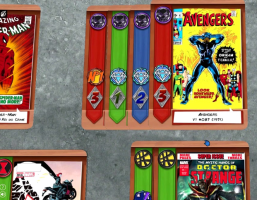
In this selection, player put cards from their hands down on the table, starting comic book collections for a specific hero or adding comic book cards to existing collections. Player will pay the market value for each card (1 for level 1 cards, 2 for level 2 cards, etc.) with an equal number of cards of that same value. So, you could pay for 3 level 1 cards by discarding 1 level 3 cards. Any cards that you discard or choose not to buy will be added and then shuffled into the Convention deck. Cards in your hand do not carry over to the next round, only cards in collections remain.
Final Scoring
After the final “Assemble Your Collections” action on the schedule, players score their collections. There are several ways to score: collection size (and value of specific heroes), varied collections (collections of different heroes), highlights, and secret stash. I won’t go into detail for each of these here, but there are plenty of ways to score a bucket of points. The person with the most buckets of points wins.
Review
Comic Hunters uses a lot of ways to accrue cards and just as many ways to score those cards after you obtain them. For the most part, the various locations work well enough to simulate the experience of their locations. An auction mechanism is a no-brainer for an auction website. The flea market feels right. And comic book conventions can be the wild, wild west when it comes to what kind of comics are on offer. So, the random comic book cards found during the Convention phases track. I enjoy all of that, but it comes at a cost. The various ways of acquiring cards can get clunky.
I struggle to shift from one mode to the next. While I like the variety, I focused means of acquiring cards could’ve worked better. I would’ve gotten into a better flow state faster with Comic Hunters. These various means with which to obtain cards also made setup and explaining the rules more difficult. Each ruleset is easy enough to explain, but the best way I found for teaching the game was giving a quick rules explanation before each location like I’m the “about the game” page before a Mario Party minigame. And these disparate mechanisms made Comic Hunters feel like a collection of minigames instead of a cohesive experience.

You may have gathered by how I explained the rules above, but the comic book store and auction website locations are lackluster. I like them from the standpoint that I could point to other games that use those same mechanisms, but those mechanisms are old hat. The flea market and convention locations are a lot more interesting and fun. I would’ve loved to play those two locations multiple times (lowering the number of minigames from four to two). I also like the idea that you must spend card values to play cards into a collection. This was a clever touch and lowers the number of bits needed. Despite any of its shortcomings, I enjoyed Comic Hunters. When it tries new things, those new things are fun.
But I can’t move to the verdict without mentioning the quality, or lack of quality, of Comic Hunters’ components. I’ve seen board game manufacturers’ sample products, and most of these companies don’t offer punch board as thin as the tokens found in Comic Hunters. Furthermore, the cards are off-center so you can see the white space between cards, and they slant at odd angles. The card material feels cheap. I don’t usually care about component quality, I’ve played my fair share of prototypes with ripped pieces of paper as chits, but I was shocked by the shoddiness of Comic Hunters’ production value.
Too Long; Didn’t Read
Comic Hunters has a fun premise and contains some interesting game mechanisms. Unfortunately, the game also deploys some tired game mechanisms that feel clunky, and the production value leaves much to be desired. Still, its low price point ($20-$25) means that Comic Hunters packs a lot of game per penny.
 jkgeekly.com
Where did you get those coloured rings around the superhero chits?
LikeLike
I can’t remember. I get a lot of my board game upgrades through Nerds Making Nerdy Things https://www.facebook.com/groups/806260131249798/. They mostly work with wooden bits, but one of the co-owner’s husbands designs resin upgrades. It also may have been Etsy. Etsy offers a lot of board game upgrade bits. That may be the one thing I buy the most from Etsy. 🤣
LikeLike
Those rings are much needed for this game. Thanks!
LikeLike