
Culdcept has titles spanning nearly two decades. It has a manga series. It’s difficult to find Western copies. Discard your card and let’s play a round of Culdcept.
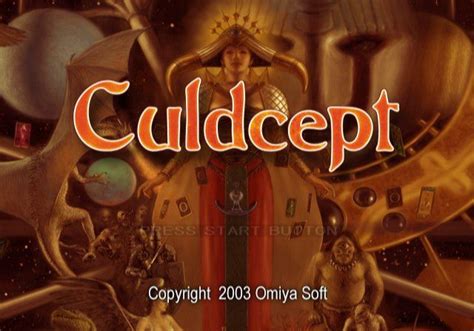
Hey, everyone! Season here. We’re trying something new this week with Video Game Cult Classics. This week, we’re focusing on Culdcept (or Karudoseputo in Japanese). The basic premise of Culdcept is Monopoly meets Magic: The Gathering in video game form. The first installment was developed in 1997 by Omiya Soft. For a video game to make this series, we’re going to consider its reception, relevance, and accessibility. Since Culdcept is predominantly a deck construction game, we’ll start with the different types of cards before jumping into gameplay.
Note: Most of the images are from the Culdcept Revolt wiki, but some will be from Culdcept Second (which will be labeled).

Card Types
Before we jump into card types, Culdcept has a card rating system (how easy cards are to obtain). After a match, cepters (players) receive “card packs.” The number of cards contained in each pack varies depending on whether the cepter won or lost. In Culdcept Revolt, cepters may also purchase card packs outside of matches. The different ratings a card can have are normal (common), strange (uncommon), rare, and extra (ultra rare). Extra cards are powerful and may only be obtained after meeting certain conditions within the game.
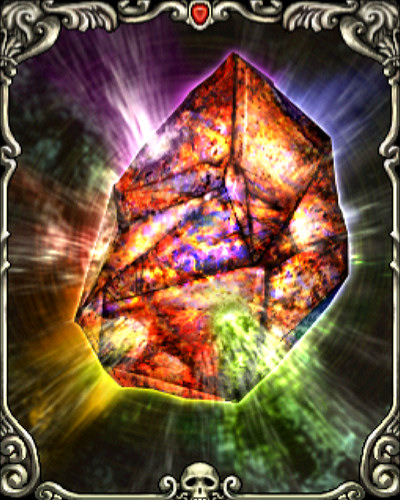
Below, we have “Rainbow Piece,” an extra item card obtained after defeating a specific cepter in story mode of Culdcept Second.
Now that we’ve got obtaining cards and their rarities down pat, let’s take a look at the categories of cards. Culdcept has three basic categories of cards: creatures, spells, and items. We’ll start with creature cards.
Creature Cards
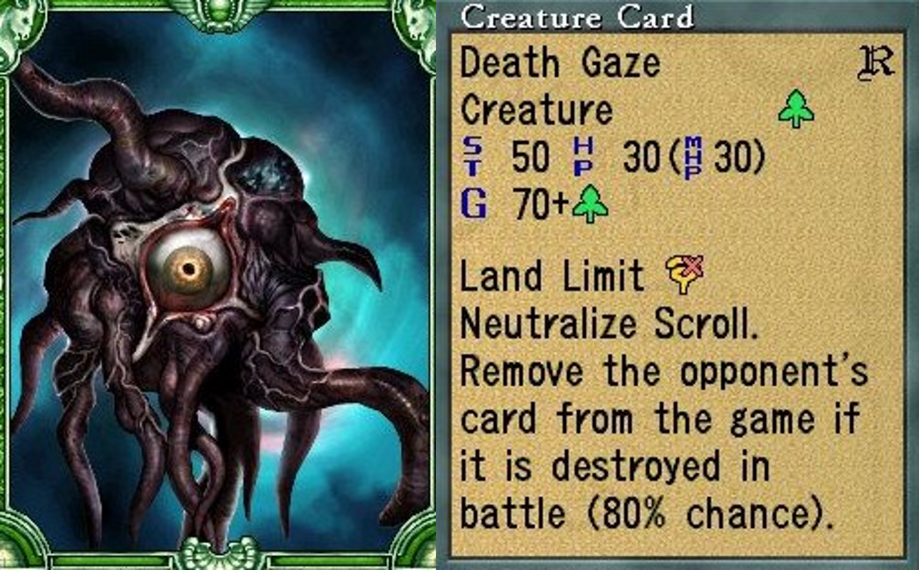
Creatures claim/defend land and attack/defend against other players. They’re essential for collecting tolls and fending off your opponents. Each creature card will have ST (strength), HP (health), MHP (max health), and G (cost). Some creatures will also have an element symbol or card symbol as part of their G. This means you must own the number of required land and/or discard a card from your hand to place that creature.
Some creatures will have “land limits” (types of lands they can’t be placed on) and “item limits” (items they’re unable to use in battle). Each creature card will have a different colored border, denoting their element. If the cepter places a creature on a land of their element, they’ll receive a land effect, meaning they’ll get bonus HP and ST from that land during battle. This excludes neutral (gray) creatures unless they have an effect that states otherwise.
Below, we have a “Death Gaze.” It’s a rare earth creature. It has ST: 50, HP: 30, MHP: 30, and G: 70+ you must own at least one more earth land to place “Death Gaze.” The printed “Land Limit” shows that “Death Gaze” cannot be placed on a wind land. The “Neutralize Scroll” effect means that it’s impervious to scroll attacks.
Spell Cards
Spells can either help or harm the casting cepter. They can be used offensively to steal magic (more on magic during “Gameplay”) from other cepters and harm their creatures or defensively to protect the casting cepter and their creatures from their opponents. Some spells have area effects, alter lands, and affect movement. Spells may have different symbols that denote which aspects of the game they affect. In Culdcept Revolt, there are “secret” spells, which aren’t revealed until they’re played. More on that later.
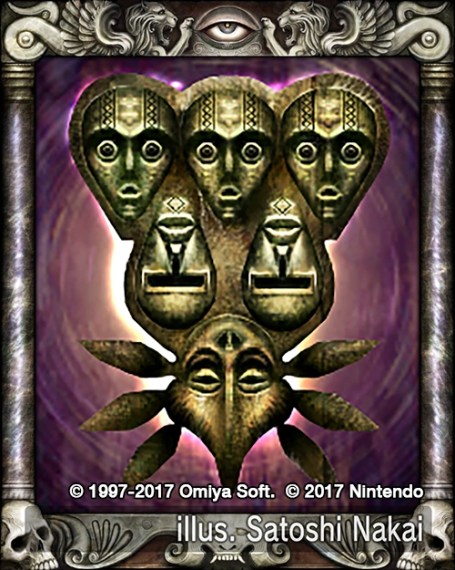
The spell below is “Holy Word 6,” which allows a cepter of the caster’s choice to have a fixed die roll of 6 on their next roll phase.
Item Cards
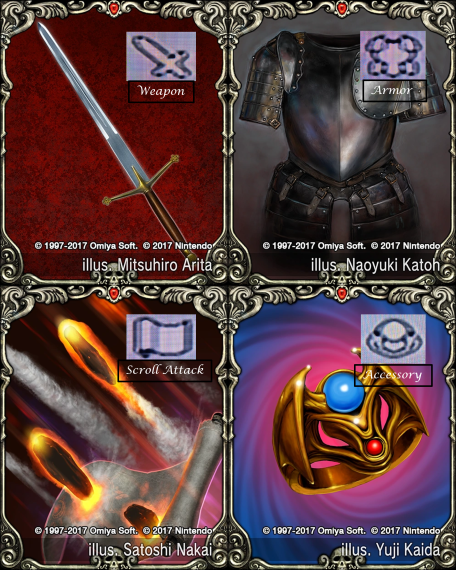
Items can be broken down into four types: weapons, armor, scroll attacks, and tools/accessories. Weapons and armor can both affect a creature’s ST and HP stat. Weapons tend to provide more strength and armor tends to provide more HP. Scroll attacks give a creature a fixed strength and can have different effects, such as critical hits to certain types of creatures and can ignore items that neutralize attacks. Tools/accessories can do a variety of things. They can neutralize attacks, penetrate (remove land effect buffs from creatures), give a creature first attack, and destroy/steal the opponent’s item. There are probably more effects we’re forgetting. Some creatures may also double as items, which is described in their effect text.
Gameplay Overview
Cepters (players) draw a card, roll two 6-sided dice, and move around a board, placing creatures and paying/collecting tolls as they go. Each installment of Culdcept has different variations and add new mechanics. For this write-up, we’re going to focus on Culdcept Revolt (2016), since it’s the most recent installment.
At the beginning of a cepter’s turn, they draw one card from their book (deck). Each cepter can hold a maximum of six cards in their hand and must discard down if they draw a seventh. If they are holding any spell cards in their hand, they may play one per turn if they have enough G (cost). Culdcept is played with player hands revealed except for “secret” spells, which aren’t revealed until they’re played.

Next, the cepter rolls the dice and moves the number of spaces on the dice. If the cepter rolls a symbol on one of the dice, it equals zero. Rolling symbols on both dice equals twelve. Land tiles are elemental and may be either vacant or occupied. The different types of land tiles are air (yellow), fire (red), earth (green), water (blue), morph, and multi-elemental. The former four are more common and provide land effects to creatures corresponding with their matching element. Morph is a neutral land tile that transforms into the element of whichever creature is placed there. In Culdcept Second, these are neutral tiles and remain neutral even after a creature is placed there. Multi-elemental provides land effects to creatures of any type but won’t provide a chain effect. More on chain effects later.

Special Tiles
There are also many types of special tiles cepters may land on. We won’t go in depth here, but we will give a brief overview of them.

Gates are represented by N, S, E, and W. They must be passed to collect magic to win the game.

Warp and Bridge tiles are similar since they send cepters to another location on the map.

Fortune Teller lets cepters choose creature, item, or spell, and gives the cepter one of the selected options at random from their book.

Spell Circle allows cepters to choose one of two spells presented, which is cast instantly, free of charge.

Card Shop allows cepters to purchase one of four cards for 20G.

Path Switch alters the path on the board for cepters, like a mine cart junction.
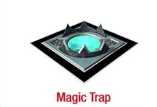
Magic Trap with either steal magic from cepters or give cepters all of the magic it has depending on what the cepter who landed on the tile rolls (1-6).

Siege Tower allows cepters to invade any land or occupy any vacant land with a creature from their hand.

Gem Store allows cepters to sell, buy, or steal Element Gems from one another, which can be used to enhance the element they’re assigned to. This increases the value of an element for a player. Cepters choose one element for the Element Gem’s rival (this element’s value decreases) and one element for the Element Gem’s ally (this element’s value increases). Element Gems are one of the more complex aspects of Culdcept Revolt and could be an article on their own.

Once a cepter lands on a tile, they will either perform the effect of the special tile, place a creature on the land tile if it’s vacant, summon a creature to battle on the land tile if it’s occupied, or use territory commands.
Chaining
If a cepter places a creature on a vacant land of an element they already own, a chain happens. Chaining raises the toll of that cepter’s lands if the lands occupied are the same element. So, if a cepter has two water lands and one fire land, the two water lands will be chained, raising the toll fee of that cepter’s water lands. The fire land will not be affected until that cepter places a creature on another vacant fire land. Chains don’t apply to multi-element lands.
Battles
Battles are fairly straightforward. If a cepter lands on a land tile occupied by another cepter, they may summon a creature to invade the opposing cepter’s land. The creature chosen must have its requirements met before being summoned, such as G, discarding a card, the number of adequate lands are occupied by the summoning cepter, and land limits.
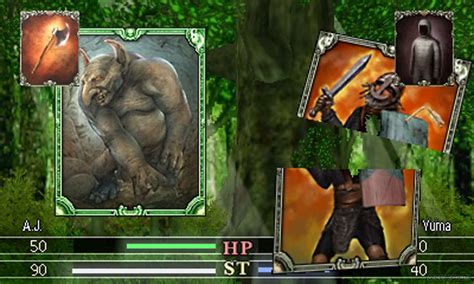
The invading creature attacks first (unless the defending creature has the “first attack” effect), dealing damage equal to its ST to the defending creature’s HP. Each cepter has the option to choose an item to use in battle. Even if an item isn’t used the backside of a blank card will lay in the upper left or right-hand corner of either creature card until the battle commences.

If an item is used it will remain in the upper left or right-hand corner of its respective creature card and its effect will occur. If a creature has a pre-battle effect, such as critical hit, that will go into effect. If a creature survives the battle and has an effect post-battle, that will go into effect before exiting the battle screen and returning to the board. If the invading creature wins, the land will be taken over. If the defending creature wins, the cepter who landed on the land will pay the toll. If both creatures get destroyed, the land becomes vacant.
Territory Commands
Territory commands can range from leveling up lands to doing a myriad of things with creatures. They may only be available for territories the cepter has passed during their move phase. All may be accessed if the cepter lands on a gate. Lands can be level one through five—five being the highest. Cepters must pay the appropriate cost in G before a land can be leveled up. Cepters may also exchange the creature currently occupying a land with one from their hand or move a creature to an adjacent land (except for defense creatures that can’t be moved). If the adjacent land is occupied, a battle ensues. Otherwise, the creature occupies a new land. If a creature has a territory ability, the ability may be used. The game ends when whichever cepter collects the required magic power first.

Phew! That wasn’t nearly as in depth as it could have gotten, but I’ll spare you the nitty gritty. The game itself teaches new players more slowly, so it’s not nearly as much of an info dump as my breakdown.
Reception
Culdcept was more of a hit in Japan than in Western countries. The original Culdcept doesn’t have an official translation. However, Culdcept did get released as Culdcept DS in 2008. Culdcept also released during the middle of the collectible card game (CCG) boom of the ‘90s. It came out one year after the Pokémon Trading Card Game (1996) and two years before the Yu-Gi-Oh! Trading Card Game (1999). Culdcept Second got an official translation and was released in North America in 2003 for PS2. This is the iteration of Culdcept I’m most familiar with. However, Culdcept Second still wasn’t very popular and sold roughly around sixty-five thousand copies globally. Culdcept 3DS released in 2012 in Japan, but this is similar to Culdcept Second. Culdcept Revolt incorporated an online element. This garnered Culdcept Revolt more popularity than its predecessors and it included elements to streamline the game.
Relevance
Since Culdcept released as a video game hybrid of popular tabletop games, you’d think it’d have a wider fanbase. I’m not sure why it’s an obscure series, but I can hazard a guess. OmiyaSoft wanted to jump on the CCG bandwagon with a video game resembling a CCG. Culdcept got sandwiched between two popular titles during that time. Yu-Gi-Oh! (the manga) began serializing in 1996 and Pokémon (the anime) started airing in 1997. Culdcept likely got overshadowed by these two titans and faded into obscurity.
The publisher, Omiya Soft, is a small, not well-known publisher outside of Culdcept. To their credit, Culdcept lasted for almost twenty years. They had enough dedicated fans to continue producing games. On their website, they advertise themselves as a variety publisher. They haven’t released anything since Clash! Hani World in 2017, which is only available in Japan.
I mentioned the manga at the beginning of this write-up, so I’ll cover the manga’s reception here. The Culdcept manga was serialized from 2004-2006, between the releases of Culdcept Second and Culdcept Saga, shortly after Culdcept Second became available in North America. I didn’t know it had a manga even though it was published in English by Tokyopop, which is a well-known English manga publishing company. Regardless, even the manga had a short shelf life.
Accessibility
If you’ve read this far and are thinking about picking up a copy of Culdcept, you’re probably asking, “Where can I find it?” Your local used video game store likely won’t have it unless you luck out. Folks sell used copies of various Culdcept titles on eBay and Amazon. The downside to getting these titles online is that they could be damaged, and you’d have to take the disc to get refurbished. Culdcept Revolt still has some new copies on the market, but their numbers are dwindling. If you want to get your hands on the original Culdcept, I recommend having a Japanese PS1 or PS2 to go with it if you’re able to find one. These aren’t the easiest games to find and the prices for English copies vary between $25-$200 USD. Maybe more, depending on where you look.

Final Thoughts
If you’re a fan of strategy and card games, I highly recommend Culdcept. I find the game charming and enjoy the different playstyles of each CPU within the game. That’s right. Unlike games like Yu-Gi-Oh! Duel Links, where each CPU has different decks, but employs a similar playstyle, CPU cepters have their unique playstyles that match their personalities and deck type. Some of them take over every land they see while others invade when they’re certain they can win. They can be predictable if you’re used to facing the same cepter, but they’ll sometimes leave you scratching your head.
Much of the information regarding Culdcept Revolt was found on Culdcept Central. If you want more in-depth guides for each game and deck strategies, please check them out.
What’s your favorite deck/strategy in Culdcept? If there are any cult classics you’d like to see covered in future posts, let us know in the comments. Thanks for reading and have an amazing rest of your day.
 jkgeekly.com