Real Name: Norman Osborn
First Comic Book Appearance: The Amazing Spider-Man (July 1964)
Affiliations in Comic Books: Cabal, H.A.M.M.E.R., Oscorp, Sinister Six, Thunderbolts
Marvel United Appearance: Marvel United: Enter the Spider-Verse (July 2020)
Marvel United Team Decks: None
Movement

BAM!

Civilians

Thugs

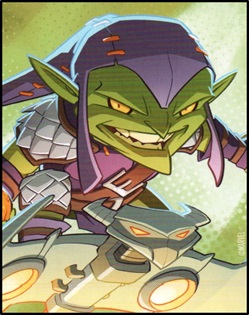
How Green Goblin Plays: Threat cards do not begin the game on any Locations, instead they are set aside in a Threat card deck and Green Goblin adds them to Locations through his BAM! and Overflow effects. This effect plays into Green Goblin’s Villainous Plot. If all Locations have a Threat card, the Heroes lose. But Green Goblin also deals far more damage than any core set villain, especially if either copy of his “Goblin Formula” has been played. Additionally, Green Goblin can’t be damaged if he has a “Kidnapped” Civilian on his Villain dashboard.
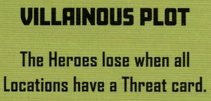
Villainous Plot: The Heroes lose when all Locations have a Threat card.
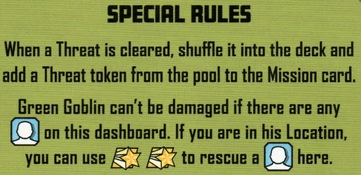
Special Rules: When a Threat is cleared, shuffle it into the deck and add a Threat token from the pool to the Mission card. Green Goblin can’t be damaged if there are any Civilian tokens on this dashboard. If you are in his Location, you can use Two Heroics to rescue a Civilian here.
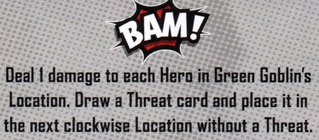
BAM!: Deal 1 damage to each Hero in Green Goblin’s Location. Draw a threat card and place it in the next clockwise Location without a Threat.
Green Goblin begins the game with the same damage as most other Marvel United villains, but his “Goblin Formula” can boost his damage to three for a single BAM!, which means that he can KO a hero with one BAM!. His henchmen complicate the issue further by providing additional damage. One (Kraven) will hunt players around the board to deal them damage.
Each one of Green Goblin’s Master Plan cards has a BAM!, so he will be triggering these effects every round. His other effect “Draw a Threat card and place it in the next clockwise Location without a Threat” plays into his win condition. This ability pairs nicely with his Overflow effect.
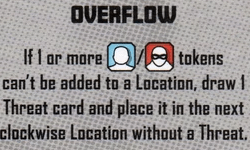
Overflow: If a civilian or thug token can’t be added to a Location, draw 1 Threat card and place it in the next clockwise Location without a Threat.
Green Goblin places a fair amount of Civilians and Thugs each turn, so Overflow can occur and when it does, he places yet another Threat on a Location without one. Again, this hastens Green Goblin’s win condition.
Note: It doesn’t matter how many Civilians and/or Thugs Green Goblin cannot place on a Location, he will only add 1 Threat at one Location without one for each Location that triggers the Overflow effect.
Threats
Green Goblin has 2 copies of 1 Threat Card (“Corporate Thugs”) and 1 copy of 4 different Threat Cards.
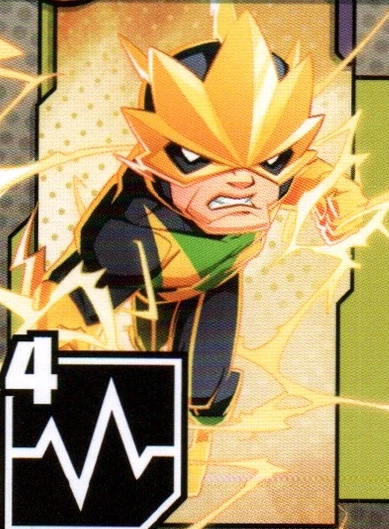
Electro (Henchman)
Health: 4
BAM!: Deal 1 Damage to each Hero in both adjacent Location.
Unlike many henchmen, “Electro” deals damage to Heroes in adjacent Locations. By himself, “Electro” isn’t a big threat, but he compounds the abilities of each of the other villains. Green Goblin hops around the board erratically and deals damage each round, “Kraven” chases Heroes and deals damage, the tank of a henchman “Lizard” deals damage to Heroes at his Location, and “Electro” hits the ones adjacent to his Location.
The combination of all four damage sources makes avoiding damage difficult. “Electro’s” effect of damaging Heroes adjacent to him makes him an obvious henchman to keep in play; you can avoid other damage (besides Green Goblin) by sticking to “Electro.”
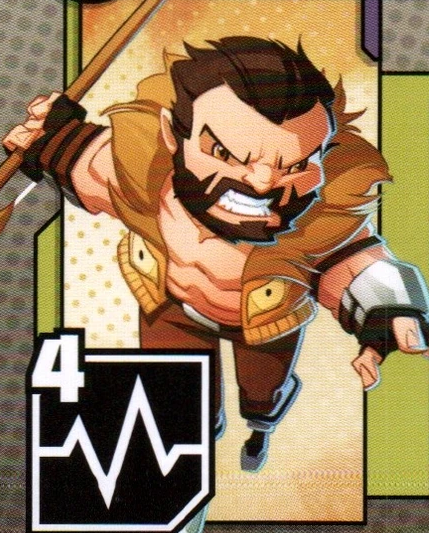
Kraven (Henchman)
Health: 4
BAM!: Move this Threat to the next clockwise Location with any Heroes and no Threat (if possible). Deal 1 damage to each Hero in that Location. As I said before, “Kraven” will hunt down Heroes. His effect is an odd one and may not be triggered. Even if a Hero is at his Location, he will try to move to a Location without a Threat and a different Hero. If one doesn’t exist, he will stay put. Players can avoid “Kraven” by staying on Locations with a Threat, but they could put themselves in danger of getting damaged by a different source.
If you have the Move to reach “Kraven,” you may consider taking him out quickly.
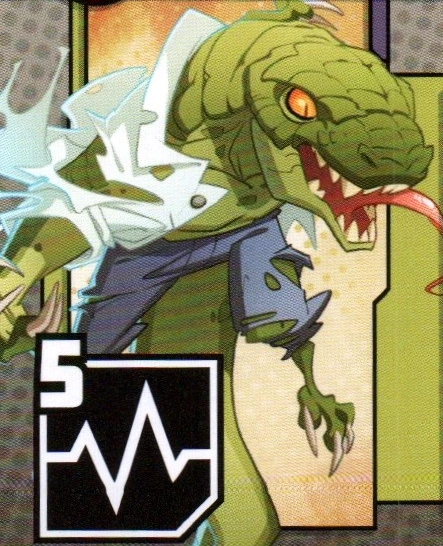
Lizard (Henchman)
Health: 5
BAM!: Deal 2 damage among Heroes in this Location (Heroes choose how to split the damage).
Players have a small amount of control with how “Lizard” doles out his damage. If a Hero has less health (fewer cards), another player can take the hit. What makes “Lizard” more difficult is his increased damage and the fact that he will trigger each round (each of Green Goblin’s cards has a BAM!) and his above average health. 5 isn’t that crazy, but when he’s accompanied by two other henchmen and a villain with decent health, 5 can be a little more than players would want to invest in a single henchman.
“Lizards” increased health, the fact that he doesn’t move, and only attacks Heroes at his Location make him a lower priority henchman to defeat.
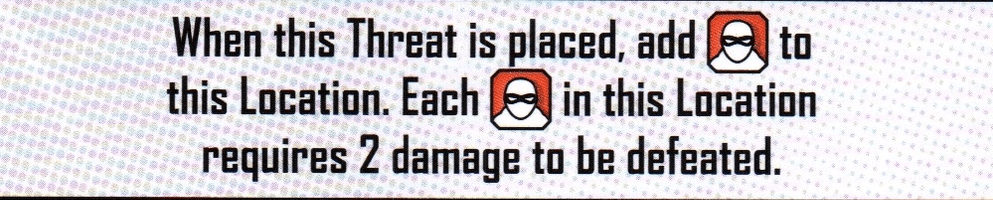
Corporate Thugs (Threat)
Clear: 3 Heroics
Constant Effect: When this Threat is placed, add 1 Thug token to this Location. Each Thug in this Location requires 2 damage to be defeated.
“Corporate Thugs” uses a familiar effect “Each Thug in this Location require 2 damage to be defeated.” It essentially makes Thugs more difficult. But “Corporate Thugs’” first effect “When this Threat is placed, add 1 Thug token to this Location” spices up this Threat. More Thugs may tempt Heroes to clear this Threat before attacking any Thugs. Note: After the Heroes clear “Corporate Thugs,” Thugs can be defeated with one damage. But this first effect can also cause Overflow, which can then cause Green Goblin to place another Threat and get closer to villain victory.
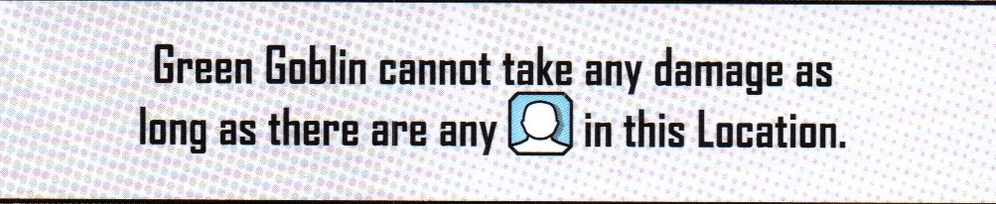
Using Civilians as Shield (Threat)
Clear: 3 Heroics
Constant Effect: Green Goblin cannot take any damage as long as there are any Civilian tokens in this Location.
“Using Civilians as Shield” only affects the late game when Green Goblin can be damaged (at least 2 missions are cleared). Simply put, Green Goblin becomes immune to damage if Civilians exist at this location. You may consider rescuing Civilians at this Location (if any exist) or if there are more Civilians than the Heroics it would take to clear this Threat, you can clear this Threat.
Note: If no Civilians are present at this Threat’s Location, Green Goblin can receive damage.
Master Plan Deck
Movement:
Green Goblin averages 2 Movement each turn. He is 33% faster than any of the core set villains. His movement varies, only have 1 card speeds of 4 and 5, 2 cards with speeds of 3 and 0, and 3 cards of speeds 1 and 2. Green Goblin may be the most unpredictable villain in terms of movement.
Civilians:
Green Goblin adds slightly more civilians than the core set villains. But he only has 4 cards in his deck that add Civilians; each of these cards either adds 4 or 6 Civilians in a single turn. This can become an issue with Green Goblin’s BAM! effect and his “Using Civilians as Shield” Threat Card.
Thugs:
Just like Civilians, Green Goblin adds slightly more Thugs than the core set villains, and he only has four cards where he does so. Four cards in Green Goblin’s deck add Thugs and they do so in the following denominations: 6, 5, 4, and 2.
BAM!:
Each card in Green Goblin’s deck has a BAM! effect. His unpredictable movement will make it difficult to know if he’ll land on a Location with Heroes. We’ve mentioned Green Goblin’s BAM! effects and his henchmen’s BAM! effects in previous sections. They are plentiful and a large portion of how this villain accomplishes his win condition.

Special Effects on Cards
1) Goblin Formula: As long as this card is faceup in the Storyline, Green Goblin has 1 extra Health and deals 1 extra damage with his BAM! effect.
“Goblin Formula” turns Green Goblin from a villain with average damage to one of the deadliest Marvel United villains. Since he has a BAM! effect on each of his cards, Green Goblin will damage Heroes if he lands on them. “Goblin Formula” boosts his damage by one with each copy in play, and Green Goblin has two copies of the card in his Master Plan deck.
If both copies of “Goblin Formula” are in play, Green Goblin can knock out a Hero with a single BAM! effect, making the Heroes’ margin for error smaller.
2) Kidnap: If there are any Civilian tokens in Green Goblin’s Location, take 1 and place it on his dashboard.
“Kidnap” is less dramatic than “Goblin Formula” and only matters when Green Goblin can be damaged. As long as a Civilian is on his dashboard, Green Goblin cannot be damaged. Heroes can rescue the Civilians on Green Goblin’s dashboard even if he cannot take damage by spending two Heroics.
This effect is thematic (Green Goblin often kidnaps people) but not nearly as annoying as Vulture’s ability; Vulture doubles down on kidnapping Civilians. Green Goblin’s “Kidnap” can be annoying as well, but in order for it to trigger, there needs to be a Civilian token at Green Goblin’s Location when the effect occurs. I’ve found this effect to fizzler more than and others, and when it does happen, it’s more of a nuisance.

General Strategy
Green Goblin becomes more difficult with more players. As such, Goblin may be the one villain in Marvel United (MU) that scales the worst. More Heroes means that Green Goblin (and his plentiful henchmen) have more chances to damage Heroes.
Keep in mind that the Heroes lose if anyone runs out of cards and Heroes discard cards whenever they receive damage. According to the MU community, the player win rate against Green Goblin is 30%. One of the worst. Green Goblin should not be the first villain you play in Marvel United.
That said, I’d play with fewer Heroes and stick to the Spider-Man theme. Heroes and the Locations in the Enter the Spider-Verse expansion work well against Green Goblin. Many of the End of Turn abilities on Locations grant the Heroes extra action tokens and the fact that the board doesn’t begin the game with Threats, means that you’re likely to gain extra tokens at the beginning.
You’ll need to manage the Threats. It can be tempting to keep “Electro” around like I said, but the Heroes lose if all the Locations have Threats. I also mentioned the Spider-Verse Locations and their tokens (Heroics and Attack) because you may need those tokens and specialize in Move. You’ll need plenty of Move to reach these Threats and rescue Civilians/defeat Thugs before Green Goblin wins.
Spider-Man has plenty of Move in his deck and his “Great Power” and “Great Responsibility” can generate even more tokens. “Great Responsibility” also negates Green Goblin’s Special Rule, “If you are in his Location, you can use Two Heroics to rescue a Civilian here,” since Spider-Man doesn’t use Heroics to rescue Civilians with “Great Responsibility;” he rescues Civilians no matter how many Heroics are required for a rescue.
Ghost-Spider can manipulate where Threats are placed and that can come in handy. And Miles Morales can delay the Villain’s turn—also a great ability to have. If you were to go against the Spider-Man theme, Captain America (from the core set) is a great option. He generates Wild tokens and has a fair amount of Heroics and Attack.
The rest may come down to luck. Since Green Goblin has multiple ways of winning (KOing Heroes, delaying Heroes from winning with kidnapping Civilians, and working toward his secret mission by placing Threats), he may not draw into the winning card for his closest win condition.
You’ll finish the Clear Threats mission for sure. The second mission you finish will depend on team composition; play to your Heroes’ strengths. Green Goblin generates Civilians and Thugs at an even rate.
Remember to time completing the first and second missions as close together as possible to avoid the villain speeding up too soon.
 jkgeekly.com