
Today’s video game cult classic is a pet simulator. Something like Nintendogs may come to mind when you think about pet simulators. Fighting pet simulators? Pokémon dominates fighting pet simulators, but I’m thinking about a lesser-known fighting pet simulator. That’s right. Monster Rancher is making an appearance on this month’s Video Game Cult Classics.
Hoppy Easter, everyone! Season here. We’ve got another video game series that spawned an anime and, coincidentally, came out in the ‘90s. Don’t worry. I’ll branch out. Monster Rancher (or Monster Farm in Japan) is a game that allows the player (rancher) to raise one monster at a time from a baby to an adult. Monster Rancher is like a cross between a Tamagotchi and Pokémon (later iterations incorporate more Pokémon like features). Like the last cult classic we covered (Culdcept), for a video game to make this series, we’ll consider its reception, relevance, and accessibility. Prepare your monsters for battle, and let’s delve into gameplay.
Gameplay Overview
Quick note: most of the gameplay you’ll see comes from Monster Rancher and Monster Rancher 2. I’m most familiar with these two games, and they embody the series’ core concepts. There are a few offshoot games I’ll mention in the accessibility section, but they won’t be the focus.
Monster Rancher has gameplay that’s easy enough to pick up on, but has a learning curve for those interested in getting the most out of their monsters. In Monster Rancher and Monster Rancher 2, players assume the role of a rancher and work with an assistant. Monster Rancher 2 has a quiz for players to take at the beginning of the game, but it doesn’t affect the gameplay.
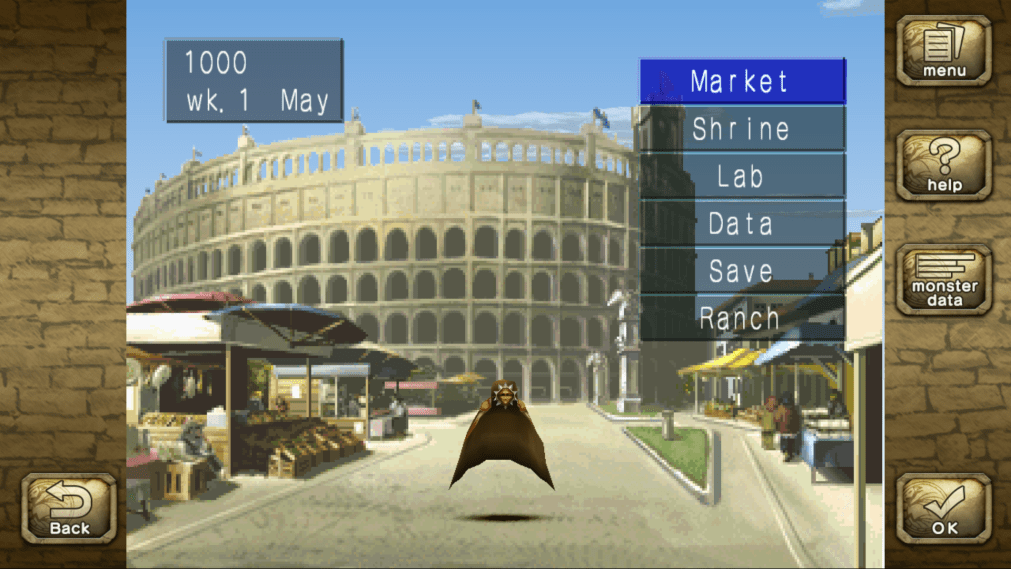
Once players get their assistant (Holly in Monster Rancher and Colt in Monster Rancher 2), they’re ready for their monster. Players can either go to the Market or the Shrine to acquire a monster. Players can also obtain new monsters at the Lab, but they’ll need to have two frozen monsters (that they can combine) to birth a new one.
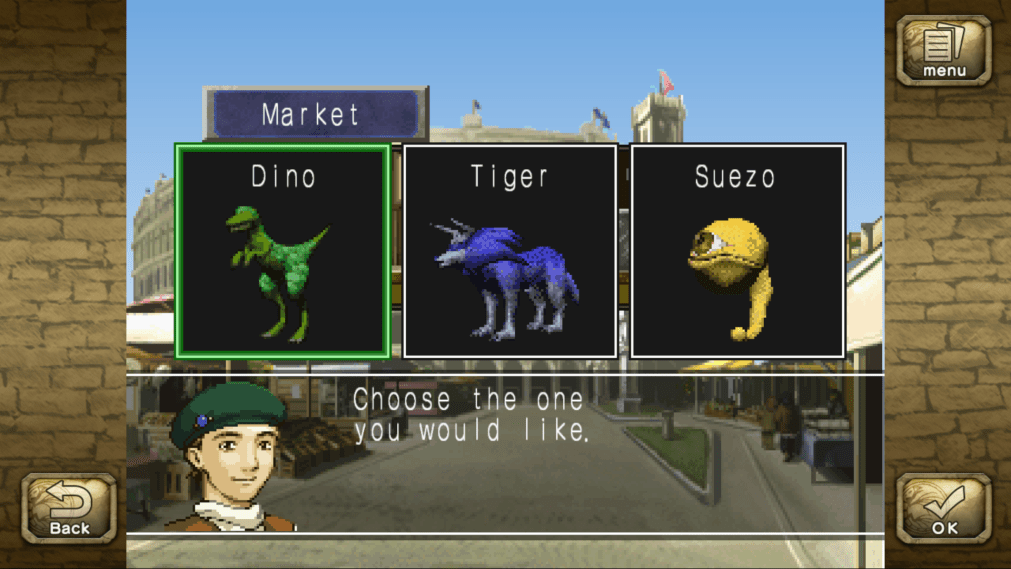
Monsters in the Market are seasonal. These monsters will be base species with not-so-great battle stats. Pictured above, we have a baseline Dino, Tiger, and Suezo. These monsters are good options for players who don’t have many CDs/PS1 game discs, or if you want something simple for a starter monster.
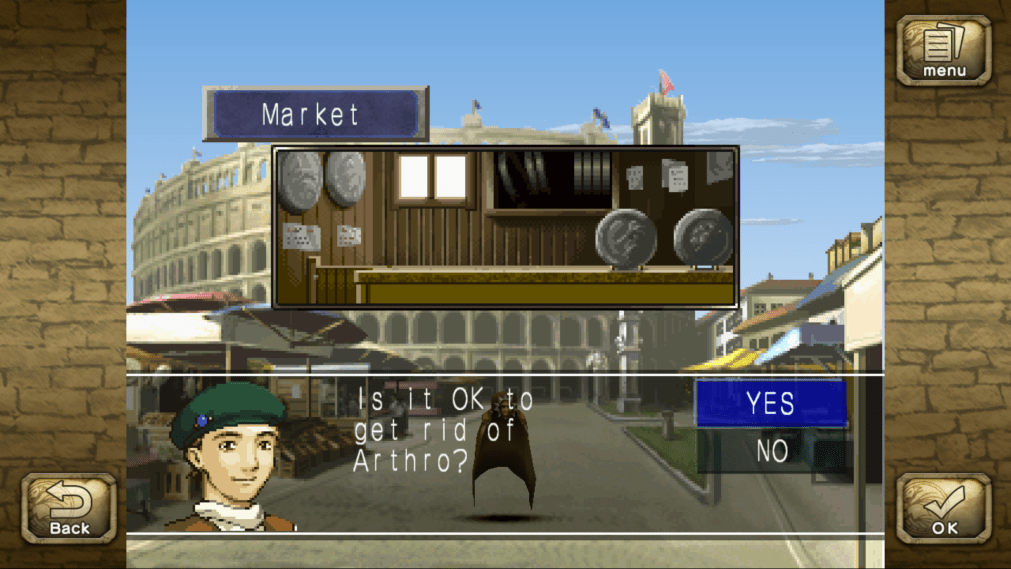
Players may also give up a monster to the Market if they no longer wish to keep the one they currently have. Personally, I never do this because I get attached to my virtual pets. If this happens on accident, there’s no need to worry. Autosave won’t screw anyone over.

The Shrine is where the magic happens. At least, that’s where it happened for me when I played as a kid. Who am I kidding? It still happens. At the Shrine, players can select a CD/PS1 disc to put into their system to get a random monster. After the game reads the disc, it generates a monster based on the disc data. The same monster will be generated from each disc. In other words, if the player remembers which monster was generated from a specific disc, they’ll get the same monster with the same stats every time.
If the same monster gets generated from a different disc (it happens a lot), the monster will likely have different stats. Make sure to remember the discs that have the stats you want to keep.
Players can visit the Lab at the start of the game, but there’s no need to unless they want to generate two different monsters and try to get something different at the Lab. The Lab is more useful after a player has fully raised at least two monsters who have learned many fighting techniques (we’ll get to those later). The following images for the Lab section are taken from Monster Rancher 2.

At the Lab, players have the option to combine monsters to get a new monster, freeze the monster they have with them, revive a frozen monster, delete a frozen monster, or analyze the monster they have with them. Analyzing a monster gives the player insight into how to raise their current monster and its personality.

It costs 500G to combine monsters. 500G is a hefty sum at the start of the game; it’s not so bad later on, once a player’s monsters compete in tournaments and win money. Players will select two of their frozen monsters to combine (players may have up to twenty frozen monsters at a time).
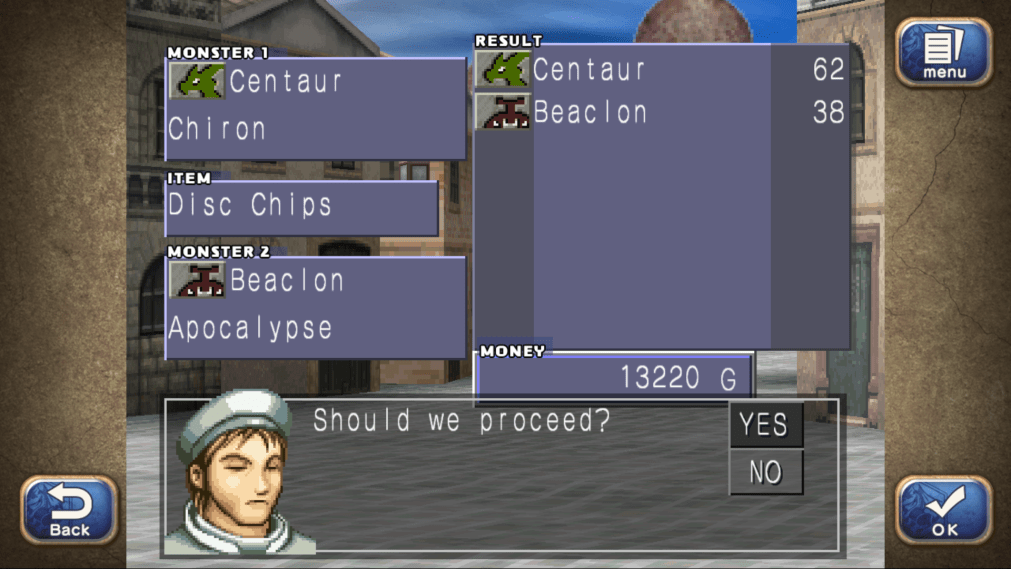
In Monster Rancher 2, once the two monsters are selected, the game will ask if the player wants to use an item as a secret seasoning. Secret seasonings (such as Disc Chips) can offer the player other options for monsters. In this case, even though I used Disc Chips, Dragon isn’t offered as an option. This is because the monsters I chose can’t be combined into a Centaur with a Beaclon as a sub-species and vise-versa. Since they’re not compatible anyway, adding Disc Chips from another monster won’t grant me additional outcomes. They also don’t have many matching stats (the stat levels don’t match per monster).
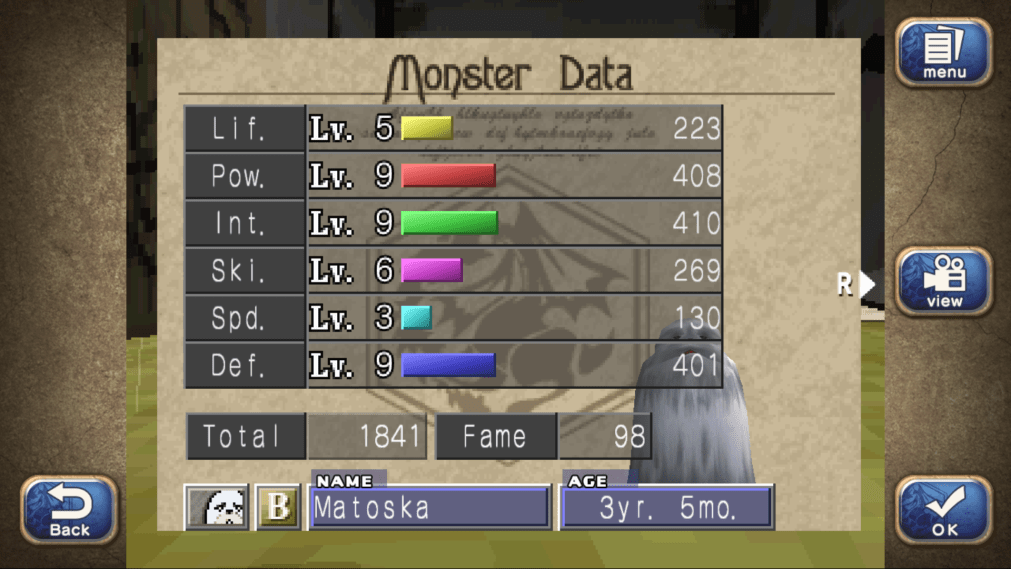
There are a total of six stats, so to get the best possible outcome, the two chosen monsters must have all six stats at matching levels. The levels here are shown next to each stat.
Here’s a quick rundown of each stat:
Life (Lif) is a monster’s hit points.
Power (Pow) is how strong a monster’s Power-type attacks are.
Intelligence (Int) measures how strong a monster’s Intelligence-type attacks hit.
Note: Power and Intelligence are interchangeable, depending on the monster’s technique types.
Skill (Ski), also called Accuracy (Acc) in later games, is the likelihood of how often your monster’s attacks hit.
Speed (Spd) affects your monster’s ability to avoid attacks.
Defense (Def) determines how much damage your monster receives.

As we can see, I ended up with a terrible outcome. That’s not bad in the Pow. and Def. department, though. Looks like I’ll have to specialize in Power-type attacks.

Back to the first Monster Rancher. Once the player returns to their Ranch, there are options for their monster. Monster Rancher operates in a week-by-week system, so players may select one thing for their monster to do each week. During Week 1 of every month, players must feed their monsters. In Monster Rancher 2, players may check the monster’s data to see what the monster likes and dislikes. Usually, food will be listed as a like or a dislike, but there are exceptions. If a player feeds the monster food it doesn’t like, it’ll be less likely to perform well.
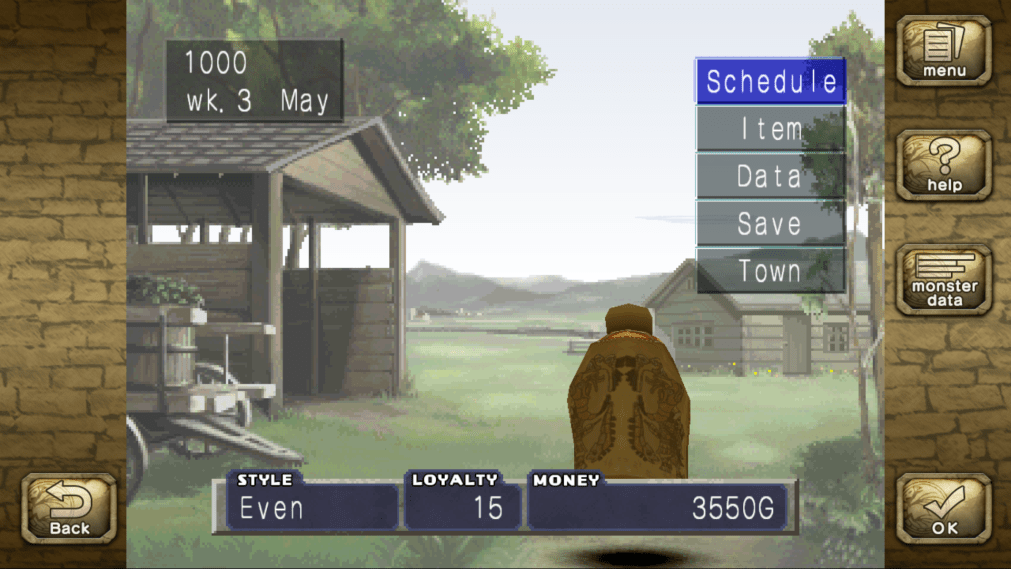
We’ll skip over Schedule for now since it’s going to be lengthier and lead into battles. Starting with the Item option, this will allow players to either buy/sell items from the shop or give an item to their monster. Be careful which item you select as monsters can only accept one item per week.

The Data option allows players to view their monster’s stats, history, and techniques. It also shows the players’ information about themselves through Breeder, such as their rancher grade, the number of monsters they’ve raised (including species), and what their monsters’ final ranks were before they either pass away or get frozen.

The Book subsection shows the player information about monsters at the market and monsters they’ve raised with some flavor text. Players may also view the monsters in action, as well as their species.
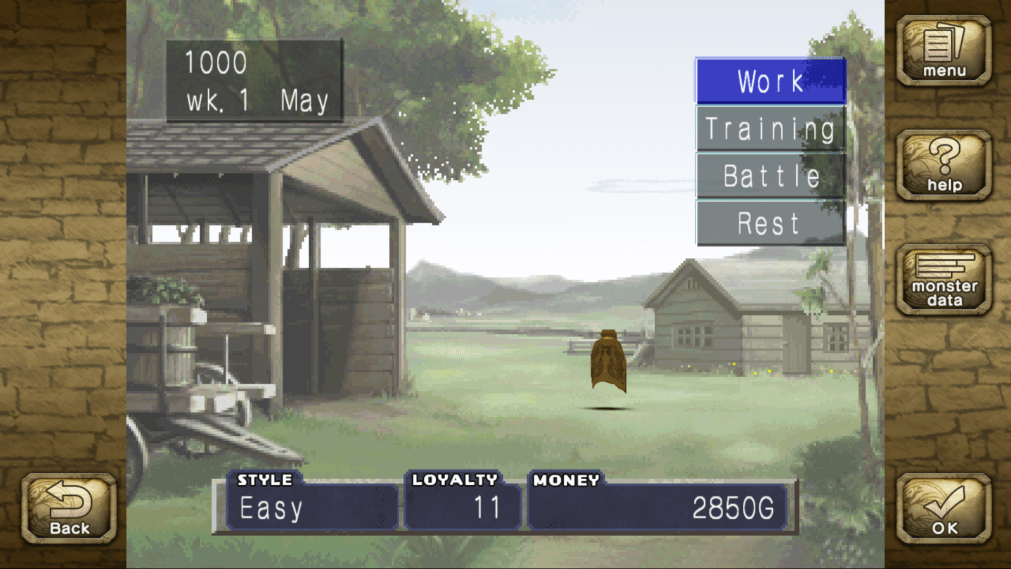
The Schedule option on the menu lets players either train monsters, battle in a tournament, or rest for one week.
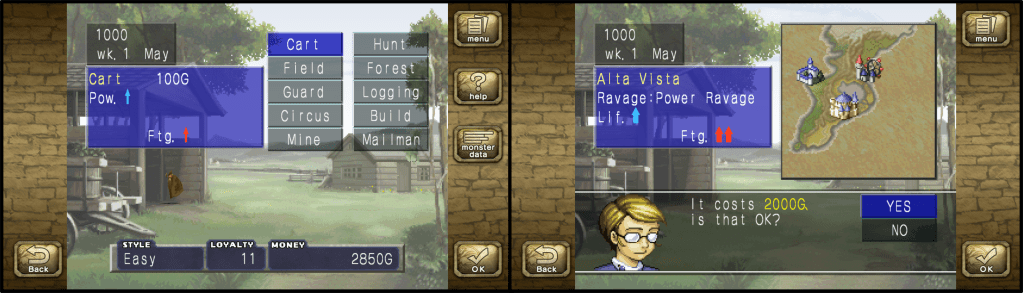
The Work option (or Drill in Monster Rancher 2) is for one week and allows the monster to train in one or two stats at a time. For Training (Errantry in Monster Rancher 2) allows the player to select a location to send their monster for one month. This will normally cost the player 2,000G, but will sometimes be at a discount for 1,000G. In Monster Rancher 2, this allows monsters to learn new techniques. In Monster Rancher, monsters must be old enough and have high enough stats to learn new techniques with a trainer in town (through the Adventure option).
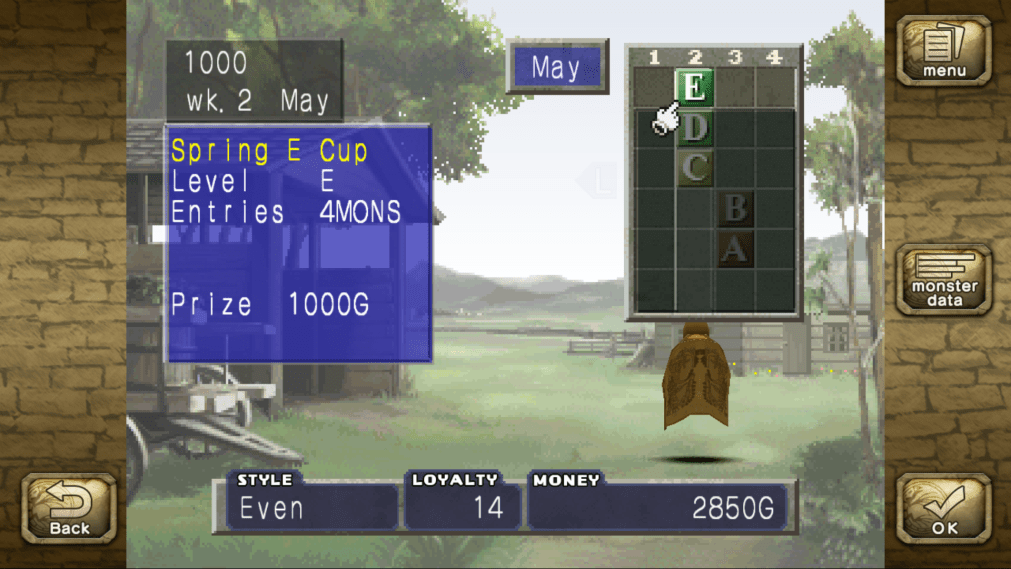
The Battle option allows players to send their monster into a tournament to win some cash and, occasionally, an item. Before any battle, the player can ask Holly about their opponent (usually their highest stat), how to execute a technique, and how to move their monster. Holly will ask if the player wants to give instructions to their monster. If the player selects no, the monster will battle by itself. If the player selects yes, they control their monster during battle.

Each battle starts by showing stats for both monsters. Arthro has more Intelligence-type techniques, so I’ll prioritize Intelligence during its training.
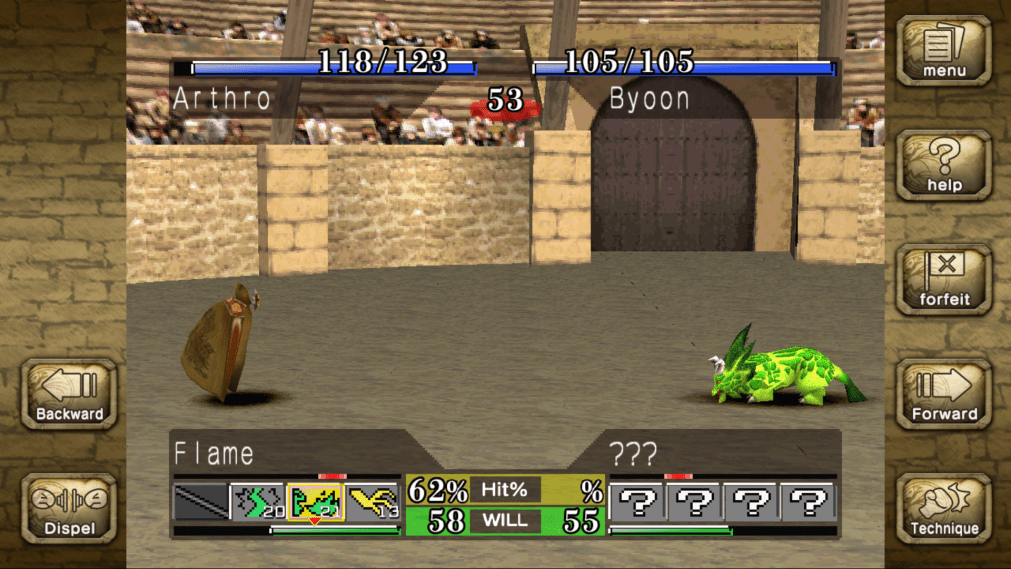
During battle, monsters have four zones (depending on their distance from their opponent) in which they may attack. Not all zones will be occupied by techniques, but that may change after a monster learns new techniques. Monsters execute techniques depending on how much Will they have (Guts in future Monster Rancher games). Techniques require a certain amount of Will, which gradually regenerates during battle, so choose techniques carefully.
Each technique also has a hit percentage, which will tell the player how likely that technique is to hit the opponent. Flame has a 62% chance to hit my opponent here and costs 21 Will. Also, what Byoon is doing in this picture is called “Foolery” (not listening to their rancher). This frequently happens when monsters don’t have much loyalty to their rancher.

Tournament battles last for sixty seconds. When time is up, the winner is determined by who has the most Life remaining. If a monster gets knocked out, a battle can end sooner. Yay! Arthro won!
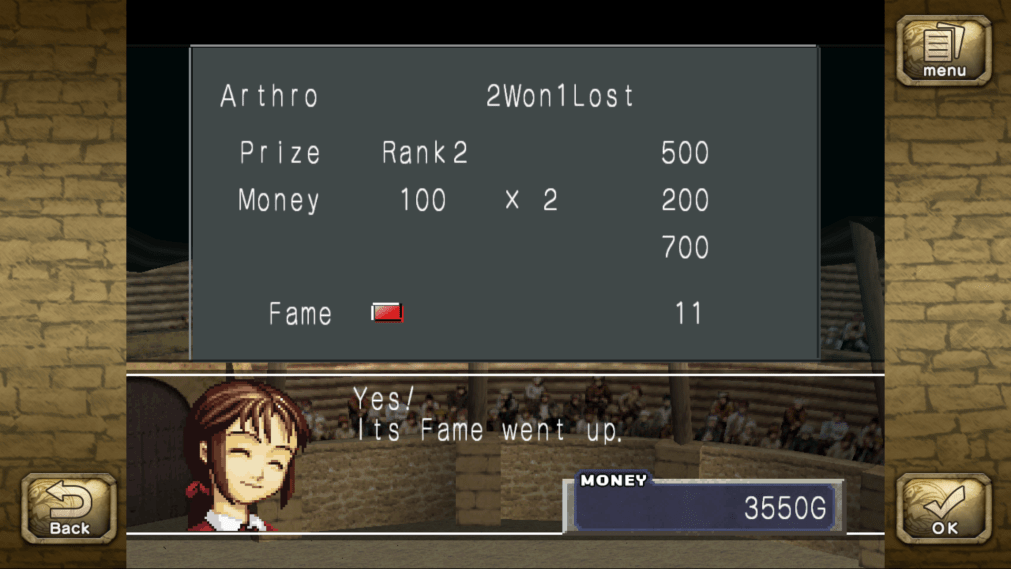
When a tournament ends, prize money is doled out based on the monster’s rank, determined by the monster’s wins. Players also receive bonus money for battles won. Here, I got second place. Notice the monster also has Fame. Fame goes up the higher a monster places in a tournament, which can lead to things as the judges awarding a player’s monster a win during a close battle and increased prize money. In Monster Rancher 2, Fame allows monsters to go on adventures and discover items necessary to unlock new monster species.
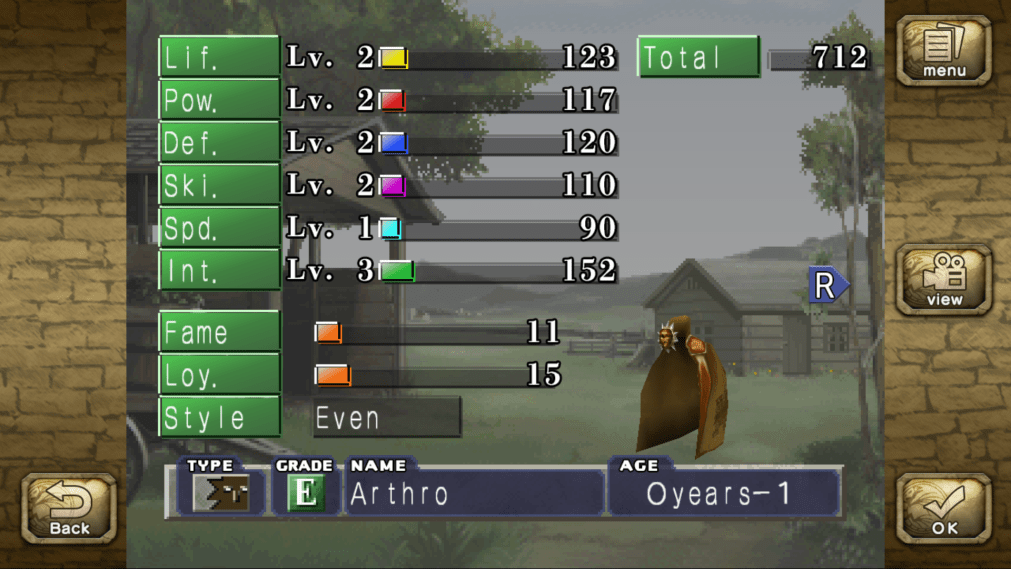
I’ll touch briefly on official tournaments. Monsters can be ranked from E (lowest) to S (highest). Every baby monster starts out at E rank. Official tournaments allow monsters to raise their rank. These tournaments occur at the end of every quarter. They include more opponents but offer less prize money. Official tournaments are essential for monsters to compete at more prestigious tournaments and to unlock more species of monsters. Since Artho is a baby, it’s an E rank.
The lifespan of a monster depends on the monster’s species and how it’s raised. Their lifespan also affects when each monster reaches their prime, which is the point in a monster’s life when training gives them the most stat boosts.
Reception

Monster Rancher has fifteen games spanning from 1997-2022. The original Monster Rancher sold over one million copies before 2000. It was a popular game that capitalized on people collecting discs. It filled a niche that exploited the success of Tamagotchi and disc collection. In later Monster Rancher games, such as Monster Rancher EVO, people could use DVDs in addition to CDs and PS1/PS2 discs. There were some other strange releases, like the platformer Monster Rancher Hop-A-Bout that played similarly to Super Mario Bros. Honestly, I’m not sure what they were thinking with that one.

During the height of Monster Rancher’s popularity, an anime series was produced from 1999-2000. The series consists of seventy-three episodes over two seasons. It follows a boy named Genki Sakura and Holly, the assistant from the original Monster Rancher.
Relevance
Monster Rancher lost steam during the transition from people collecting discs to streaming and became irrelevant. People no longer collect discs. Okay. We have a bookshelf full of discs at my house, but that’s an anomaly. Monster Rancher jumped on the Tamagotchi bandwagon, raked in the cash, and then faded. It’s still popular inside Japan, and Koei Tecmo Games keeps Monster Rancher relevant by catering to their Japanese audience.
Accessibility

Monster Rancher’s original producer, Tecmo, merged with Koei to create Koei Tecmo Games in 2009. The Tecmo part of Koei Tecmo was dissolved in 2010. The company used the Tecmo name until 2016. This may have contributed to the direction of the Monster Rancher franchise.

If one were to look online or in their local game store for a copy of Monster Rancher, it’s slim pickings. These games are available for purchase online, but at an increased price. Original copies cost the same as a new video game. Despite this, Monster Rancher and Monster Rancher 2 are accessible to the public through Steam. That’s right. All of the screenshots I’ve taken for this article are from Monster Rancher 1 & 2 DX on Steam.
These ports differ slightly from the original games (such as monster lifespans), but they’re so similar to the originals that it feels nostalgic. The Steam ports also have an option to search their database for discs to read, so there are hundreds of options that wouldn’t be available to someone who doesn’t collect discs.
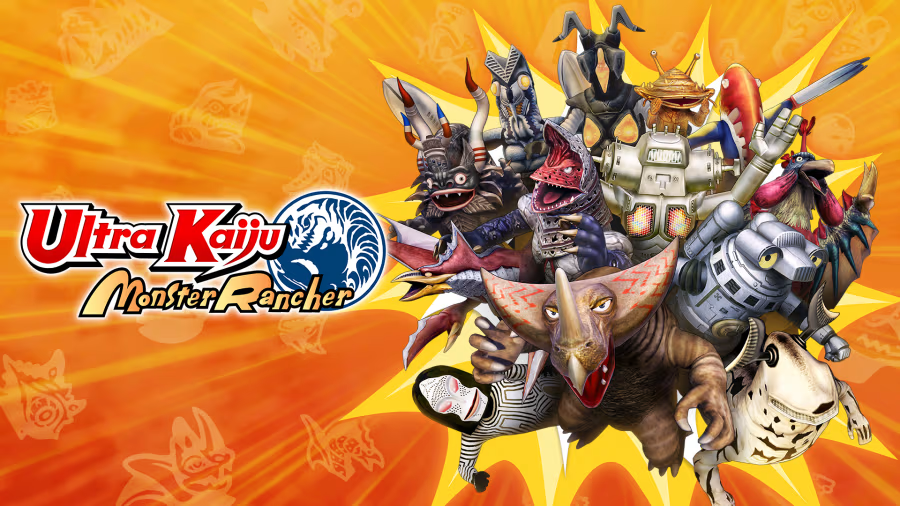
Other games in the Monster Rancher franchise are less accessible. Ultra Kaiju Monster Rancher is the most recent entry. Players raise kaiju monsters the same way they would monsters from the original games. I’ve never heard of this game before conducting research, but it’s available to download from the Nintendo e-shop. As of the time of this posting, it’s on sale until April 28, 2025.
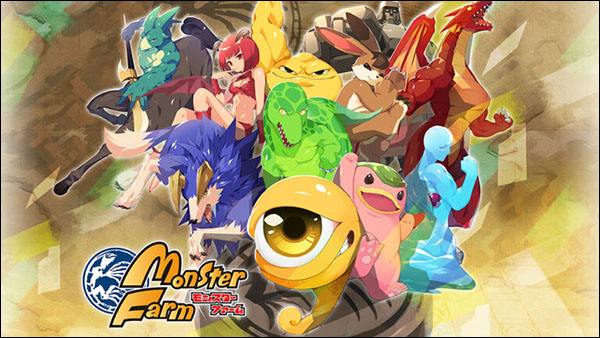
As of this post, a Monster Rancher mobile game will release in Japan only later this year. This game will be available on the popular East Asian messaging platform, LINE. I’m unsure of this game’s inner workings, but it seems like players will be able to interact with their monsters directly. Maybe it has some sort of AR model like Pokémon Go.
One last thing. If anyone is interested in the anime side of things, Monster Rancher is available to watch on Amazon Prime Video without ads for Prime members.
Final Thoughts
Monster Rancher is a franchise I grew up with, and it’s one of my favorite pet simulation games. It’s great for casual and hardcore players. There’s a science behind raising these monsters that players can learn. It can get tedious, especially when you get a new monster and must start the raising process again. It takes time to unlock new content. There are always new mysteries to solve in Monster Rancher, and every monster is unique.
Do you have a preferred breed/species of monster? What’s your favorite monster you’ve raised in Monster Rancher? If there are any cult classics you’d like to see covered in future posts, let us know in the comments. Thanks for reading and have an amazing rest of your day.
 jkgeekly.com